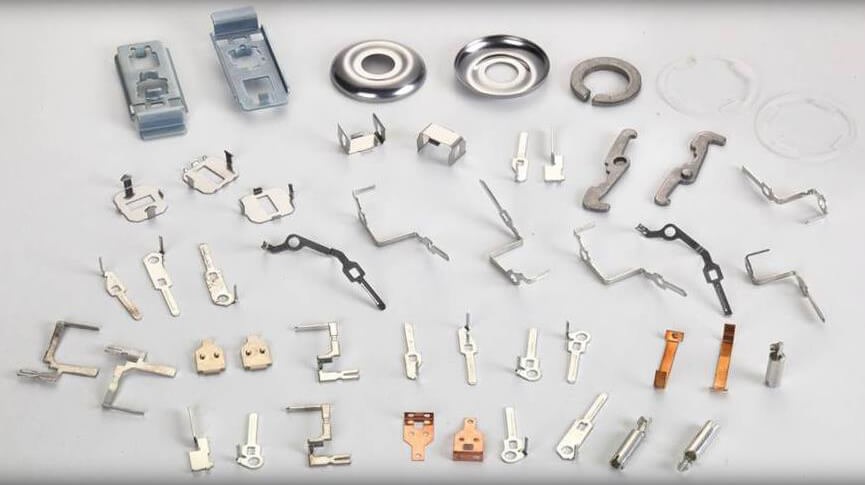

Open the bonnet, look under the dash, or slide beneath a car on a ramp, and you’re surrounded by stamped metal. A typical passenger vehicle contains more than 300 stamped sheet metal components, accounting for roughly 250–350 kg of material and close to 45% of the vehicle’s total structure. Very little of that is accidental; stamping remains the automotive industry’s default manufacturing process because nothing else matches its combination of speed, repeatability, and cost-per-part at scale.
For automotive metal stamping companies, the challenge isn’t proving the process works; it’s proving it can hold precision consistently across production runs that stretch into the millions of units. At Eigen Engineering, that consistency is exactly what we build our stamping lines around.
Why Stamping Dominates Automotive Manufacturing?
The economics are hard to argue with. High-volume stamped parts typically cost between $0.30 and $1.50 per unit, compared with $3–$12 for equivalent CNC-machined components. At the volumes a single vehicle platform demands (often tens of thousands of units per month), that cost difference compounds into a genuinely decisive manufacturing advantage. Progressive stamping alone can reduce unit costs by 20–30% compared with machining for structural brackets, which is why OEMs default to it wherever the part geometry allows.
Speed matters just as much as cost. Modern automotive press shops routinely run dozens of strokes per minute, and some large-scale operations are documented producing around 10,000 stamped panels a day from a single press line. No other forming process gets close to that combination of throughput and dimensional consistency.
Where Progressive Die Components Show Up?
Progressive die components are everywhere in a modern vehicle, from small brackets and clips through to structural chassis elements and battery enclosure parts in electric platforms.
The progressive die process (feeding a continuous strip of metal through a sequence of stations that each perform one operation, such as piercing, bending, or coining) is particularly suited to automotive work because it combines high-speed output with minimal material waste and strong repeatability station after station.
Some of the most common automotive stamped components include:
- Body panels and structural brackets
- Battery trays and motor housing components for EV platforms
- Connector terminals, bus bars, and electrical contacts
- Fasteners, clips, and reinforcement brackets
- Chassis and suspension components requiring tighter linear tolerances
The rise of electric vehicles has added real momentum here; battery tray and motor housing components increasingly demand sub-10-micron tolerances in some applications, pushing Tier 1 suppliers toward more advanced progressive tooling and tighter process control than earlier internal-combustion platforms typically required.
Tolerance Standards in Automotive Stamping
Automotive stamping tolerances are generally governed by a combination of ISO 2768 for general linear dimensions, DIN 6930 for stamped steel parts specifically, and ASME Y14.5 for geometric dimensioning and tolerancing. Under the medium tolerance class of ISO 2768, general linear dimensions typically fall between ±0.1 mm and ±0.25 mm, though this widens with material thickness; a bracket under 1 mm might hold ±0.1 mm, while a thicker structural part may require ±0.3 mm.
Springback is one of the persistent technical challenges in automotive stamping, particularly with high-strength steels increasingly used for lightweighting and crash performance. Because these materials elastically recover slightly after bending, die design has to compensate in advance so the final formed angle matches the drawing, not just the tool geometry.
Quality Systems That Automotive OEMs Require
Automotive supply chains are unusually structured around formal quality gates. IATF 16949:2016 certification is now essentially a prerequisite for serious OEM work, and stamped parts typically move through Advanced Product Quality Planning (APQP) with formal Production Part Approval Process (PPAP) submission before volume production is authorised.
This isn’t paperwork for its own sake; it’s the mechanism by which OEMs verify that a supplier’s process, not just a single sample part, is capable of holding tolerance across an entire production run.
How Does Eigen Engineering Support Automotive Programmes?
Eigen Engineering builds automotive stamping programmes around the same discipline the sector expects: progressive die tooling engineered for the specific material and geometry involved, in-process dimensional verification rather than end-of-line sampling alone, and documentation that supports APQP and PPAP submission without gaps.
Where EV platforms demand tighter tolerances on battery and structural components, we work with customers early in the design phase to confirm what’s genuinely achievable before tooling is committed, avoiding the costly rework that comes from discovering a tolerance issue after the dies are cut.
Choosing the Right Stamping Partner
Not every automotive stamping requirement needs the same supplier. Simple brackets and clips may only need a compound die and a straightforward commercial tolerance, while EV structural and battery components increasingly demand progressive tooling capable of holding sub-10-micron precision. Understanding where your component sits on that spectrum (and choosing an automotive metal stamping partner whose capability genuinely matches it) is the single biggest factor in avoiding both overpaying for unnecessary precision and under-delivering on a part that needs it.
If you’re sourcing stamped components for a new vehicle programme, Eigen Engineering’s engineering team is glad to review your drawings and recommend the most reliable, cost-effective stamping approach for your application.