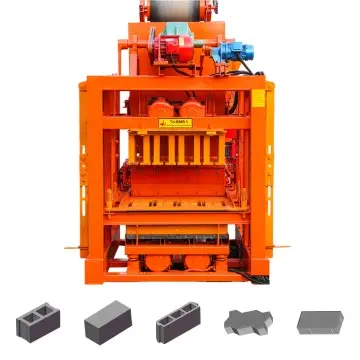

Construction businesses depend on a reliable supply of masonry products to keep projects moving. Delays in obtaining blocks can affect wall construction, labor scheduling, and overall project coordination. For contractors, developers, and building-material suppliers with regular requirements, manufacturing blocks directly may be an option worth evaluating. The decision begins with selecting equipment that matches the intended products and production conditions.
A Construction Block Making Machine is used to form concrete mixtures into blocks for construction applications. Available configurations range from simpler manually assisted machines to hydraulic and automated systems. Each option offers a different balance of output, operator involvement, investment, and maintenance requirements. The right choice depends on the scale of the project and the business’s ability to manage production.
1. Define the Required Block Types
The first step is identifying which blocks the project or business needs. Common products include solid concrete blocks, hollow blocks, and selected specialized masonry units.
These products differ in shape, dimensions, material requirements, and intended applications. A machine designed for one mold arrangement may not be suitable for another without additional tooling.
Prepare a list of required block sizes and quantities before contacting suppliers. If the equipment needs to produce several designs, confirm whether compatible molds are available and how easily they can be changed.
2. Estimate the Required Production Volume
Production capacity should reflect the actual construction schedule or expected customer orders. A contractor completing one project may have a different requirement from a manufacturer supplying several building sites.
Calculate the approximate number of blocks needed and the period in which they must be produced. Include a realistic allowance for maintenance, material delays, rejected units, and curing time.
Ask suppliers for production estimates based on the exact block dimensions. Maximum cycle figures may not represent normal output under site conditions.
3. Select an Appropriate Automation Level
Construction block-making equipment is available in several operating arrangements.
- Manual equipment may suit limited production where investment and output requirements are modest.
- Semi-automatic equipment uses powered forming operations while workers remain involved in material feeding and product handling.
- Fully automatic systems coordinate more production stages and may suit businesses with regular, higher-volume demand.
The most advanced option is not automatically the best choice. Automation requires suitable power infrastructure, trained operators, maintenance resources, and enough production volume to justify the investment.
4. Assess Site and Factory Requirements
The available working area has a major influence on equipment selection. A production setup may need space for aggregate storage, cement handling, mixing, forming, fresh-block movement, curing, and finished-product storage.
The surface or foundation must be suitable for the machine and its operating loads. Electricity, water, drainage, and access for material deliveries should also be considered.
For on-site production, transport and relocation requirements may be important. For a permanent facility, a layout that supports a logical flow of materials can reduce handling and improve coordination.
5. Review Machine Construction and Features
A careful inspection should cover the machine frame, mold assembly, compaction system, vibration components where fitted, control panel, and hydraulic or electrical systems.
Buyers should ask about:
- Supported block dimensions and mold options.
- Production cycle and realistic output.
- Electrical supply and power requirements.
- Installation and commissioning arrangements.
- Routine maintenance and replacement parts.
- Warranty conditions and technical assistance.
A demonstration can help verify how the machine operates and whether the finished blocks meet the intended product requirements.
6. Understand the Complete Cost of Production
The purchase price is only one part of the investment. Other costs may include transportation, foundations, installation, mixers, molds, pallets, handling equipment, storage, and curing facilities.
Operating expenses include cement, aggregates, water, electricity, labor, maintenance, and rejected products. Manufacturers should estimate the cost per saleable block rather than focusing only on the machine’s price.
If blocks are being produced for a construction project, compare the total in-house production cost with the delivered cost of purchasing equivalent products. Include the value of labor, site space, management time, and any equipment that must be purchased separately.
7. Give Quality Control Equal Importance
A machine cannot guarantee that every block will meet the required standard. The concrete mixture must be properly designed, measured, and mixed. Forming conditions should remain consistent, and molds must be kept in suitable condition.
Fresh blocks need careful handling and appropriate curing. Finished products should be inspected for dimensions, visible defects, and other characteristics required by the project specification.
Where necessary, arrange suitable testing to confirm strength and performance. Keep production records so that any quality issue can be traced to the relevant batch or operating conditions.
8. Choose a Supplier That Can Support the Equipment
Supplier support matters throughout the machine’s working life. Confirm whether installation guidance, operator training, spare parts, maintenance information, and technical assistance are available.
Ask for written details of the warranty and the responsibilities of both parties. Clear documentation helps avoid misunderstandings about delivery, commissioning, and after-sales service.
Making the Right Equipment Decision
A construction block-making machine should be selected according to product requirements, production volume, site conditions, workforce, and total operating cost. Buying equipment without considering these factors can lead to unnecessary expense or production limitations.
A structured comparison of machine specifications, supplier support, and expected demand makes the decision more reliable. With suitable equipment and disciplined production practices, businesses can establish a consistent supply of blocks for their construction needs.