
Businesses have spent years automating repetitive tasks. From sending notifications to processing documents, traditional automation has helped teams save time and reduce manual work. However, many business challenges are not limited to individual tasks. They involve several connected decisions, different software platforms, and unexpected situations.
Imagine a field service company managing equipment installations across multiple locations. A technician reports a problem, spare parts need to be checked, schedules must be adjusted, and customers need updated information. Each activity may be handled by a different department or application.
Coordinating these steps manually can slow down the entire process. This is where Agentic AI introduces a more flexible approach.
Moving From Individual Tasks to Connected Workflows
Traditional automation generally follows predefined instructions. When a specific condition occurs, the system performs an assigned action.
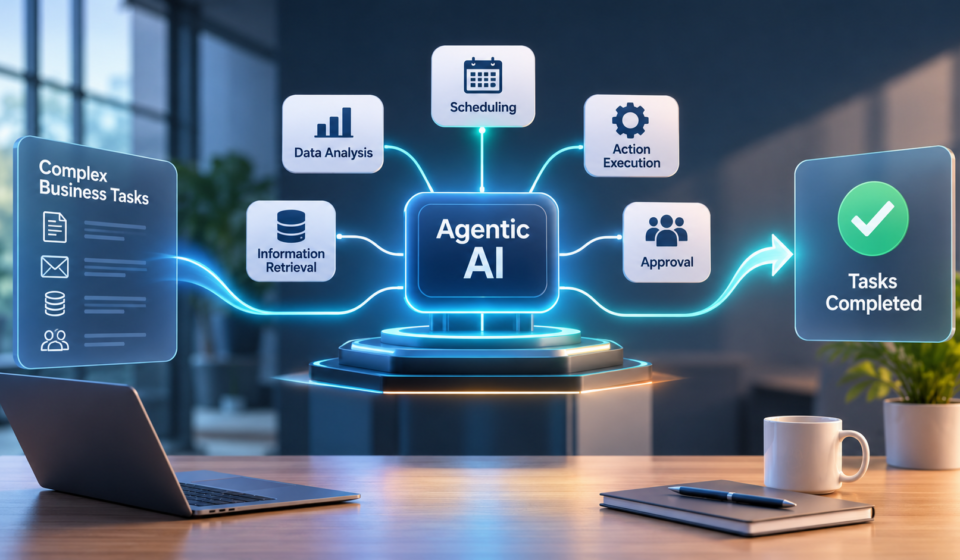
Agentic AI takes a broader approach. It can understand a goal, plan a sequence of tasks, retrieve relevant information, use connected tools, and evaluate the results.
For example, an AI agent supporting field service operations could:
- Review an incoming maintenance request.
- Retrieve equipment history and technical documentation.
- Check spare-part availability through an inventory system.
- Identify scheduling conflicts.
- Prepare an updated service plan.
- Request employee approval before confirming significant changes.
The agent does not need to handle every decision independently. Its role is to coordinate information and permitted actions while involving employees when necessary.
This shift from isolated automation to connected execution is an important part of modern agentic AI development.
How Multiple AI Agents Can Work Together
Some business processes are too broad for a single agent to manage efficiently. A multi-agent architecture can divide responsibilities between specialized agents.
Consider an company processing complex claims. Different agents could handle specific responsibilities:
Document analysis agent: Extracts relevant information from submitted documents.
Policy review agent: Retrieves applicable policy details and identifies relevant conditions.
Data validation agent: Checks whether required information is complete and consistent.
Coordination agent: Collects the findings and prepares the claim for human review.
Each agent performs a defined role, while an orchestration layer manages communication and task progression.
This structure can make complex workflows easier to organise, test, and maintain. Businesses can use agentic AI solutions to address these requirements through specialised agents that work together within clearly defined responsibilities.
What Does It Take to Build Reliable Agentic Systems?
Developing an AI agent involves much more than selecting a language model. The surrounding architecture determines whether the system can operate effectively in a real business environment.
Several components deserve attention:
- Large language models (LLMs): Help agents interpret instructions, understand context, and generate responses.
- Retrieval-augmented generation (RAG): Allows agents to retrieve relevant information from approved business documents and knowledge sources.
- API integrations: Connect agents with CRM, ERP, inventory, communication, and other business applications.
- Orchestration frameworks: Coordinate tasks, manage agent interactions, and control workflow execution.
- Memory and context management: Help maintain relevant information across different stages of a task.
- Monitoring and evaluation: Track performance, identify errors, and assess whether agents are achieving their intended objectives.
Security must also be built into the architecture. Access permissions, activity logs, validation rules, and human approval mechanisms help prevent agents from performing actions beyond their authority.
Choosing the Right Development Partner
Businesses planning to introduce intelligent agents need a development partner that understands both AI engineering and operational requirements.
An experienced agentic AI development company should be able to evaluate existing processes, identify suitable automation opportunities, and design an architecture that fits the organisation’s technology environment.
When assessing a potential partner, businesses should consider:
- Experience with LLMs, RAG, and AI agent frameworks.
- Ability to integrate existing enterprise applications.
- Understanding of single-agent and multi-agent architectures.
- Knowledge of security, access control, and data governance.
- Testing, deployment, monitoring, and ongoing support capabilities.
Start With a Problem Worth Solving
Not every business process needs an AI agent. Processes with repeated coordination, information gaps, and multiple decision points are often better candidates than simple tasks that traditional automation already handles effectively.
A sensible starting point is to select one workflow, document its challenges, and identify which activities an agent can safely support. The system can then be tested under real operating conditions before its responsibilities are expanded.
Agentic AI is not simply another way to automate repetitive work. It creates opportunities to connect decisions, applications, and business activities in a more coordinated way. With the right architecture and human oversight, organisations can make complex operations easier to manage while keeping important decisions accountable.