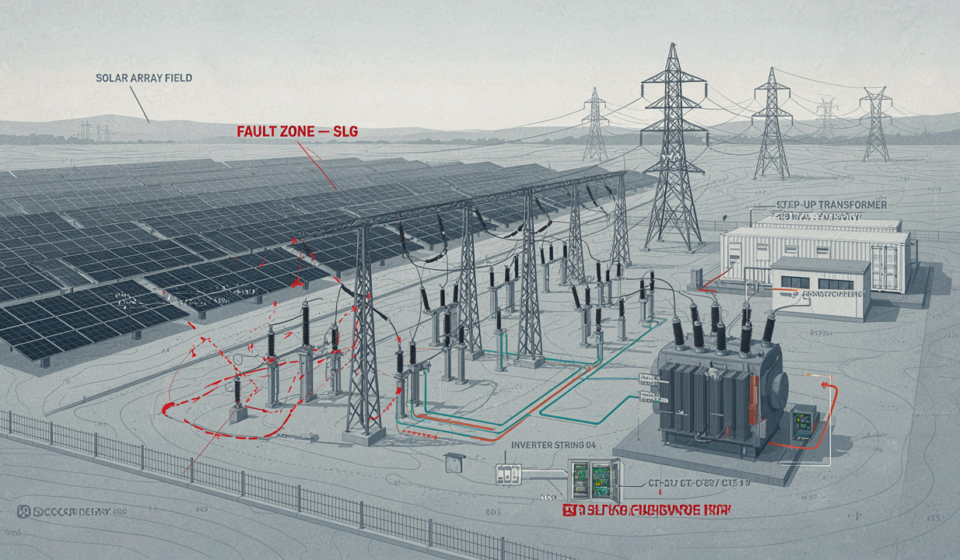

As renewable generation continues to expand, inverter-based resources (IBRs) such as solar photovoltaic plants, battery energy storage systems, and modern wind farms are becoming an important part of electric power networks. While these technologies provide valuable grid-support capabilities, their electrical behavior differs significantly from conventional synchronous generators.
One important area engineers must understand is zero-sequence current. Zero-sequence components are closely associated with ground-fault behavior, transformer connections, grounding arrangements, and protection-system performance. In inverter-based facilities, the behavior can be particularly complex because the inverter controls and transformer configuration influence how current flows during unbalanced conditions.
Understanding zero-sequence current in power plants is therefore essential when designing grounding systems, selecting protection equipment, evaluating fault levels, and assessing the interaction between the plant and the utility grid.
What Is Zero-Sequence Current?
In symmetrical-component analysis, an unbalanced three-phase current can be represented as three separate components: positive sequence, negative sequence, and zero sequence.
Zero-sequence current consists of three phasor currents that have equal magnitude and are in phase with one another. Mathematically, it can be expressed as:
I₀ = (Ia + Ib + Ic) / 3
where Ia, Ib, and Ic represent the phase currents.
Unlike positive- and negative-sequence currents, zero-sequence current does not represent a balanced three-phase system. Instead, it is commonly associated with current returning through a neutral conductor, grounding system, transformer neutral, or other available ground-return path.
This makes zero-sequence current particularly important when analyzing line-to-ground and other ground-related faults.
Why Zero-Sequence Current Matters in Inverter-Based Plants
In a conventional power plant, synchronous generators can contribute substantial fault current because of their electromagnetic characteristics. An inverter-based resource behaves differently.
Power electronic converters typically control their current output electronically. During a fault, the inverter may limit current, modify its current waveform, or inject controlled current based on its protection and grid-support controls.
As a result, engineers cannot always assume that conventional generator fault-current characteristics apply to an IBR facility.
The amount and direction of zero-sequence current can depend on several factors, including:
- Inverter control strategy
- Transformer winding configuration
- Transformer grounding method
- Collector-system configuration
- Neutral grounding impedance
- Plant grounding design
- Grid impedance
- Fault location
- Inverter current limits
- Protection and ride-through controls
These factors make zero-sequence current in inverter-based plants an important consideration during both interconnection studies and detailed electrical design.
How Transformers Influence Zero-Sequence Current
Transformers are one of the most important elements affecting zero-sequence current paths in an inverter-based facility.
For example, a grounded-wye transformer winding can provide a path for zero-sequence current, depending on the grounding arrangement. In contrast, a delta-connected winding can prevent zero-sequence current from passing directly through that winding to the external system.
Consider a solar plant with inverter transformers connecting the medium-voltage collector system to a high-voltage substation. The transformer winding connections can significantly affect whether a ground fault on one side produces measurable zero-sequence current on the other side.
Engineers therefore need to examine transformer vector groups, winding connections, neutral grounding, and zero-sequence impedance when developing plant models.
A simplified fault model that ignores these details can produce inaccurate ground-fault current results and potentially affect protection settings.
Performing Zero-Sequence Current Analysis
A detailed zero-sequence current analysis evaluates how zero-sequence current behaves under different operating and fault conditions.
The study typically begins with an accurate representation of the electrical network. This may include the utility source, transmission system, plant transformers, collector feeders, inverter models, grounding equipment, and relevant transmission or distribution lines.
Engineers can then evaluate scenarios such as:
- Single-line-to-ground faults
- Ground faults on collector feeders
- Ground faults at the main transformer
- Ground faults on the transmission connection
- Different grid-strength conditions
- Various transformer grounding configurations
- Changes in inverter operating conditions
For inverter-based facilities, accurate equipment models are especially important. The model should represent the applicable inverter fault-current behavior and control characteristics rather than simply treating the inverter as a conventional synchronous generator.
The results can then be used to determine expected fault-current magnitudes, current contributions from different sources, and available ground-return paths.
Protection, Grounding, and System Design Considerations
Zero-sequence current calculations directly support several practical engineering decisions.
Protection systems: Ground-fault relays and other protection functions may rely on residual or zero-sequence current measurements. If expected fault-current levels are different from traditional assumptions, protection settings may need to be evaluated accordingly.
Grounding systems: Engineers need to understand available ground-fault current paths when designing plant grounding and bonding systems. This helps support safe fault-current dissipation and appropriate equipment protection.
Transformer selection: Zero-sequence impedance and winding configuration can affect fault behavior and should be considered during transformer specification.
Current transformers: CT configuration and accuracy can influence the reliability of ground-fault detection. Engineers need to consider the expected zero-sequence current range when developing protection schemes.
Interconnection studies: Utilities may require detailed fault-current information before approving an IBR interconnection. Accurate zero-sequence modeling helps demonstrate how the plant will behave during abnormal system conditions.
Improving Reliability Through Accurate IBR Modeling
As inverter-based generation becomes more prevalent, power-system engineers must move beyond traditional assumptions about fault-current behavior.
A robust analysis considers the complete electrical system rather than looking at the inverter in isolation. Transformer connections, grounding systems, collector networks, inverter controls, and utility-system characteristics can all influence the resulting zero-sequence response.
For renewable developers and grid operators, this analysis can help identify potential protection challenges early in the project lifecycle. It can also support better equipment selection, grounding design, relay coordination, and interconnection documentation.
Ultimately, understanding zero-sequence current in power plants is not simply a theoretical exercise. It is an important part of designing reliable and properly protected inverter-based facilities.
With accurate models and carefully defined study assumptions, engineers can better understand ground-fault behavior and develop protection and grounding strategies that are appropriate for modern renewable power systems.
Conclusion
The increasing deployment of solar PV, battery storage, and wind generation is changing how engineers evaluate fault behavior across the electric grid. Because inverter-based resources have different current characteristics from conventional generators, zero-sequence behavior deserves careful attention.
A comprehensive zero-sequence current analysis should account for inverter characteristics, transformer configurations, grounding methods, collector-system design, and the connected utility network. This provides a stronger technical foundation for protection studies, grounding design, equipment selection, and reliable grid interconnection.
For modern renewable projects, understanding zero-sequence current in inverter-based plants can help engineers address ground-fault behavior with greater confidence while supporting safe, dependable, and grid-compliant facility design.