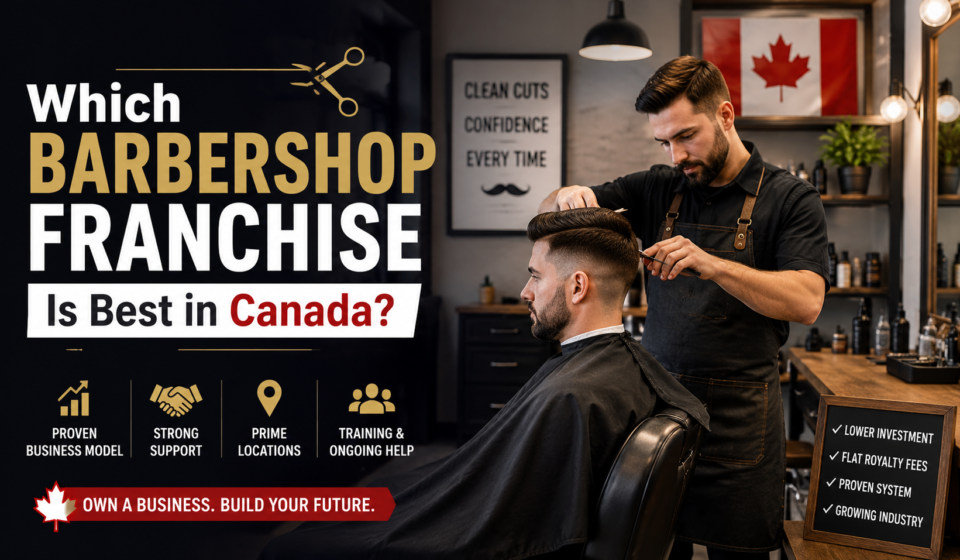

Walk into any decent barbershop on a Saturday morning and you’ll notice something: it’s full. Guys waiting with coffee, someone getting a hot towel shave, the buzz of clippers in the background. That’s not an accident. Men’s grooming in Canada has quietly turned into one of the steadier small-business categories out there, and a growing number of people are asking the same question: if I wanted to own a piece of that, which barbershop franchise would actually make sense?
There’s no one-size-fits-all answer, but there is a clear way to think it through. This guide breaks down what actually matters when comparing barbershop franchises in Canada, how the major players stack up, and a closer look at MVP Modern Barbers, one of the more accessible options currently in the market.
The Canadian Barbershop Market Is Bigger Than People Think
It’s easy to assume a barbershop is a small, local kind of business and in one sense, it is. But zoom out and the numbers tell a different story. Canada’s hair and nail salon sector is valued at roughly $6.0 billion in 2026, and it’s grown at a steady 4.2% a year since 2021 (IBISWorld, 2026). That’s not explosive growth, but it’s consistent, the kind of number that tells you people keep coming back, month after month, regardless of what’s happening in the wider economy.
The same pattern shows up globally. The male grooming products market was worth about USD 54.4 billion in 2022 and is expected to climb to USD 80 billion by 2030 (Fortune Business Insights, 2023). A few things are driving that:
- Grooming has become routine, not occasional. Beard trims, skin care, and hot towel shaves are now standard requests, not upsells.
- Men are visiting more often. A haircut used to be a once-a-month errand. Now it’s closer to a habit some men book every two to three weeks.
- Franchises have gotten easier to run. Better training systems and booking technology mean you no longer need to be a barber yourself to own a barbershop.
That last point matters a lot for anyone comparing franchises, because it changes who can realistically get into this business.
What Actually Matters When Comparing Barbershop Franchises
Every franchise brochure looks good on paper. The real differences show up once you get past the photos and into the fine print.
How Much It Costs, and How the Fees Work
Investment ranges swing widely across Canadian barbershop brands anywhere from around $75,000 to well over $400,000 depending on the concept. But the sticker price is only part of the picture. Two things are worth checking closely:
- The royalty structure. Some franchises take a percentage of your monthly revenue. Others charge a flat monthly fee. A flat fee is easier to plan around, and it means that as your shop gets busier, more of that extra revenue stays with you instead of scaling up with the franchisor’s cut.
- The real startup cost. Build-out, equipment, and working capital add up fast, and franchisor estimates don’t always include everything. Ask current franchisees what they actually spent, not just what the brochure says.
How Much Support You Actually Get
Most people opening a barbershop today aren’t barbers themselves. That’s fine but it means the franchisor’s support system carries a lot of weight. Look at how much help you get with hiring barbers, training staff, and running the shop day to day. A strong franchisor treats onboarding as a real process, not a welcome packet.
Where the Shop Actually Goes
Foot traffic makes or breaks a barbershop. Franchises that help with site selection instead of leaving you to figure out a location on your own take a real risk off the table before you even open the doors.
How the Top Canadian Barbershop Franchises Compare
| Franchise | Founded | Investment Range | Royalty Structure | Barbering Experience Required |
| MVP Modern Barbers | 2004 | From ~$75,000 | Flat monthly fee | No |
| Tommy Gun’s Original Barbershop | 1979 | From ~$400,000 | Percentage-based (~6–7%) | No |
| First Choice Haircutters | 1980 | 182,000–274,000 | Percentage-based (~7%) | No |
Tommy Gun’s sits at the premium end of bigger investment, bigger build-out, a brand built around a distinct 1930s-inspired look. First Choice Haircutters has the largest footprint in Canada overall, but it’s a general hair salon brand rather than a barbershop-specific one. MVP Modern Barbers sits in a different lane entirely: a lower-cost entry point built specifically around men’s grooming, without the flagship-level price tag.
A Closer Look at MVP Modern Barbers
MVP Modern Barbers has been around since 2004, and the brand has grown into a network of shops across the country, including locations in Toronto, Halifax, Moncton, Saskatoon, and Fort McMurray. What sets it apart isn’t just the pricing, it’s how the whole experience is put together, from the moment someone books a chair to the moment they walk out.
The core service is the Hall of Fame Haircut, a full sit-down experience that includes a consultation, a hot face towel, a scalp massage, a hair wash, and the cut and style itself, with complimentary neck trims between visits. It’s built to feel less like a quick errand and more like something you actually look forward to. For guys who want the traditional barbershop ritual, there’s the Hot Straight Shave: shave oil, hot towels, a moisturizing shave cream, a hot lather shave, cool towels, and a post-shave cooling lotion to finish. And for anyone looking to switch things up entirely, MVP also offers Colour & Camouflage services full coverage for grey hair or a complete change of look.
A few other details round out the experience:
- Digital check-in, so clients don’t have to wait around wondering how long the line is
- A dedicated mobile app (available on the App Store and Google Play) for booking and managing appointments
- A service guarantee, so if a cut doesn’t land right, it gets made right
- An in-house product line, including matte clay, texture paste, smooth fusion, and organic shave cream, sold both in-shop and online
From a franchise-ownership angle, this consistency matters. A new franchisee isn’t building a brand from scratch; they’re plugging into a system that already has a defined service menu, a recognizable in-shop experience, and a customer base that knows what to expect walking in. That’s a meaningfully different starting point than opening an independent shop and building all of that reputation from zero.
On the business side, the numbers back up the accessibility angle: an initial investment starting around $75,000, and a flat monthly royalty fee instead of a percentage cut of revenue. For someone testing the franchise model for the first time, or looking to open a second location without committing flagship-level capital, that combination lowers the financial bar to get started while the training and hiring support built into the franchise system helps close the gap for owners who aren’t barbers themselves.
A Simple Checklist Before You Sign Anything
Whichever franchise you’re leaning toward, run it through this list first:
- Does the total investment fit your budget, with a buffer left over for the unexpected?
- Does the royalty structure (flat fee vs. percentage) match how you expect the business to grow?
- Does the franchisor actually help with hiring and training, or just point you to a manual?
- Is site selection support included, or are you on your own?
- Have you talked to two or three existing franchisees, not just the corporate team?
- Has a franchise lawyer in your province reviewed the disclosure document?
- Does marketing support continue after launch, or stop once the doors open?
So, Which One Is Best?
Honestly, it depends on what you’re optimizing for. If brand heritage and a flagship-style presence matter most to you, Tommy Gun’s has the longer history and the bigger footprint. But if you’re looking for a lower-cost way into a growing industry, backed by a defined service menu, a flat and predictable fee structure, and a system built for owners who aren’t necessarily barbers themselves, MVP Modern Barbers is worth putting near the top of your list.
Either way, don’t skip the boring parts, read the disclosure document closely, talk to real franchisees, and get a lawyer to look everything over before you sign.
Frequently Asked Questions
Do I need barbering experience to open an MVP Modern Barbers franchise?
No. The franchise is built for business owners first, with support in place for hiring and training qualified barbers.
How much does it cost to open a barbershop franchise in Canada?
It varies a lot by brand — from around $75,000 for a leaner concept like MVP Modern Barbers up to $400,000 or more for flagship-style barbershop brands.
What’s the difference between a flat-fee and a percentage royalty?
A percentage royalty takes a set share of your monthly revenue, so payments rise as the business grows. A flat fee, which MVP Modern Barbers uses, stays the same no matter how much the shop earns which tends to favor high-performing locations.
Is the barbershop industry actually growing in Canada?
Yes. Canada’s hair and nail salon sector is worth roughly $6.0 billion as of 2026 and has grown steadily for the past several years (IBISWorld, 2026).
Also read this article, Best Budget-Friendly Cottage Rentals in Ontario.