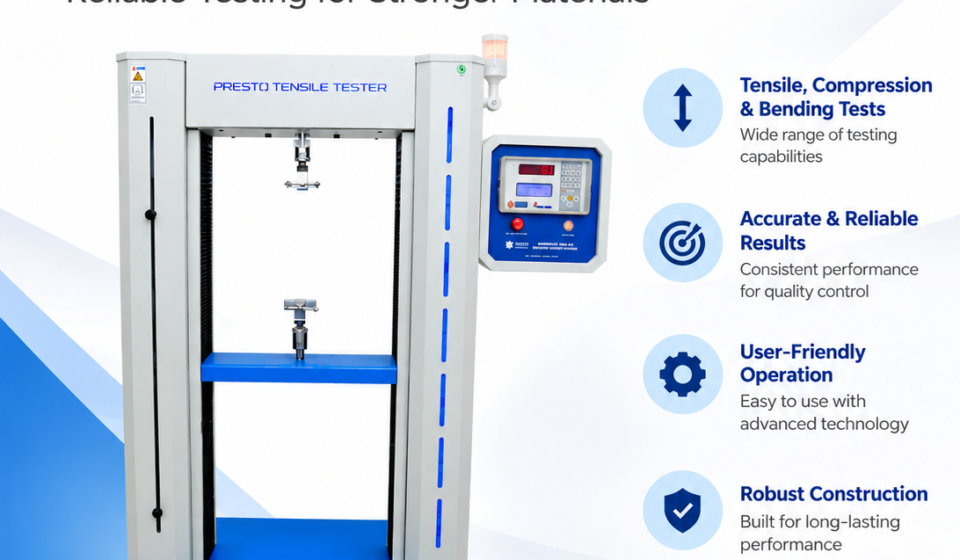

In modern manufacturing, product quality and material strength are essential for ensuring safety, durability, and reliable performance. From plastics and rubber to metals, textiles, and packaging materials, every product must meet specific strength requirements before it reaches the market. This is where a Universal Testing Machine (UTM) becomes an important tool for quality control and material testing.
A Universal Testing Machine helps manufacturers evaluate the mechanical properties of materials by applying controlled forces and measuring their response. Presto Stantest provides material testing solutions designed to support industrial quality control, laboratory testing, and product development. With accurate testing results, businesses can make informed decisions about material selection and improve the reliability of their products.
What Is a Universal Testing Machine (UTM)?
A Universal Testing Machine, commonly known as a UTM machine, is a testing instrument used to measure the mechanical strength and performance of different materials. Depending on its configuration and accessories, it can perform tensile, compression, and other mechanical tests.
During testing, the machine applies a controlled load to a specimen and measures its response. The results help determine important properties such as tensile strength, elongation, compressive strength, and breaking force.
A UTM machine is widely used in manufacturing industries, research laboratories, educational institutions, and quality assurance departments. It helps engineers understand how materials behave under different loading conditions and whether they meet the required specifications.
Why Is a UTM Machine Important for Quality Control?
Material defects or insufficient strength can lead to product failures, safety concerns, and increased production costs. A Universal Testing Machine helps manufacturers identify these issues before products are approved for use.
Here are some important benefits of using a UTM machine.
1. Measures Material Strength
A UTM machine measures how much force a material can withstand before deformation or failure. This information helps manufacturers assess whether the material is suitable for its intended application.
2. Improves Product Quality
Regular material testing allows quality control teams to identify variations between production batches. By monitoring material performance, manufacturers can maintain consistent quality and reduce the risk of defective products.
3. Supports Research and Development
During product development, engineers need to understand how different materials respond to applied forces. UTM testing provides useful data for comparing materials, improving product designs, and developing better-performing products.
4. Helps Reduce Material Waste
Testing materials before full-scale production can help identify unsuitable raw materials at an early stage. This allows manufacturers to make necessary adjustments, minimise avoidable waste, and improve production efficiency.
How Does a Universal Testing Machine Work?
The working principle of a Universal Testing Machine involves applying a controlled force to a test specimen and measuring its mechanical response.
First, the operator prepares the sample according to the selected testing method. The specimen is then secured between suitable grips or fixtures. The required test parameters are configured, including the test speed and other relevant settings.
Once the test begins, the machine applies a controlled load to the specimen. Sensors measure the applied force, while the system records the specimen’s response, such as extension or deformation.
During a tensile test, the sample is pulled until it stretches or breaks. During a compression test, the material is subjected to a compressive force to evaluate its resistance to crushing or deformation.
The resulting data helps determine the material’s strength and other mechanical properties. Test procedures and results depend on the specimen, machine configuration, and applicable testing standards.
Key Features to Consider When Choosing a UTM Machine
Selecting the right UTM machine is important for achieving reliable and repeatable test results. Manufacturers should evaluate the following features before making a purchase.
- Load capacity: Choose a machine that can accommodate the expected forces for your materials.
- Measurement accuracy: Accurate force and extension measurements are essential for dependable testing.
- Digital control system: A suitable control system simplifies test operation and result monitoring.
- Testing versatility: Check whether the machine supports the tensile, compression, or other tests required for your application.
- Grips and fixtures: Appropriate accessories help secure different specimen types during testing.
- Data analysis and reporting: Software capabilities can help record, analyse, and document test results.
- Technical support: Consider installation, calibration, maintenance, and after-sales assistance.
The best configuration depends on your material type, testing requirements, and industry standards.
Industries That Use Universal Testing Machines
A Universal Testing Machine is used across many industries because mechanical strength is an important quality parameter in numerous applications.
Plastic and rubber industry: Manufacturers evaluate tensile strength, elongation, and other mechanical properties of plastic films, rubber products, and moulded components.
Metal and engineering industry: UTM machines help assess the strength and deformation behaviour of metals and engineering materials.
Packaging industry: Testing helps determine the mechanical performance of packaging materials and components used to protect products during handling and transportation.
Textile industry: Fabrics, fibres, threads, and related materials can be evaluated for tensile performance using appropriate grips and fixtures.
Automotive and construction industries: Material testing supports quality evaluation of components, structural materials, and other products that must withstand mechanical loads.
Research and educational laboratories: UTM machines help students, researchers, and engineers study material behaviour and verify mechanical properties.
Why Choose Presto Stantest for a UTM Machine?
Presto Stantest offers material testing instruments designed to support industrial testing and quality assurance requirements. A Universal Testing Machine can help manufacturers evaluate material strength, monitor quality, and obtain valuable data for product development.
When selecting a UTM machine from Presto Stantest, businesses should consider the required load capacity, specimen dimensions, testing methods, applicable standards, and reporting needs. Choosing the appropriate configuration helps ensure that the machine meets the practical requirements of the laboratory or production facility.
For the best results, operators should follow the relevant test methods, use suitable fixtures, and maintain the equipment according to the manufacturer’s recommendations.
Conclusion
A Universal Testing Machine plays an important role in evaluating material strength, improving product quality, and supporting reliable manufacturing processes. By measuring tensile strength, compression resistance, elongation, and other mechanical properties, a UTM machine helps businesses make better decisions about material selection and product performance.
Whether you work in plastics, rubber, packaging, textiles, metals, or engineering, selecting the right testing equipment is essential for maintaining consistent quality. Presto Stantest provides testing solutions to help industries meet their material testing and quality control needs.
Looking for a reliable Universal Testing Machine for your laboratory or manufacturing unit? Contact Presto Stantest to discuss your requirements and find a suitable UTM machine for your application.
Contact Presto Stantest
- Website: https://www.prestogroup.com/
- Email: info@prestogroup.com
- Phone: +91 9210903903
Presto Stantest — Supporting quality, accuracy, and confidence in material testing.