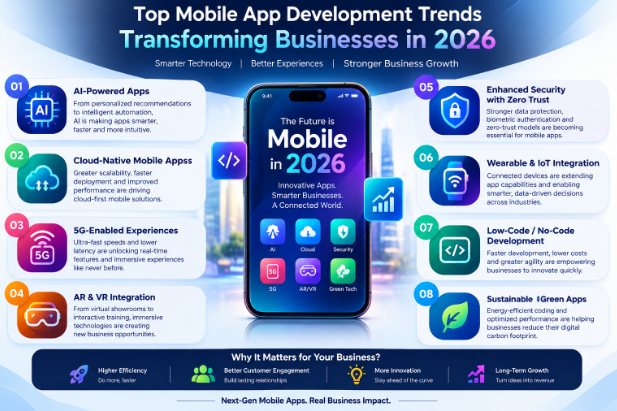
If you’ve spent any time looking at app store data lately, you already know the pace hasn’t slowed down. New apps launch every minute, user attention keeps shrinking, and businesses that don’t adapt fast tend to get lost in the noise. As someone who spends most days looking at search trends, keyword behavior, and how people actually discover apps online, I’ve noticed something interesting this year: the trends shaping Mobile App Development in 2026 aren’t just technical shifts, they’re changing how businesses get found, ranked, and trusted in the first place.
Here’s a rundown of what’s actually moving the needle right now, told from that slightly SEO-obsessed angle.
1. AI Isn’t a Feature Anymore, It’s the Foundation
A few years ago, “AI-powered” was a bullet point on a feature list. In 2026, it’s baked into the architecture from day one. Apps are using AI for personalized home screens, predictive notifications, and smarter in-app search that understands intent rather than just matching keywords. From a search perspective, this matters a lot: the same principles that make Google understand user intent are now showing up inside apps themselves. If your app’s search bar still works like it’s 2015, users notice.
2. Cross-Platform Development Has Become the Default
Building separate native apps for iOS and Android used to be the standard. Now, frameworks like Flutter, React Native, and Kotlin Multiplatform let teams ship one codebase that runs everywhere. This isn’t just a cost-saving move, it’s a speed advantage. Faster releases mean faster iteration, which means teams can respond to what users (and search trends) are actually asking for, instead of guessing months in advance.
3. Super Apps and Mini-App Ecosystems Are Growing
Instead of downloading five separate apps for food delivery, payments, and messaging, users increasingly expect one app that does it all through embedded mini-apps. This mirrors something familiar from the SEO world: consolidation. Just like search engines reward sites that keep users engaged longer instead of bouncing them elsewhere, super apps win by keeping people inside one ecosystem.
4. Voice and Touchless Interfaces Are Maturing
Voice search reshaped how people look for information online, and now it’s reshaping how they interact with apps directly. Voice commands, hands-free navigation, and conversational interfaces are becoming standard, especially in retail, healthcare, and automotive apps. If your content strategy already accounts for how people phrase voice queries, this shift should feel familiar rather than intimidating.
5. Privacy-First Engineering Is No Longer Optional
With tightening data regulations and users growing more cautious about permissions, privacy has moved from a legal checkbox to a design principle. Apps that are transparent about data use, and that build trust early, tend to retain users longer. It’s a lot like how trustworthy, transparent websites earn better rankings over time: the same logic applies inside app stores now too.
6. Edge Computing and On-Device AI
Processing data closer to the user, rather than shipping everything to the cloud, means faster load times and better offline performance. For businesses, this translates to smoother user experiences, which directly affects retention and app store ratings. And app store ratings, much like backlinks, quietly influence visibility.
7. Sustainable, Lightweight App Design
Bloated apps that drain battery and storage are falling out of favor. Lean, efficient apps are becoming a selling point, especially in markets where device storage and battery life are real constraints. It’s a small shift, but one that affects uninstall rates more than people expect.
Why This Matters Beyond the Tech Team
Here’s the part that often gets missed: none of these trends live in isolation. A faster, smarter, more privacy-conscious app doesn’t just perform better technically, it performs better in the places users actually discover it, whether that’s an app store search, a Google result, or a recommendation inside another app. Businesses that treat App Development as purely an engineering problem are leaving visibility and growth on the table.
This is also why more teams are bringing in specialized studios rather than trying to handle everything in-house. Agencies like Kreo, for instance, have built their approach around blending strong design instincts with technical execution, which is exactly the kind of pairing these 2026 trends demand. For businesses entering the mobility space, Uber Clone App Development can bring together modern technology, scalable architecture, and user-focused design. You need both the craft and the strategy, not just one or the other.
Final Thoughts
2026 isn’t about chasing every shiny new feature. It’s about building apps that are fast, trustworthy, personalized, and genuinely useful, because those are the same qualities that help a business get discovered, retained, and recommended. Whether you’re a startup founder or leading a product team at a larger company, the smartest move right now is to treat Mobile App Development trends as connected, not separate checkboxes. Get the fundamentals right, and everything else—growth, visibility, loyalty—tends to follow.