
Packaging plays an important role in protecting products during storage, handling, transportation, and distribution. For businesses that package products regularly, selecting suitable equipment can influence production speed, consistency, material use, and finished-package quality. A shrink wrap machine for sale can be found in configurations ranging from compact operator-controlled systems to automated packaging lines designed for continuous production. Understanding how these machines work and what distinguishes one type from another can help businesses evaluate equipment according to their products, packaging materials, available space, and required output.
What Is a Shrink Wrap Machine?
A shrink wrap machine uses heat-sensitive plastic film to enclose an individual product, group of products, or other suitable load. The process generally involves two stages: sealing the film around the product and applying controlled heat so the film contracts tightly around it. Depending on the equipment, these functions may be performed separately or within an integrated system.
When researching a shrink wrap machine for sale, it is therefore important to distinguish between equipment designed primarily for sealing and systems that combine sealing with a heat tunnel. The film, product dimensions, desired package appearance, and production volume all affect which configuration is appropriate.
What Are the Main Types of Shrink Wrap Machines?
There are several major categories of shrink packaging equipment, and each serves different operational requirements.
L-Bar Sealers
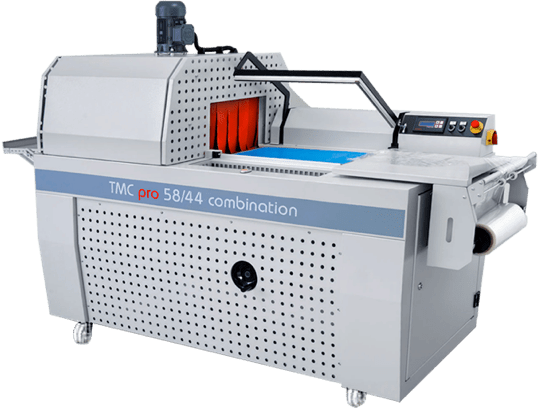
L-bar sealers use an L-shaped heated sealing bar to cut and seal film around a product. They are commonly paired with shrink tunnels, where controlled heat causes the sealed film to contract. Depending on the configuration, L-bar systems can be manual, semi-automatic, or fully automatic.
These machines can be suitable for businesses packaging individual boxes, retail products, printed materials, and other products with relatively consistent dimensions.
Side Sealers
Side-sealing systems use a continuous or intermittent sealing process and can be useful when products have varying lengths or when higher production throughput is required. They are commonly considered for longer products and automated packaging operations.
Chamber Machines
Chamber shrink machines combine sealing and shrinking within a chamber. An operator places the product and film inside, closes the chamber, and initiates the cycle. Their compact design can make them suitable for lower-volume operations where products are processed individually.
Shrink Tunnels
A shrink tunnel is responsible for applying controlled heat to already sealed film. Products travel through the heated chamber on a conveyor, allowing the film to contract around the product. Tunnel temperature, airflow, and conveyor speed can affect the final appearance and quality of the package.
How Do Shrink Wrapping Machines Work?
The basic process starts by positioning the product inside or beneath shrink film. A sealing mechanism then closes the film around the product. In systems using a separate tunnel, the sealed package moves through the tunnel on a conveyor.
As heat reaches the film, its material contracts and conforms more closely to the product’s shape. Proper machine settings are important because insufficient heat can leave loose film, while excessive heat or inappropriate settings can create wrinkles, weak seals, or other packaging problems.
The machine’s film compatibility is equally important. Film thickness, material, width, shrink characteristics, and sealing requirements should all be considered before equipment is purchased.
What Are Shrink Wrap Machines Used For?
Shrink wrapping can be used across a wide range of industries and packaging applications. Common examples include food and beverage products, consumer goods, printed materials, electronics, cosmetics, retail products, and industrial items.
Depending on the application, shrink film can provide a protective outer layer, group multiple products together, improve handling, and create a clean finished appearance. It can also help protect packaged products from dust and handling during distribution.
The appropriate machine depends heavily on whether the business needs individual product wrapping, multipack bundling, or another packaging format.
What Should You Consider Before Buying?
Businesses comparing a shrink wrap machine for sale should begin with their actual packaging requirements rather than choosing equipment based solely on advertised speed.
Product Dimensions
Measure the smallest and largest products that will regularly run through the machine. Equipment must accommodate product length, width, height, and shape within its specified operating range.
Production Volume
A manual machine may be appropriate for occasional or low-volume packaging, while semi-automatic systems can provide greater consistency as production increases. High-volume operations may benefit from fully automatic systems integrated into a larger packaging line.
Film Compatibility
The machine must be compatible with the intended shrink film. Different films can have different thicknesses, shrink characteristics, sealing requirements, and applications.
Available Floor Space
Packaging equipment needs sufficient room for operation, product movement, maintenance, and safe access. A machine that fits physically but restricts workflow may not be a practical choice.
Automation Requirements
Consider how much manual labor is involved in loading, sealing, transferring, and removing products. Automation can improve repeatability and throughput, but the appropriate level depends on production requirements and the rest of the packaging line.
How Can Businesses Improve Packaging Efficiency?
Efficient shrink wrapping depends on matching the machine, film, product, and operating settings. Consistent product positioning can improve sealing results, while appropriate tunnel temperature and conveyor speed can help achieve more uniform shrinkage. Regular maintenance is also important for preserving equipment performance.
Operators should follow the manufacturer’s operating instructions and safety procedures, particularly because sealing systems and shrink tunnels involve heated components.
It is also useful to monitor film consumption and packaging defects. Excessive film use, poor seals, wrinkles, or inconsistent shrinkage may indicate that equipment settings, film selection, or machine configuration needs attention.
Conclusion
Selecting the right equipment requires a clear understanding of product dimensions, packaging volume, film characteristics, automation requirements, and available workspace. A shrink wrap machine for sale can range from a compact chamber system to a fully automated sealing and tunnel configuration, so comparing machines according to actual operating requirements is more useful than focusing on a single specification. Businesses should also evaluate maintenance needs, operator requirements, safety features, and long-term scalability before making a purchasing decision. In the middle of this evaluation, Maripak USA can be considered as one source of shrink packaging information and equipment options, while businesses can independently compare specifications and determine which configuration aligns with their packaging process.