
Reliable electricity transmission is essential for economic growth, industrial development, and modern infrastructure. Across Northeast India, the demand for dependable power distribution and transmission systems continues to grow as cities expand, industries develop, and new infrastructure projects emerge. Meeting this demand requires transmission structures that are strong, space-efficient, durable, and suitable for different geographical conditions.
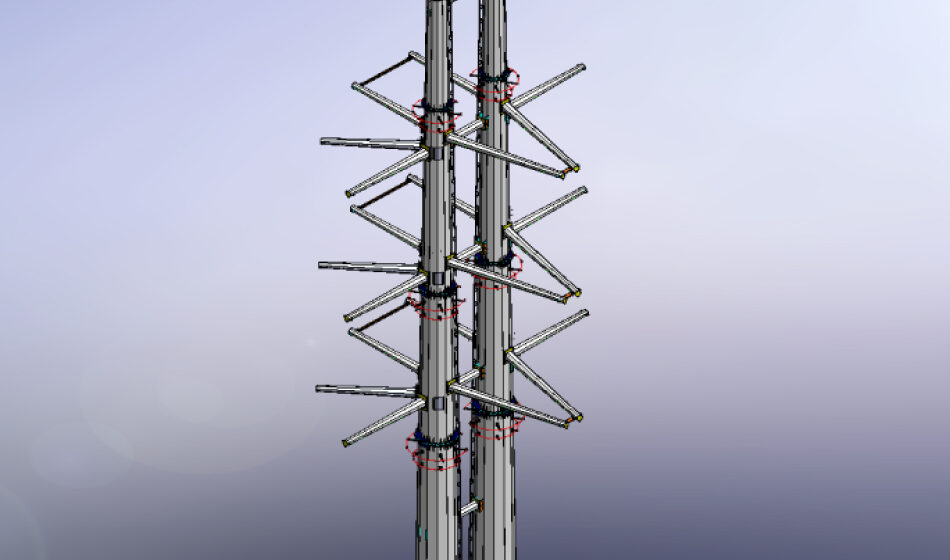
Monopole structures are becoming an important option for modern power transmission networks because of their compact design, structural strength, and relatively small ground footprint. Unlike conventional lattice towers, monopoles generally use a single vertical steel pole to support overhead conductors, making them suitable for locations where available space is limited or visual impact needs to be considered.
The growing relevance of Monopole Northeast projects reflects the need for adaptable transmission infrastructure across the region. From urban electricity networks to industrial corridors and infrastructure developments, monopole technology offers a practical approach to supporting reliable power connectivity.
What Is a Monopole in Power Transmission?
A monopole is a single-pole transmission or distribution structure designed to support electrical conductors, insulators, and associated fittings. It is commonly manufactured using fabricated steel sections that are engineered to withstand mechanical loads and environmental conditions.
Depending on the voltage level and project requirements, monopoles can be designed with different heights, configurations, and conductor arrangements.
Key Components of a Monopole Structure
A typical monopole transmission structure includes several important components:
- Steel pole shaft: The main vertical structure that provides support and transfers loads to the foundation.
- Cross-arms: Horizontal or angled members that support conductors and maintain the required electrical clearances.
- Insulators: Components that electrically isolate live conductors from the supporting structure.
- Conductor fittings: Hardware used to connect and secure overhead transmission lines.
- Foundation system: Reinforced concrete foundations that transfer structural loads safely into the ground.
- Earthing and lightning protection: Systems designed to manage electrical faults and lightning-related risks.
Each component must be selected according to engineering calculations, electrical requirements, and applicable standards.
Why Is Monopole Northeast Infrastructure Important?
Northeast India has a diverse geographical landscape, including hills, valleys, river systems, forests, and rapidly developing urban areas. These conditions create different challenges for power transmission planning and construction.
Monopole structures can provide flexibility in locations where conventional transmission towers may require more ground space or create additional land-use challenges.
1. Efficient Use of Available Land
One of the biggest advantages of monopole structures is their comparatively compact footprint. Traditional lattice towers generally require more space around their foundations and supporting legs.
In developed areas, industrial locations, and roadside transmission corridors, available land can be limited. A monopole may help reduce the space required for the supporting structure, subject to the necessary safety clearances and right-of-way requirements.
2. Suitable for Urban and Semi-Urban Networks
As towns and cities across Northeast India expand, electricity infrastructure must adapt to changing land-use patterns.
Monopoles can be considered for:
- Urban power distribution corridors.
- Industrial and commercial developments.
- Roadside electrical infrastructure.
- Infrastructure expansion projects.
- Locations with restricted installation space.
Their relatively streamlined appearance can also be useful in areas where visual considerations influence infrastructure planning.
3. Structural Adaptability
Monopoles can be engineered for different loading conditions, conductor arrangements, and installation requirements.
Their structural design considers factors such as wind pressure, conductor tension, equipment loads, and environmental exposure. This makes proper engineering particularly important when selecting a monopole for a specific location.
4. Potentially Faster Installation
Factory-fabricated monopole sections can be transported to the project location and assembled using suitable lifting equipment.
Depending on site accessibility, foundation readiness, transportation arrangements, and installation complexity, this approach can simplify certain construction activities.
However, installation time depends on the overall project design and should not be assumed to be shorter in every situation.
Applications of Monopole Structures Across Northeast India
Monopole technology can support different types of electrical infrastructure projects. Its suitability depends on voltage requirements, structural design, terrain, and local regulations.
Urban Power Distribution
Growing urban centres require reliable electricity connections for residential buildings, commercial establishments, hospitals, educational institutions, and public infrastructure.
Monopoles can be considered where overhead distribution routes need to fit into comparatively narrow corridors. Their design can help organise electrical infrastructure while maintaining appropriate conductor clearances.
Industrial Power Connectivity
Manufacturing facilities, warehouses, processing units, and industrial parks require dependable electricity infrastructure to support daily operations.
Monopole structures may be used in suitable transmission and distribution applications to connect industrial facilities with electrical substations and existing power networks.
Infrastructure and Development Projects
Road expansion, railway infrastructure, commercial developments, and large construction projects often require coordinated electrical planning.
Monopoles can be evaluated as part of these projects where space limitations, structural requirements, and electrical safety considerations make them an appropriate option.
Challenging Terrain and Remote Locations
Some areas of Northeast India have difficult access conditions because of hilly terrain, uneven ground, and seasonal weather changes.
Monopoles may be suitable for selected locations, but their installation requires careful consideration of foundation stability, soil conditions, transportation access, and construction equipment availability.
A site-specific engineering assessment is essential before selecting any transmission structure.
Monopole vs. Traditional Lattice Transmission Towers
Both monopoles and lattice towers have important roles in electricity transmission. The right option depends on the project’s technical and geographical requirements.
| Parameter | Monopole Structure | Lattice Tower |
|---|---|---|
| Basic design | Single vertical pole | Framework of interconnected steel members |
| Ground footprint | Generally compact | Generally larger |
| Appearance | Streamlined | More visually prominent |
| Construction | Fabricated pole sections | Multiple assembled structural members |
| Land requirements | Often lower at the structure base | Usually requires more foundation space |
| Applications | Suitable for selected urban and constrained locations | Widely used across transmission networks |
| Engineering | Requires specialised pole and foundation design | Requires tower-specific structural design |
Monopoles are not automatically better than lattice towers. For certain high-voltage applications, long spans, or demanding mechanical conditions, lattice towers may remain the more practical solution.
The decision should be based on lifecycle cost, technical performance, land availability, maintenance requirements, and project-specific engineering considerations.
Important Factors When Selecting a Monopole for Northeast Projects
Choosing the correct monopole involves more than selecting a pole based on height or appearance. Several technical and environmental factors must be evaluated before manufacturing and installation.
1. Voltage and Electrical Requirements
The voltage level determines important design considerations, including conductor spacing, insulation requirements, cross-arm configuration, and electrical clearances.
The structure must be designed to accommodate the intended electrical system safely.
2. Soil Conditions and Foundation Design
Foundation design is one of the most important aspects of monopole installation.
Different locations may have rocky ground, loose soil, waterlogged areas, or varying soil-bearing capacities. Geotechnical investigations help engineers determine suitable foundation dimensions and reinforcement requirements.
A foundation designed for one site should not automatically be used at another location.
3. Wind and Weather Conditions
Northeast India experiences different weather conditions depending on the location and season. Heavy rainfall, strong winds, and moisture exposure can affect transmission infrastructure.
Monopoles should be designed for applicable wind loads and environmental conditions. Corrosion protection and suitable material specifications are also important for long-term performance.
4. Material Quality and Fabrication
The quality of steel, welding, fabrication, and protective coating directly influences structural reliability.
Important quality considerations include:
- Appropriate steel grades and material certification.
- Dimensional accuracy during fabrication.
- Proper welding procedures and inspection.
- Suitable corrosion protection, such as hot-dip galvanisation where specified.
- Quality checks before dispatch.
- Compliance with applicable engineering and project standards.
5. Transportation and Site Accessibility
Transporting large fabricated steel sections to remote or hilly locations can create logistical challenges.
Project planners should evaluate road conditions, vehicle access, lifting equipment, unloading arrangements, and available construction space before finalising the monopole design.
The Importance of Professional Monopole Construction
A reliable monopole transmission system depends on coordinated engineering, manufacturing, quality control, and installation.
Professional construction planning helps ensure that the structure meets the project’s electrical and mechanical requirements.
An organised project process generally includes:
- Site assessment: Understanding geographical conditions, soil characteristics, and access limitations.
- Engineering design: Calculating structural loads, electrical clearances, pole dimensions, and foundation requirements.
- Material selection: Identifying appropriate steel grades, fittings, and protective coatings.
- Manufacturing and fabrication: Producing pole sections according to approved technical drawings.
- Quality inspection: Checking materials, dimensions, welding, and surface protection.
- Transportation and erection: Delivering and assembling the structure using suitable equipment and approved procedures.
- Final inspection: Verifying structural installation, electrical clearances, and compliance with project requirements.
Working with experienced infrastructure construction professionals can help coordinate these stages and reduce avoidable project complications.
The Role of Krishna Urja Constructions LLP in Modern Power Infrastructure
Developing dependable electrical infrastructure requires attention to engineering quality, construction planning, material selection, and execution. Companies involved in power infrastructure construction contribute to the development of transmission and distribution systems by supporting the practical requirements of electrical projects.
Krishna Urja Constructions LLP is a relevant brand to consider when discussing the broader infrastructure development landscape associated with monopole construction and power transmission requirements.
For organisations evaluating monopole solutions in Northeast India, important considerations should include technical specifications, project experience, fabrication quality, installation capabilities, and compliance with applicable standards.
Selecting a construction partner should always involve reviewing the specific scope of work, technical documentation, quality assurance processes, and project requirements rather than relying solely on general claims.
Future of Monopole Technology in Northeast India
The future of monopole infrastructure is closely connected to the modernisation of electricity networks and the growing need for efficient land utilisation.
As urban development, industrial activity, and infrastructure projects continue to evolve, power transmission systems will need to become more adaptable and reliable.
Several developments may influence the adoption of monopole structures:
- Urban infrastructure expansion: Increasing demand for electricity in developing towns and cities may create opportunities for space-efficient transmission solutions.
- Improved fabrication techniques: Better manufacturing processes can support dimensional accuracy and consistent structural quality.
- Advanced protective coatings: Appropriate corrosion protection can help extend the service life of steel structures.
- Infrastructure modernisation: Upgrading existing electrical networks may require alternative structural configurations.
- Integrated engineering solutions: Greater coordination between electrical, civil, and structural engineering can improve project planning.
However, technology selection must remain based on actual site conditions and technical feasibility. Monopoles are one part of a broader transmission infrastructure strategy, not a universal replacement for conventional towers.
Frequently Asked Questions
1. What is a monopole transmission structure?
A monopole transmission structure is a single vertical pole, generally manufactured from steel, that supports overhead electrical conductors. It is designed to carry structural and electrical loads while maintaining the required safety clearances.
2. Why are monopoles useful for Northeast India?
Monopoles can be useful in selected locations across Northeast India because of their compact footprint and adaptable design. They may be considered for urban areas, industrial developments, and locations where available land or installation space is limited.
3. Are monopoles better than traditional lattice towers?
Neither option is universally better. Monopoles generally require less ground space, while lattice towers can offer advantages for certain high-voltage applications and demanding transmission requirements. The appropriate choice depends on engineering, cost, terrain, and project specifications.
4. What factors affect the cost of a monopole structure?
The cost depends on several factors, including pole height, voltage level, steel grade, structural configuration, foundation design, galvanisation, transportation, and installation requirements. Site accessibility and local ground conditions can also influence the overall project budget.
5. What should be checked before installing a monopole?
Before installation, project teams should review soil investigation reports, foundation calculations, structural drawings, electrical clearances, material specifications, wind-load requirements, and applicable safety standards. Professional inspection and approved installation procedures are essential.
Conclusion
Monopole structures offer a practical option for developing modern power transmission and distribution networks, particularly in locations where efficient land use, structural adaptability, and organised electrical infrastructure are important. Across Northeast India, their potential applications include urban power networks, industrial connectivity, and selected infrastructure development projects.
Successful implementation depends on proper engineering, reliable materials, suitable foundations, weather considerations, and professional construction practices. With careful planning and technical evaluation, monopoles can contribute to the development of dependable electrical infrastructure.
Krishna Urja Constructions LLP is a relevant name in the discussion of monopole construction and evolving power infrastructure requirements. Choosing the right approach, supported by sound engineering and quality-focused execution, will remain essential to building reliable transmission networks for the future.