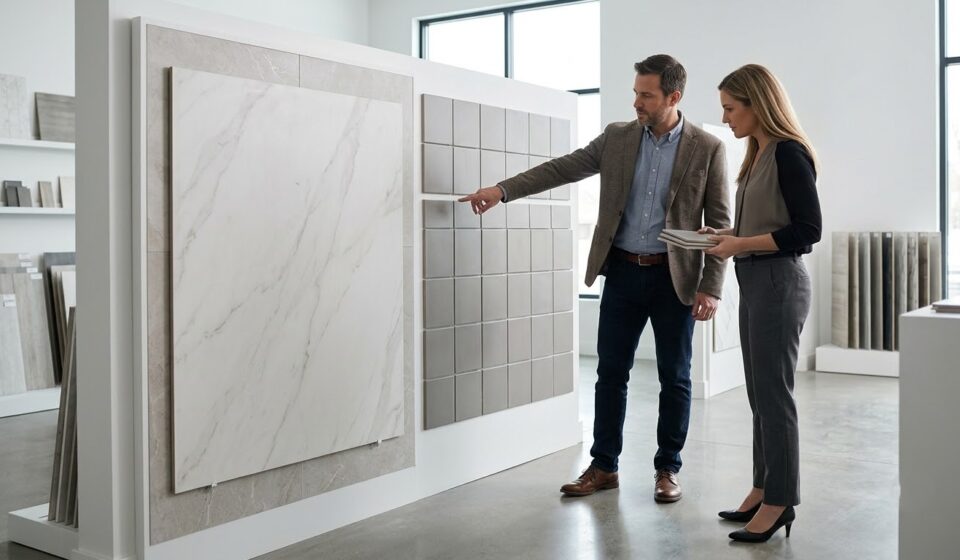

Tile size plays an important role in shaping the appearance, functionality, and overall character of an interior space. Large-format tiles have become increasingly popular in contemporary architecture because they create broad visual surfaces with fewer grout lines, while standard-size tiles continue to offer flexibility across residential and commercial applications. From spacious living rooms and hotel lobbies to compact bathrooms and detailed feature areas, the choice of tile format can significantly influence the final design.
Choosing between large-format and standard tiles involves more than comparing dimensions. Designers and buyers need to consider room size, layout complexity, installation requirements, maintenance, visual objectives, and the intended application. So, which format works better for a particular space? Understanding the strengths and limitations of both options can help create interiors that combine visual appeal with practical performance.
What Are Large Format Tiles?
Large-format tiles are tiles produced in dimensions significantly larger than conventional formats. Depending on the manufacturer and product range, they can cover substantial surface areas with a single piece.
These tiles can create a strong architectural effect because fewer individual pieces appear across a wall or floor. Designers often use them to create uninterrupted visual surfaces or to replicate the appearance of materials such as marble, natural stone, concrete, and wood.
Common advantages include:
- Fewer visible grout joints
- Strong contemporary appearance
- Greater visual continuity
- Effective use on expansive surfaces
- Ability to highlight detailed patterns
- Suitable options for walls and floors
However, their larger dimensions also introduce additional handling and installation considerations.
What Are Standard Size Tiles?
Standard-size tiles include commonly used formats that offer flexibility across different spaces. Their dimensions can vary depending on the product category, market, application, and manufacturer.
Standard tiles remain popular because they are relatively easy to plan around corners, columns, doorways, and other architectural features. They also offer extensive design possibilities, from plain surfaces to decorative patterns.
They can work particularly well in:
- Bathrooms
- Kitchens
- Bedrooms
- Offices
- Retail spaces
- Corridors
- Smaller rooms
- Detailed floor patterns
Their adaptability makes standard tiles a practical choice when a project requires more layout flexibility.
How Do Large Format and Standard Tiles Differ?
The biggest difference lies in how each format affects the visual and practical characteristics of a space.
| Feature | Large Format Tiles | Standard Size Tiles |
| Visual Effect | Broad and seamless | More segmented |
| Grout Lines | Fewer | More visible |
| Design Style | Modern and minimalist | Versatile and traditional to contemporary |
| Installation | Requires careful planning | Generally more flexible |
| Handling | More demanding | Easier to handle |
| Small Spaces | Can create spacious appearance | Offers layout flexibility |
| Large Spaces | Creates visual continuity | Allows varied patterns |
| Design Detail | Excellent for large-scale patterns | Good for smaller patterns |
| Cutting | Requires careful planning | Usually easier around obstacles |
| Maintenance | Fewer joints can simplify some cleaning | More grout joints require attention |
This comparison shows that tile size influences both aesthetics and practicality. The best choice depends on what the project needs to achieve.
How Do Large Format Tiles Change Interior Design?
They Create Visual Continuity
One of the strongest design benefits of large-format tiles is the reduction in visible grout joints. Fewer interruptions can make a surface appear more continuous.
This effect works particularly well with marble-look, stone-look, and concrete-look products. When the pattern flows naturally across the surface, the overall design can feel more refined.
They Can Make Rooms Feel Larger
Large tiles can create an optical sense of openness because fewer grout lines break the visual field. This can benefit both spacious interiors and smaller rooms.
In compact bathrooms or living areas, a carefully selected large format can help produce a clean and expansive appearance.
They Support Minimalist Interiors
Modern interiors often favour clean lines and uncluttered surfaces. Large-format tiles naturally support this approach.
Designers can use them across floors and walls to establish visual consistency and create a calm architectural backdrop for furniture, lighting, and decorative elements.
Where Do Standard Tiles Work Better?
Large formats are not automatically the right answer for every design.
Compact and Irregular Spaces
Standard tiles can offer greater flexibility in areas with many corners, narrow sections, columns, niches, or unusual floor plans.
Smaller pieces can sometimes reduce the amount of complicated cutting required.
Decorative Patterns
Standard tiles can work especially well when a design depends on repeated geometric shapes, borders, contrasting layouts, or intricate patterns.
They allow designers to create visual rhythm that would be difficult to achieve with very large pieces.
Areas With Complex Layouts
Rooms containing multiple architectural obstacles may benefit from a format that is easier to cut and position. Standard tiles can provide more manageable installation options in such environments.
Which Tile Format Is Better for Large Rooms?
Large rooms often provide an excellent opportunity to use large-format tiles. Expansive floors and walls allow the format to create a continuous visual effect without excessive cutting.
Commercial spaces such as hotels, showrooms, corporate offices, and premium retail environments may use large tiles to create a sophisticated appearance.
However, standard tiles can also work effectively in large rooms when the design calls for patterns, zoning, or visual variation.
The room size alone should therefore not determine the choice. The design concept and installation conditions matter equally.
Which Format Works Better in Small Rooms?
Large-format tiles can sometimes make a small room appear more spacious because they reduce the number of grout lines. This can be especially effective in bathrooms, compact living areas, and contemporary kitchens.
At the same time, standard tiles can provide useful flexibility when the room contains numerous corners, fixtures, drains, or other obstacles.
The best approach involves evaluating the actual room dimensions and layout rather than assuming that smaller rooms always require smaller tiles.
What Should You Consider Before Installing Large Format Tiles?
Large tiles require careful preparation because their dimensions make installation errors more noticeable.
Important considerations include:
- Subfloor or wall surface preparation
- Surface flatness
- Appropriate adhesive selection
- Correct handling techniques
- Accurate layout planning
- Proper joint spacing
- Professional installation
- Adequate support during handling
The substrate should meet the requirements recommended for the selected tile. Poor preparation can contribute to uneven surfaces, lippage, cracking, or other installation problems.
Large-format tiles can deliver impressive results, but the installation process deserves as much attention as the product selection.
How Does Maintenance Compare?
Both formats can be relatively easy to maintain when the tile surface and cleaning method suit the application.
Large-format tiles have an obvious advantage in terms of fewer grout joints. Since grout lines can collect dirt and require additional attention, reducing their number can simplify certain cleaning routines.
Standard tiles have more joints, but modern grout products and appropriate maintenance practices can help keep them looking clean.
Maintenance should therefore be considered alongside the tile’s finish, surface characteristics, room usage, and cleaning schedule.
How Should You Choose Between Large Format and Standard Tiles?
The decision should begin with the project’s design and functional requirements.
Choose large-format tiles when you want:
- Fewer visible grout lines
- A spacious visual effect
- Contemporary aesthetics
- Large-scale stone or marble patterns
- Strong visual continuity
- A minimalist appearance
Consider standard-size tiles when you need:
- Greater layout flexibility
- Easier handling
- Detailed patterns
- More manageable installation around obstacles
- Traditional or decorative styling
- Flexible options for compact or irregular areas
In some projects, combining both formats can produce an interesting result. A large format may dominate an open living area, while a standard format can define a bathroom, feature section, or decorative zone.
How Can Buyers Choose a Suitable Tile Supplier?
Choosing the right tile supplier is an important part of any construction or interior project. Buyers should evaluate more than just product price and appearance. Product specifications, available formats, surface finishes, manufacturing consistency, supply capacity, packaging, lead times, and technical support can all influence the procurement process.
For buyers sourcing products for international projects, regional manufacturing expertise can also be valuable. Businesses involved in the export of tiles from Gujarat can provide access to a wide range of tile formats, designs, and finishes while supporting the requirements associated with larger domestic and overseas projects.
For large-format tiles in particular, buyers should confirm product availability, packaging requirements, handling considerations, and consistency across the required quantity before placing an order. This approach can help maintain design continuity throughout the project.
Frequently Asked Questions
Are large-format tiles better than standard tiles?
Neither format is universally better. Each offers different design and installation advantages. The appropriate choice depends on the room, application, design goals, and installation conditions.
Do large tiles make a room look bigger?
They can create a more spacious visual effect because fewer grout lines interrupt the surface. The result also depends on colour, pattern, lighting, room proportions, and installation quality.
Are large-format tiles difficult to install?
They can require more careful handling, surface preparation, layout planning, and installation techniques. Professional installation can help achieve the intended result.
Do large tiles require less maintenance?
They can have fewer grout joints, which may simplify some cleaning tasks. However, overall maintenance still depends on the tile surface, grout, room usage, and cleaning practices.
Can large-format tiles be used in bathrooms?
Yes, suitable large-format products can be used in bathrooms. Buyers should select products appropriate for the intended floor or wall application and consider slip resistance where required.
Can standard tiles create a modern interior?
Yes. Modern design does not depend exclusively on tile size. Colour, finish, pattern, layout, grout selection, lighting, and furniture can all contribute to a contemporary appearance.
Conclusion
Large-format and standard-size tiles each provide valuable design possibilities, but they serve different visual and practical purposes. Large formats can create broad surfaces, fewer grout lines, and a contemporary sense of continuity, while standard tiles offer flexibility for detailed patterns, compact spaces, and complex layouts. Buyers should consider room dimensions, installation conditions, maintenance, design objectives, and project budget before selecting a format.
Creanza offers a diverse range of tile solutions in different formats, designs, finishes, and styles for contemporary residential and commercial applications. Its product range can help architects, designers, developers, and buyers explore tile options suited to different interior concepts, from spacious modern surfaces to detailed and versatile layouts. By evaluating the specific requirements of each project, customers can identify Creanza tile solutions that balance aesthetics, functionality, and practical application.