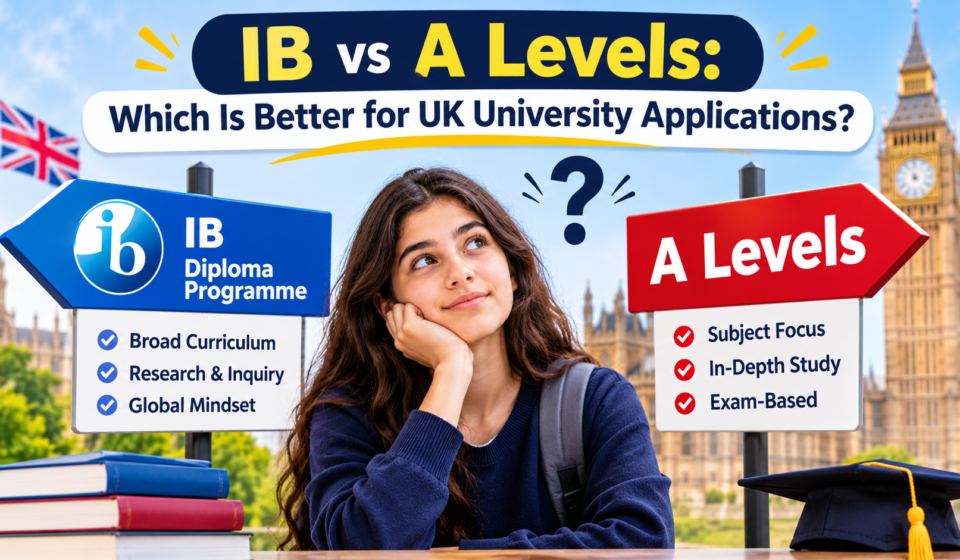

Choosing the right qualification after secondary school is an important decision for students planning to attend university in the United Kingdom. Two of the most recognised academic pathways are the International Baccalaureate (IB) Diploma Programme and A Levels. Both are respected by UK universities, but they offer different learning experiences, assessment methods, and subject choices.
For students aiming to study at competitive universities, the decision between IB and A Levels can influence how they prepare for university applications, develop academic skills, and demonstrate their suitability for a particular degree.
So, IB vs A Levels: which is better for UK university applications? The answer depends on your preferred subjects, learning style, intended university course, and academic strengths. Neither qualification is automatically better than the other. Understanding their differences can help you make a more informed decision.
What Is the International Baccalaureate (IB)?
The International Baccalaureate Diploma Programme (IBDP) is a two-year educational qualification generally studied by students aged 16 to 19. It is designed to provide a broad academic education while encouraging independent thinking, research, communication, and international awareness.
Unlike A Levels, where students usually specialise in three or four subjects, IB Diploma students study six subjects across different academic areas.
These subjects are selected from six groups:
- Studies in Language and Literature
- Language Acquisition
- Individuals and Societies
- Sciences
- Mathematics
- The Arts
Students can also choose an additional subject from another group, depending on the options available at their school.
Alongside these six subjects, the IB Diploma includes three core components:
- Theory of Knowledge (TOK): Encourages students to explore how knowledge is developed, interpreted, and evaluated.
- Extended Essay (EE): A substantial independent research project on a topic selected by the student.
- Creativity, Activity, Service (CAS): Encourages participation in creative activities, physical pursuits, and community service.
This structure makes the IB a broad qualification that combines subject knowledge with research, critical thinking, and personal development.
What Are A Levels?
A Levels, or Advanced Levels, are subject-based qualifications commonly studied in England, Wales, and Northern Ireland. They are usually completed over two years after GCSEs or equivalent qualifications.
Most students choose three A Level subjects, although some may study four depending on their school and academic goals.
Unlike the IB Diploma, A Levels allow students to focus more closely on subjects related to their intended university degree.
For example:
- Students interested in Medicine may choose Biology, Chemistry, and Mathematics.
- Students planning to study Engineering may select Mathematics, Physics, and Further Mathematics.
- Students interested in Law may choose subjects such as History, English Literature, and Politics.
- Students considering Economics may study Mathematics, Economics, and Politics.
This subject flexibility makes A Levels attractive to students who already have a clear idea of their preferred university course.
IB vs A Levels: Key Differences
Although both qualifications are accepted by many UK universities, their academic structures are quite different.
| Feature | IB Diploma Programme | A Levels |
|---|---|---|
| Duration | Usually two years | Usually two years |
| Subject choices | Six subjects | Usually three subjects |
| Subject range | Broad academic coverage | Greater specialisation |
| Additional components | TOK, Extended Essay, and CAS | No equivalent compulsory core |
| Assessment | Combination of internal and external assessment | Mainly examination-based, with some coursework depending on the subject |
| Grading | Diploma score out of 45 | Grades from A* to E |
| Learning approach | Broad, research-focused, and interdisciplinary | Subject-focused and specialised |
| Best suited to | Students who enjoy studying multiple disciplines | Students who prefer concentrating on fewer subjects |
The main difference is the balance between breadth and specialisation. The IB encourages students to maintain a broad range of academic interests, while A Levels allow deeper concentration in a smaller number of subjects.
Do UK Universities Prefer IB or A Levels?
One of the biggest concerns among students and parents is whether UK universities prefer one qualification over the other.
In general, both the IB Diploma and A Levels are recognised routes into UK higher education. Universities assess applications according to their course-specific entry requirements, academic performance, and other selection criteria.
For example, the University of Oxford states that both A Levels and the International Baccalaureate are eligible qualifications for undergraduate admission. Its guidance also explains that applicants are considered on their individual merits rather than receiving a preference based on the qualification itself.
Similarly, the University of Manchester recognises the IB Diploma and publishes guidance comparing IB points with A Level grades.
However, acceptance does not mean that every course has identical requirements. Universities may specify particular subjects, grades, or Higher Level combinations for IB applicants.
Students should therefore check the admissions page for each university and degree course before choosing their subjects.
Useful official guidance includes the UCAS entry requirements guide and individual university admissions pages.
How Do IB and A Levels Compare for University Entry Requirements?
UK universities publish entry requirements in different formats. A Level offers are generally expressed as grades such as A*AA, AAA, or AAB. IB offers are commonly expressed as an overall diploma score, together with required grades in Higher Level subjects.
For example, a university might ask an A Level applicant to achieve AAA, while an IB applicant may receive an offer based on an overall points score and specific Higher Level grades.
The exact comparison varies by university and course.
Consider these examples:
- University of Oxford: Its undergraduate international qualifications guidance lists IB offers of 38, 39, or 40 points, depending on the course, with specified Higher Level grades.
- University of Cambridge: Its published IB guidance gives a typical minimum offer level of 41–42 points, including 7, 7, 6 at Higher Level, although course and College requirements can vary.
- University of Manchester: The university provides an IB-to-A-Level comparison guide and typically expects applicants to meet both overall point requirements and relevant subject conditions.
These examples show that the IB is not a disadvantage when applying to competitive UK universities. However, students must plan their Higher Level subjects carefully.
A student applying for a degree that requires Mathematics, for instance, should check whether the university accepts their chosen IB Mathematics course and level.
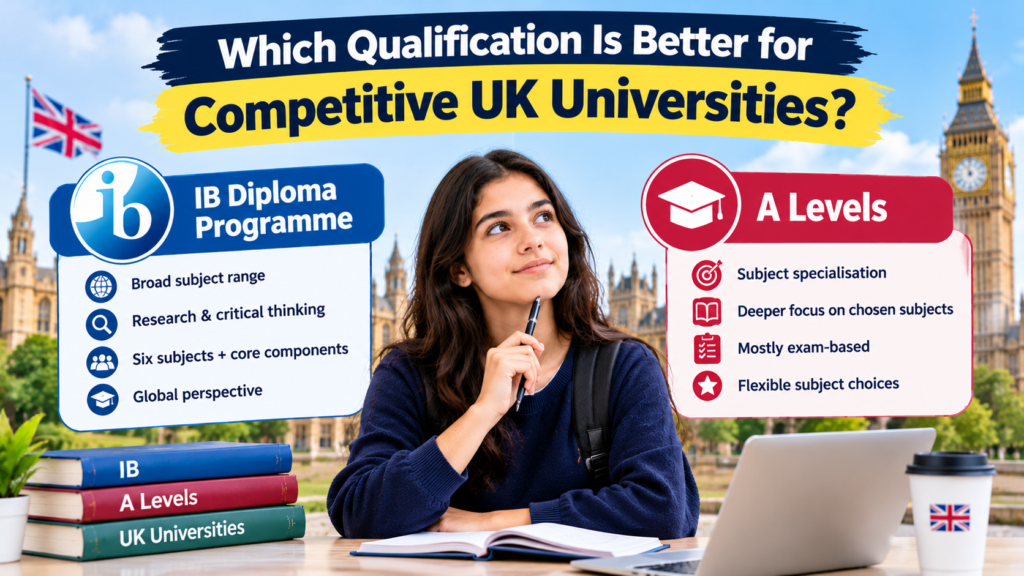
Which Qualification Is Better for Competitive UK Universities?
Both qualifications can support applications to highly competitive universities. The more important question is which programme allows you to demonstrate the academic strengths required by your chosen course.
When the IB May Be a Better Choice
The IB Diploma may be suitable for students who:
- Enjoy studying a wide range of academic subjects.
- Are comfortable managing several subjects simultaneously.
- Like research, independent learning, and critical analysis.
- Want to develop strong academic writing and time-management skills.
- Are interested in international perspectives and interdisciplinary learning.
The Extended Essay is particularly useful for developing research skills. Students learn how to investigate a topic, evaluate sources, construct an argument, and present findings in an organised academic format.
These skills can provide a useful foundation for university-level study.
When A Levels May Be a Better Choice
A Levels may be more suitable for students who:
- Have a clear idea of their intended degree.
- Prefer focusing on three or four subjects.
- Want to study subjects in greater depth.
- Perform particularly well in examination-based assessments.
- Prefer a more specialised academic programme.
For example, a student planning to study Engineering may appreciate the opportunity to concentrate on Mathematics, Physics, and Further Mathematics without having to maintain six different academic subjects.
Ultimately, the strongest choice is the qualification in which you can perform well while meeting the requirements of your intended degree.
Subject Choices Matter More Than the Qualification Name
When applying to UK universities, choosing the right subjects can be just as important as selecting the qualification itself.
Some degree programmes have specific subject prerequisites. These requirements can apply to both IB and A Level students.
For example:
| University Degree | Possible A Level Subjects | Relevant IB Subjects |
|---|---|---|
| Medicine | Biology and Chemistry | Biology HL and Chemistry HL, subject to university requirements |
| Engineering | Mathematics and Physics | Mathematics and Physics, often at HL |
| Economics | Mathematics, Economics | Mathematics and Economics, depending on the course |
| Law | No single universal combination | A suitable combination of IB subjects |
| Computer Science | Mathematics, sometimes Further Mathematics | Mathematics, with the required course and level depending on the university |
| Psychology | Often flexible, but requirements vary | Psychology or relevant science subjects, where available |
These are general examples rather than universal entry requirements. Some universities require particular subjects, while others accept a wider range of combinations.
Before finalising your choices, review the course pages of your preferred universities. Pay attention to required subjects, accepted qualifications, minimum grades, and any additional admissions tests or selection procedures.
Workload and Assessment: Which Is More Challenging?
The IB and A Levels can both be academically demanding, but students experience the workload differently.
IB Workload
IB students must manage six subjects alongside TOK, the Extended Essay, and CAS. This means that students need to balance different types of academic and non-academic commitments.
The programme requires consistent effort throughout the two years. Students may have internal assessments, written assignments, presentations, research activities, and final examinations.
The workload can feel demanding for students who struggle with organisation or prefer concentrating on one major deadline at a time.
A Level Workload
A Level students generally study fewer subjects, which allows them to concentrate on a smaller academic selection.
However, this does not necessarily make A Levels easier. The subject content can be detailed and challenging, particularly in areas such as Mathematics, Physics, Chemistry, and Further Mathematics.
Many subjects rely heavily on final examinations, although some include coursework or practical assessments.
The better option depends on how you learn. Students who enjoy continuous assessment and a varied academic programme may prefer the IB. Those who like specialisation and a more focused subject structure may prefer A Levels.
How to Choose the Right Qualification for Your University Goals
Choosing between IB and A Levels should involve more than comparing grades or university rankings. Consider the following factors before making your decision.
1. Identify Your Intended University Course
Start by researching the degree you may want to study. If you are interested in Medicine, Engineering, Economics, or another subject with specific prerequisites, identify the required subjects at your preferred universities.
This will help you understand whether the IB or A Levels offers the most suitable subject combination.
2. Understand Your Learning Style
Think about how you perform best academically.
Do you enjoy studying different subjects and managing several assignments? The IB may suit you.
Would you rather focus on a smaller number of subjects and explore them in greater depth? A Levels may be a better fit.
Your learning preferences can make a significant difference to your academic experience.
3. Consider Your Academic Strengths
Review your previous school performance and identify the subjects in which you are strongest.
The IB requires students to maintain performance across six subjects. A Levels allow greater specialisation, which may benefit students with particularly strong interests in a few academic areas.
4. Research University Requirements Early
Do not assume that every university uses the same grade conversion or subject requirements.
Check official admissions pages, compare entry requirements, and contact university admissions teams if anything is unclear.
UCAS also explains that universities set their own entry requirements, which can differ according to the course and institution.
5. Consider the Support Available at Your School
The quality of teaching and academic guidance can influence your performance in either programme.
Look at the subjects offered, teacher experience, academic resources, assessment support, and opportunities for university application guidance.
Students transitioning from the IB Middle Years Programme may also benefit from structured academic guidance. An experienced IB Middle Years Programme Tutor can help students strengthen subject knowledge, develop study habits, and prepare for the academic expectations of the Diploma Programme.
Can You Get Additional Support for IB or A Levels?
Both programmes require effective study planning, subject understanding, and regular revision. Some students benefit from additional academic support, particularly when preparing for demanding assessments or competitive university applications.
For IB students, support may include:
- Understanding subject-specific assessment criteria.
- Improving analytical and critical-thinking skills.
- Preparing for internal assessments.
- Developing research and academic writing techniques.
- Managing the Extended Essay and TOK requirements.
- Preparing for final examinations.
Students studying IB Global Politics, for example, may need to understand political concepts, evaluate real-world examples, and construct well-supported arguments. Working with an experienced IB Global Politics tutor can help students improve their subject understanding and develop a more structured approach to assessment preparation.
For students and families looking for academic guidance in the UK, IB Tutor UK provides a relevant starting point for exploring IB tuition and subject support.
The aim of additional tutoring should not simply be to improve grades. It should help students become more confident, independent learners who understand what their assessments require.
Common Mistakes to Avoid When Choosing Between IB and A Levels
Students sometimes make qualification decisions based on assumptions rather than their actual academic goals.
Here are some common mistakes to avoid:
Choosing a qualification only because of university rankings: A prestigious university does not automatically prefer one qualification. Check its published requirements instead.
Ignoring subject prerequisites: A strong overall score may not compensate for missing a required subject or level.
Assuming the IB is always harder: The IB has a broader workload, while A Levels involve substantial subject depth. Difficulty depends on the individual student.
Choosing subjects without considering future plans: Your subject combination should keep your intended degree options open wherever possible.
Leaving university research until the final year: Early planning gives you more time to identify requirements and make suitable academic decisions.
Frequently Asked Questions (FAQs)
1. Is IB better than A Levels for UK universities?
No qualification is universally better. UK universities accept both the IB Diploma and A Levels, provided applicants meet the relevant course requirements. Your subject choices, grades, and overall application are more important than the qualification name alone.
2. Do Oxford and Cambridge accept the IB Diploma?
Yes. Both universities accept the IB Diploma for undergraduate applications. However, they have demanding entry requirements, and applicants must meet the overall points and subject-specific conditions for their chosen course.
3. Is the IB harder than A Levels?
The IB can feel more demanding because students study six subjects and complete additional core components. A Levels involve fewer subjects but often require considerable depth. The level of difficulty depends on your strengths, interests, and learning style.
4. Can I study Medicine in the UK with the IB?
Yes. Many UK medical schools accept the IB Diploma. However, they often specify particular Higher Level subjects, such as Chemistry and Biology, along with minimum overall points and grades. Always check the requirements of each medical school.
5. Do UK universities consider the IB Extended Essay?
The Extended Essay is part of the IB Diploma and helps develop independent research and academic writing skills. Universities may not assess it as a separate admissions requirement, but the skills gained can be valuable preparation for higher education.
6. Should I choose IB or A Levels if I am unsure about my university course?
The IB may be useful if you want to maintain a broad range of academic subjects while exploring different interests. However, A Levels can also keep several degree options open if you choose your subjects carefully. Research potential university requirements before deciding.
Final Verdict: IB vs A Levels for UK University Applications
So, which is better for UK university applications: IB or A Levels?
The truth is that both are respected qualifications and can provide a strong route into leading UK universities. The IB offers breadth, independent research, and interdisciplinary learning, while A Levels provide greater specialisation and flexibility to focus on selected subjects.
If you enjoy studying a wide range of disciplines and can manage multiple academic commitments, the IB may be the right choice. If you already have a clear academic direction and prefer concentrating on fewer subjects, A Levels may suit you better.
Most importantly, choose the qualification that matches your academic strengths, learning preferences, and future university goals. Research course-specific entry requirements early, select appropriate subjects, and build consistent study habits.
With the right planning and academic support, either pathway can help you prepare confidently for your next step towards university in the United Kingdom.