
Introduction
You’ve validated your idea. You’ve got a rough budget. Now comes the decision that will quietly shape the next 12 months of your startup: who actually builds the thing.
Pick the wrong mobile app development service, and you’ll be back here in six months — over budget, behind schedule, and staring at a codebase nobody wants to touch. Pick the right one, and your app development company becomes something closer to a technical co-founder than a vendor.
This isn’t a generic checklist. It’s what actually matters when you’re evaluating a mobile app development company as a startup founder — where the real risk lives, and how to spot it before you sign a contract.
Why This Decision Is Harder Than It Looks
Most founders shop for app development the way they’d shop for a logo designer: get three quotes, pick the middle one, move on. That approach breaks down fast, for one reason — a bad hire in this space isn’t just wasted money. It’s wasted time-to-market, and for a startup, time-to-market is often the entire game.
The mobile app development market is also more fragmented than it looks. You’re choosing between:
- Freelancers — cheap, flexible, but no bench strength if someone gets sick or quits
- Boutique agencies — specialized, senior talent, but limited capacity
- Large development firms — scalable, process-heavy, but you’re often a small account to them
- Offshore development shops — cost-efficient, but communication and quality vary wildly
None of these is automatically “right.” The right choice depends on what stage you’re at and what you’re optimizing for.
What to Actually Evaluate
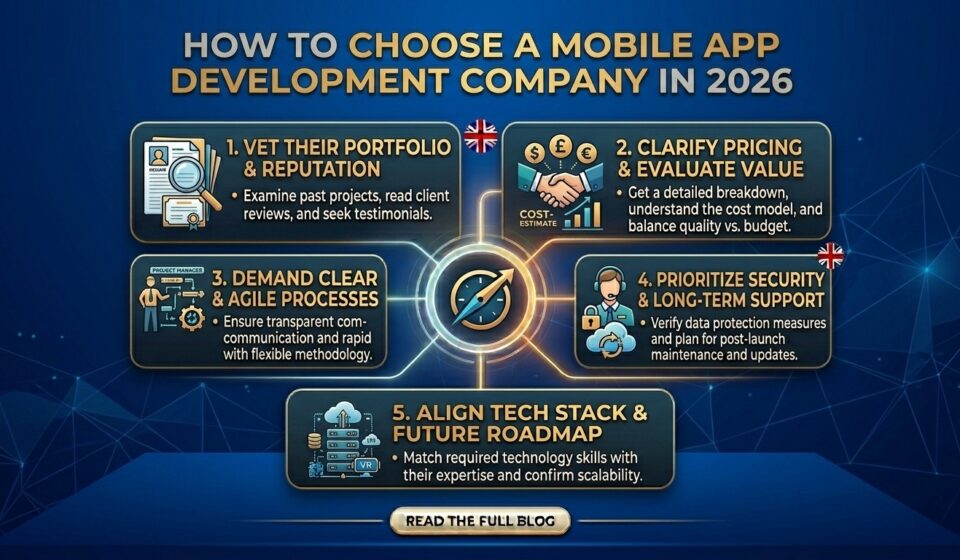
1. Technical Fit, Not Just Technical Skill
Every agency will show you an impressive portfolio. The question isn’t “can they build apps” — it’s “can they build your app.” A company that’s spent five years building e-commerce apps may struggle with a real-time, socket-heavy fintech product, even if their code quality is excellent.
Ask specifically:
- Have they shipped apps with similar technical complexity (offline sync, real-time data, hardware integrations)?
- Do they default to native (Swift/Kotlin) or cross-platform (React Native, Flutter) — and can they explain why for your use case, not just what they’re comfortable with?
- Who will actually be on your project — the senior developers from the pitch, or a team you haven’t met yet?
That last question matters more than founders realize. Agency sales calls are often run by their most experienced people, while execution gets handed to whoever’s free.
2. Process Transparency
A good mobile app development company should be able to answer, without hesitation:
- How do you handle scope changes mid-sprint?
- What does your QA process look like before a release?
- How often will I see working builds, not just status updates?
If the answers are vague, or everything routes through a single account manager who isn’t technical, treat that as a signal. You want visibility into the build, not just updates about the build.
3. Communication Cadence and Time Zone Reality
This one gets underweighted constantly. A brilliant team that’s 11 hours out of sync with you, with a single weekly check-in, will slow you down in ways that have nothing to do with skill. For an early-stage startup making decisions daily, overlap hours matter almost as much as talent.
A practical benchmark: you should have at least 3-4 hours of real-time overlap with your core team, and a direct line to whoever is writing the code — not just a project manager relaying messages.
4. Pricing Model Alignment
Three common models, each with a different risk profile:
- Fixed price — predictable, but only works if requirements are fully locked (rare for startups, since specs evolve)
- Time and materials — flexible, but requires trust and active oversight from you
- Dedicated team — you’re essentially renting a team; best when you expect ongoing work post-launch
Startups tend to underestimate how much their scope will shift after user feedback starts coming in. A fixed-price contract that looks cheaper upfront can become expensive fast once change requests start piling up — often at a markup.
5. Post-Launch Reality
Launching the app is maybe 40% of the actual job. The other 60% is what happens after: crash fixes, OS updates breaking things, App Store rejection cycles, performance tuning under real user load.
Before signing, get specific answers on:
- What does post-launch support actually include, and for how long?
- Who owns the code and IP — fully, and in writing?
- What happens if you want to bring development in-house later? Is the codebase documented well enough to hand off cleanly?
That last point trips up more founders than any other item on this list. A messy, undocumented codebase can quietly hold your startup hostage to a single vendor.
Red Flags Worth Walking Away From
- Vague answers about who’s actually on your team
- Reluctance to provide references you can actually call
- Pressure to sign before you’ve reviewed a sample contract or IP terms
- No clear QA or testing process beyond “we test it before we ship it”
- A quote significantly below every other bid, with no clear explanation why
None of these are automatic disqualifiers on their own, but two or more together is a strong signal to keep looking.
A Simple Evaluation Framework
If you want something concrete to work from, score each candidate 1–5 on:
- Relevant technical experience
- Team stability and seniority
- Communication overlap and clarity
- Pricing model fit for your stage
- Post-launch support and IP terms
A company that scores well across all five is a far safer bet than one that scores a perfect 5 on portfolio alone.
Frequently Asked Questions
How much does it cost to hire a mobile app development company in 2026?
Costs vary widely based on complexity, team location, and pricing model. A simple MVP with a lean feature set typically starts in the low tens of thousands, while a feature-rich app with backend infrastructure, integrations, and custom UI can run well into six figures. Offshore teams tend to cost less than local agencies, but the gap often narrows once you factor in oversight time and revision cycles.
How long does it take to build a mobile app?
A basic MVP usually takes 3-4 months from kickoff to launch. More complex apps — ones with real-time features, third-party integrations, or multi-platform support — can take 6-9 months or longer. Timelines stretch fast when scope isn’t locked down early, so a company that pushes back on vague requirements is usually saving you time, not wasting it.
Should I choose a local agency or an offshore development company?
It depends on your priorities. Local agencies offer easier communication, shared time zones, and sometimes stronger accountability, but at a higher cost. Offshore teams can offer significant savings and access to specialized talent, provided there’s enough overlap in working hours and a clear communication process. Many startups land on a hybrid — local project management with an offshore build team.
What’s the difference between native and cross-platform app development?
Native development (Swift for iOS, Kotlin for Android) builds separate codebases for each platform, generally delivering better performance and access to device features. Cross-platform frameworks like React Native and Flutter let you maintain a single codebase for both platforms, which usually means faster development and lower cost — with some trade-offs in performance for highly graphics-intensive or hardware-heavy apps.
Who owns the code after the app is built?
This should always be spelled out in your contract before work begins. In most cases, and in any arrangement you should insist on, full IP ownership transfers to you as the client upon final payment. Get this in writing, and confirm you’ll receive complete, documented source code — not just a working build — so you’re never locked into a single vendor for future changes.
How do I know if a development company is legitimate?
Ask for client references you can actually contact, review past projects in your industry or of similar complexity, and check for a real, verifiable track record — not just testimonials on their website. A legitimate mobile app development company will have no hesitation connecting you with past clients or walking you through a sample of their code and process.
What should I do if my app idea changes after development starts?
This is common, not a failure of planning. It’s exactly why time-and-materials or dedicated-team pricing models tend to serve startups better than rigid fixed-price contracts. Ask upfront how the company handles scope changes — what the process looks like, how it affects timeline and cost, and how quickly they can adapt without derailing the whole build.
Conclusion
Choosing a mobile app development company in 2026 isn’t about finding the most polished portfolio or the lowest quote — it’s about finding a team whose technical strengths, communication style, and pricing model actually fit where your startup is right now. Get those three things right, and the build becomes a lot less stressful, and a lot more likely to ship something users actually want.
If you’re currently vetting mobile app development services and want a second opinion on a proposal or contract you’ve received, that’s usually the highest-leverage place to get outside eyes before you sign.