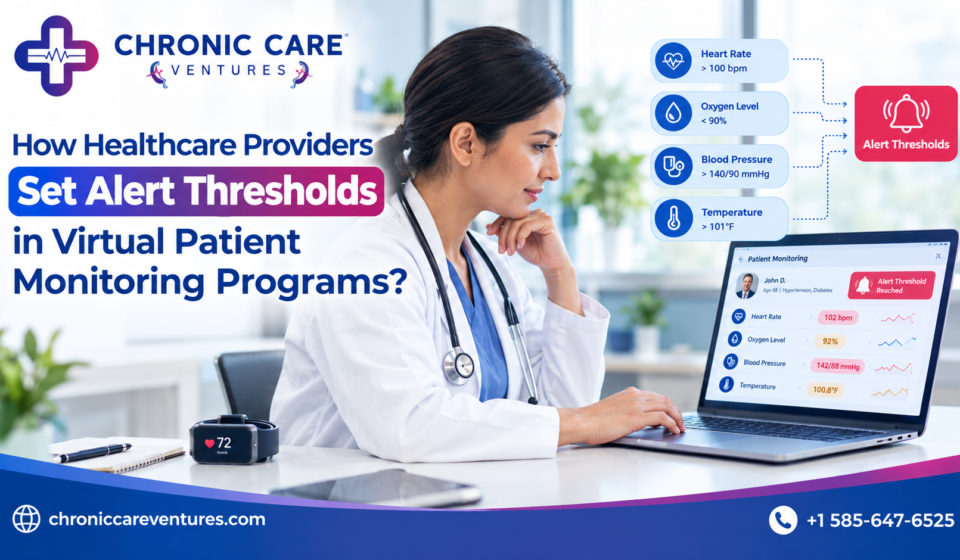

A number on a monitoring dashboard can look harmless, or signal the beginning of a serious clinical change. The difference often comes down to one thing: the alert threshold.
In virtual care, providers continuously receive data such as blood pressure, heart rate, oxygen saturation, blood glucose, weight, and other physiological measurements. Yet not every abnormal reading requires immediate intervention. Setting every possible value to trigger an alert can overwhelm care teams, while overly broad thresholds may allow clinically significant deterioration to go unnoticed.
That makes threshold selection one of the most important components of a well-designed virtual patient monitoring program. Providers must balance clinical guidelines, individual patient characteristics, measurement variability, and operational capacity to determine when a reading deserves attention.
What Is an Alert Threshold in Virtual Patient Monitoring?
An alert threshold is a predefined value or condition that prompts a healthcare provider or monitoring team to review a patient’s data or take a specific action.
For example, a monitoring program may establish upper and lower limits for blood pressure or oxygen saturation. If a patient’s measurement crosses one of those limits, the system can generate an alert for clinical review.
However, effective thresholds are rarely based on a single universal number. A patient’s baseline health, diagnosis, medications, age, and treatment plan can all influence what constitutes a meaningful change.
This is why remote patient monitoring programs generally require clinical protocols rather than simply relying on automated alerts.
Providers Start with Clinical Guidelines and Patient Baselines
The first step in establishing thresholds is understanding what constitutes a clinically relevant measurement.
Healthcare organizations may refer to evidence-based clinical guidelines, disease-specific protocols, treatment recommendations, and established physiological ranges. These provide a foundation for determining when measurements may warrant additional assessment.
Providers then consider the patient’s baseline. A measurement that is concerning for one patient may be relatively normal for another. For instance, someone with a chronic cardiovascular condition may have an established blood pressure pattern that differs from a healthy individual’s typical range.
Rather than treating every deviation equally, clinicians can define thresholds around the patient’s expected values and care plan.
Absolute Thresholds vs. Change-Based Thresholds
Healthcare providers commonly use two broad approaches when designing monitoring alerts.
Absolute Thresholds
An absolute threshold triggers an alert when a measurement crosses a predefined value.
For example, an alert may be generated when oxygen saturation falls below a specified clinical limit. This approach is useful when a particular value has established clinical significance.
Change-Based Thresholds
A change-based threshold focuses on how much a measurement has shifted from the patient’s normal baseline.
Consider daily weight monitoring for a patient with heart failure. A sudden increase over a short period may be more informative than the patient’s absolute weight because rapid changes can indicate fluid retention.
Using both approaches can provide a more complete picture. A system can monitor whether a measurement has crossed a clinically important limit while also detecting unusual changes from the patient’s personal baseline.
Patient-Specific Factors Influence Threshold Selection
A major strength of virtual patient monitoring is its ability to support individualized monitoring strategies.
Providers may adjust thresholds according to:
- Underlying medical conditions.
- Current medications.
- Recent procedures or hospitalizations.
- Age and physiological characteristics.
- Pregnancy status when relevant.
- Existing symptoms.
- Historical vital-sign patterns.
- Treatment goals.
- Risk of acute deterioration.
This patient-specific approach can improve the clinical relevance of alerts. Instead of applying identical rules to every individual, providers can create protocols that reflect the patient’s actual risk profile.
Alert Severity Can Be Tiered
Not every alert requires the same response. For this reason, healthcare providers may establish multiple alert levels.
A lower-level alert might prompt routine review by a monitoring team. A more significant deviation could require same-day clinical follow-up. A critical reading, particularly when accompanied by concerning symptoms, may require immediate escalation according to the organization’s protocol.
Tiered alerts help care teams prioritize their workload. They also create a clearer connection between a data point and the appropriate clinical action. The objective is not simply to identify abnormal readings but to establish a reliable pathway for responding to them.
Providers Consider False Alerts and Alert Fatigue
One of the biggest challenges in remote patient monitoring is alert fatigue. If a monitoring system generates excessive alerts for minor fluctuations, clinicians may spend valuable time reviewing measurements that do not require intervention. Over time, excessive notifications can make it more difficult to recognize genuinely urgent events.
Providers therefore evaluate alert frequency when reviewing their protocols. Thresholds may be refined when data shows that a particular alert repeatedly results in no clinical action. This does not mean the threshold should automatically be removed. Instead, the care team may determine whether the threshold is appropriately sensitive, whether additional contextual information is needed, or whether the alert should be assigned a different severity level.
Data Quality Matters Before an Alert Is Triggered
An abnormal measurement is only useful when the underlying data is reliable. Device accuracy, patient technique, connectivity problems, improper positioning, calibration issues, and inconsistent measurement timing can all affect monitoring data.
For example, a blood pressure reading taken incorrectly may appear significantly different from the patient’s normal values. If the system immediately escalates every isolated abnormal reading, the care team may receive unnecessary alerts.
Well-designed virtual patient monitoring programs therefore incorporate data validation and repeat-measurement protocols where clinically appropriate. Providers may also consider trends and multiple readings rather than responding to every isolated deviation.
Thresholds Should Be Continuously Evaluated
Alert thresholds are not necessarily permanent settings. Healthcare organizations can review monitoring data to determine whether their protocols are producing clinically useful alerts. Metrics such as alert volume, response times, escalation rates, clinical interventions, and patient outcomes can help identify opportunities for improvement.
Providers may also revise thresholds when clinical guidelines change, patient populations shift, new devices are introduced, or monitoring programs expand.
This creates a continuous improvement cycle: establish a threshold, monitor its performance, evaluate clinical usefulness, and refine the protocol when necessary.
Building a Smarter Alert Strategy
The effectiveness of remote patient monitoring does not depend simply on collecting more physiological data. Its value comes from identifying the information that requires attention and connecting it to an appropriate clinical response.
Healthcare providers must therefore approach alert thresholds as part of a broader clinical decision-making framework. Evidence-based guidelines establish the foundation, patient-specific factors add context, data quality supports accuracy, and tiered escalation pathways help determine what happens next.
When these elements work together, monitoring becomes more than a stream of numbers on a screen. It becomes a structured mechanism for recognizing meaningful changes, prioritizing clinical attention, and supporting timely patient care.
Ultimately, the most effective virtual patient monitoring programs are not those that generate the most alerts. They are the ones that generate the right alerts, at the right time, with enough clinical context to support the right response.