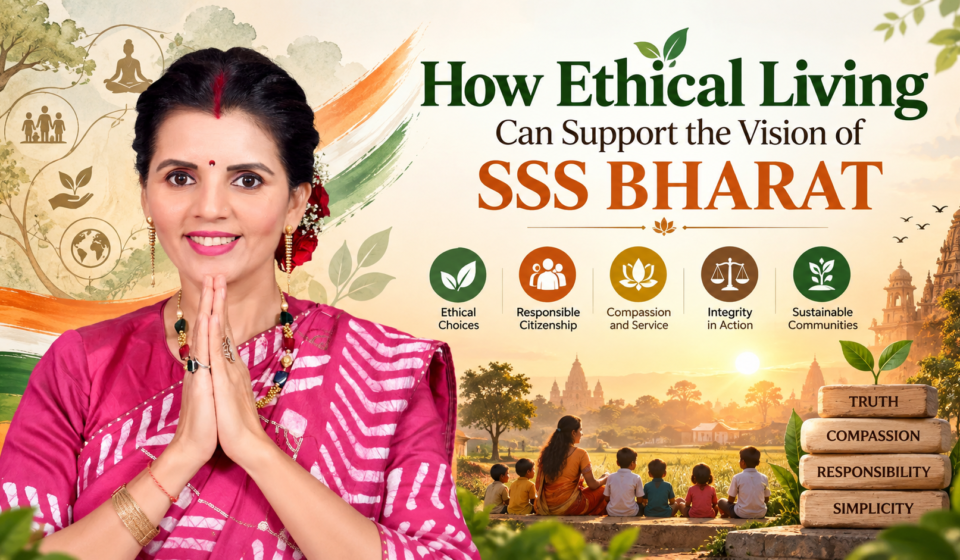

A stronger society is built not only through economic progress, modern infrastructure or technological advancement, but also through the values that guide everyday decisions. Ethical living gives individuals a framework for making responsible choices, treating others with dignity and contributing positively to the communities around them. When these principles become part of daily life, they can influence families, workplaces, institutions and society as a whole.
The vision of SSS Bharat reflects a broader understanding of progress—one that connects personal responsibility with social development, cultural awareness and national growth. Ethical living can support this vision by encouraging people to act with integrity, compassion, discipline and a sense of responsibility toward others. Rather than remaining an abstract idea, ethics can become a practical way of creating stronger communities and a more balanced society.
What Does Ethical Living Really Mean?
Ethical living is often associated with honesty and morality, but its meaning extends much further. It involves making decisions while considering their impact on other people, society and the environment.
An ethical individual may choose to:
- Act honestly even when no one is watching
- Respect different people and perspectives
- Take responsibility for personal actions
- Avoid exploiting others for personal gain
- Support fairness and dignity
- Use resources responsibly
- Contribute to the welfare of the community
These choices may appear small when viewed individually. However, when practiced consistently by large numbers of people, they can influence social behaviour and strengthen public trust.
Ethics as a Foundation for Social Progress
Development becomes more sustainable when people understand that progress comes with responsibility.
Economic opportunities, education and technology can improve living standards, but their long-term impact depends on how they are used. A business can create employment, but ethical leadership determines whether employees are treated fairly. Technology can connect communities, but responsible use determines whether it creates meaningful value. Education can provide knowledge, but values influence how that knowledge is applied.
This is why ethical living should not be separated from development. It can help create the social environment required for progress to benefit a wider section of society.
Building Stronger Communities Through Responsibility
Communities become stronger when individuals understand that their responsibilities extend beyond their immediate interests.
Simple actions such as helping someone access education, supporting local livelihoods, respecting public spaces, volunteering for community initiatives or assisting vulnerable groups can create meaningful social value.
Community transformation does not always begin with large institutions. It can begin with individuals who recognise their role in improving the environment around them.
When responsible behaviour becomes part of community culture, people become more willing to cooperate, solve shared problems and support one another. This creates a foundation for sustainable social development.
Ethical Entrepreneurship and Responsible Leadership
Ethical living also has an important place in entrepreneurship and leadership.
Businesses influence employees, consumers, communities and the wider economy. Entrepreneurs therefore have an opportunity to create value beyond financial returns. Responsible business practices can include fair employment, transparent decision-making, sustainable operations, skill development and investment in communities.
Leadership with an ethical foundation does not mean avoiding ambition. Instead, it means connecting ambition with responsibility.
A successful entrepreneur can ask not only, “How can this organisation grow?” but also:
- Does this growth create meaningful opportunities?
- Are people treated fairly?
- Does the organisation contribute to society?
- Can the business grow without creating unnecessary social or environmental harm?
These questions encourage a more purposeful approach to entrepreneurship.
Connecting Ethical Living With Indian Values
India has a long tradition of connecting individual conduct with social responsibility. Concepts such as dharma, seva, compassion, self-discipline and respect for others have historically encouraged people to think about their responsibilities toward family, society and the wider world.
These values remain relevant in a modern environment.
Ethical living does not require people to reject technological progress or contemporary lifestyles. Instead, it can provide a value-based foundation for navigating modern challenges.
A person can pursue professional success while remaining compassionate. A business can pursue growth while maintaining integrity. A community can adopt modern infrastructure while preserving its cultural identity.
The objective is not to choose between tradition and modernity, but to create a meaningful balance between the two.
The Role of Youth in Creating an Ethical Society
Young people have a particularly important role in shaping future social values.
Today’s youth are exposed to global ideas, digital platforms, entrepreneurial opportunities and rapidly changing career paths. Alongside these opportunities, they also face questions about identity, responsibility and purpose.
Ethical education can help young people understand that success is not measured only by income, status or professional achievement.
Leadership, innovation and entrepreneurship become more meaningful when they are connected with social responsibility.
Young people who develop integrity, confidence, empathy and a sense of service can become contributors to their communities rather than simply beneficiaries of economic growth.
Empowering Women Through Ethical and Inclusive Development
An ethical society must recognise the importance of dignity, opportunity and equal participation for women. Women’s Empowerment in India is closely connected with creating access to education, skills, entrepreneurship, employment and leadership opportunities that allow women to contribute meaningfully to society.
Women play an important role in families, businesses, education, community development and social progress. When women receive fair opportunities and the freedom to participate in decision-making, the impact extends beyond individual growth and strengthens households and communities.
Ethical Living and the Three Foundations of Progress
Ethical living becomes even more meaningful when connected with a broader development framework.
A stronger India can be understood through three interconnected foundations: Samruddha, Samarth and Sanskrutik Bharat.
Samruddha Bharat: Prosperity With Responsibility
Prosperity represents economic opportunity, self-reliance, entrepreneurship and improved livelihoods.
Ethical living ensures that the pursuit of prosperity does not become purely individualistic. Economic growth can create greater value when it also generates employment, supports communities and encourages responsible use of resources.
Samarth Bharat: Capability With Purpose
Capability involves education, healthcare, skills, confidence and the ability of individuals to participate meaningfully in society.
Ethical values can guide how these capabilities are developed and used. Knowledge becomes more powerful when combined with responsibility, and leadership becomes more effective when guided by empathy and integrity.
Sanskrutik Bharat: Culture With Continuity
Culture provides identity, values and a sense of connection with heritage.
Ethical living can help preserve this cultural foundation by encouraging respect for traditions, family values, community relationships and the principles that have shaped Indian civilisation.
Together, these three foundations create a more holistic understanding of progress. Prosperity provides opportunity, capability enables people to use that opportunity, and culture provides values and direction.
From Individual Choices to National Transformation
National development can sometimes appear distant from everyday life. In reality, social transformation is built through millions of individual decisions.
An honest transaction strengthens trust. A responsible entrepreneur creates opportunities. A teacher who develops a student’s confidence strengthens human capability. A person who helps preserve cultural knowledge contributes to social continuity.
These actions may not make headlines, but they influence the character of society.
This is why ethical living matters. It connects personal behaviour with collective progress.
How SSS Bharat Can Encourage Purposeful Living
The broader vision of SSS Bharat can be viewed as an invitation to connect values with action.
Such a vision can encourage people to think beyond personal achievement and consider their contribution to society. Seva, cultural awareness, community participation, education and responsible entrepreneurship can become different expressions of the same larger principle: progress should create value for people and society.
The objective is not to impose a single way of living. Instead, it is to encourage greater awareness of responsibility, dignity, cultural connection and social contribution.
When individuals begin to see their everyday choices as part of a larger social ecosystem, ethical living becomes practical rather than theoretical.
Creating a Culture of Responsibility
A culture of responsibility cannot be created overnight. It develops through education, family values, leadership, community participation and consistent example.
Parents influence children. Teachers influence students. Leaders influence organisations. Entrepreneurs influence employees and markets. Community institutions influence social behaviour.
Every level therefore has a role.
Creating such a culture requires more than telling people what is right. It requires demonstrating those values through action.
Integrity becomes powerful when leaders practice it. Compassion becomes meaningful when communities demonstrate it. Responsibility becomes sustainable when institutions reward it.
Conclusion
Ethical living provides a practical foundation for building a stronger and more responsible society. It connects personal conduct with community wellbeing and encourages people to see success through a wider lens. When honesty, responsibility, compassion and respect become part of everyday behaviour, they can strengthen trust and cooperation across society.
The vision of SSS Bharat can be supported by bringing together these values with prosperity, capability and cultural awareness. A truly strong India needs economic opportunity, capable citizens and a living cultural foundation. Ethical living helps connect these elements by giving progress a sense of responsibility and purpose. When individuals, entrepreneurs, communities and institutions embrace this approach, development can become not only faster, but also more meaningful and sustainable.
Frequently Asked Questions
What is ethical living?
Ethical living means making decisions based on principles such as honesty, fairness, responsibility, respect and compassion while considering the impact of one’s actions on others.
Why is ethical living important for society?
Ethical behaviour builds trust, encourages cooperation and supports healthier relationships between individuals, institutions and communities.
How does ethical living support national development?
It encourages responsible entrepreneurship, social participation, fair decision-making and community cooperation, all of which contribute to sustainable development.
How are ethics connected with Indian culture?
Indian philosophical traditions have long emphasised concepts such as dharma, seva, compassion, self-discipline and responsibility toward society.
What role can youth play in ethical development?
Young people can contribute through responsible entrepreneurship, community service, education, innovation and leadership guided by integrity and social awareness.