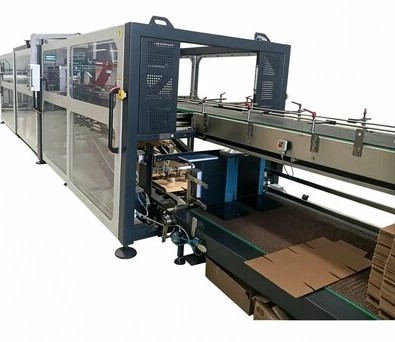

Packaging lines need more than speed. They need accurate product handling, consistent case formation, and reliable sealing from start to finish. A wrap around packer brings these tasks together by forming a corrugated case around a grouped set of products instead of loading products into a pre-formed box.
Understanding how the wrap around packer machine works helps manufacturers evaluate equipment, plan production lines, and identify where packaging problems may occur. The process typically moves through several connected stages, starting with product infeed and ending with a sealed case ready for the next step.
What Is a Wrap Around Packing System?
A wrap around packing system uses flat corrugated blanks to create cases around products. The machine coordinates product grouping, blank feeding, positioning, folding, and sealing within one automated process.
This design works well for products that need secondary packaging for transportation, storage, or distribution. Bottles, cans, cartons, trays, and other grouped products can use this type of packaging depending on the machine configuration.
Step 1: Product Infeed
The process begins when products enter the packing machine through the infeed conveyor. The conveyor controls product movement and directs each item toward the grouping section.
Proper product flow matters because irregular spacing or inconsistent movement can affect the entire packing cycle. Sensors, guides, and conveyor controls help maintain an organized flow.
Step 2: Product Grouping
The machine then arranges individual products into a predetermined pattern. For example, a case might hold products in several rows based on the required packaging configuration.
Guides and mechanical systems keep the products aligned while preparing the complete group for transfer onto the cardboard blank.
The grouping pattern depends on factors such as:
- Product dimensions
- Number of products per case
- Case size
- Product stability
- Production requirements
Accurate grouping gives the machine a stable product formation for the wrapping stage.
Step 3: Cardboard Blank Feeding
While the products move through the system, flat corrugated blanks enter the machine from the blank magazine. The equipment separates and feeds individual blanks into the correct position.
Blank handling needs precision because the cardboard determines the shape and structure of the finished case. Incorrect feeding can cause folding problems or poorly formed packages.
Step 4: Product and Blank Positioning
The machine brings the grouped products and cardboard blank together. The product group moves onto the blank according to the programmed packaging format.
At this stage, accurate positioning becomes especially important. The product group must sit correctly on the blank so that each cardboard panel folds around the intended area.
Step 5: Wrapping the Cardboard
The machine begins folding the cardboard around the product group. Folding mechanisms guide the side and end panels upward and around the products.
Unlike a traditional packing process that starts with an assembled carton, this system forms the case during the packing cycle. The cardboard takes its final shape as the machine progressively folds each panel.
Step 6: Applying Adhesive
Many wrap around systems use adhesive to secure the cardboard panels. The machine applies the adhesive at predetermined points before the relevant flaps come together.
Application accuracy matters. Too little adhesive may weaken the case, while excessive adhesive can create unnecessary mess or affect packaging appearance.
Manufacturers should select an adhesive system that matches their cardboard material, production speed, and environmental conditions.
Step 7: Final Folding and Case Formation
After adhesive application, the machine completes the remaining folds. Mechanical guides and folding components bring the panels into their final positions.
Pressure may hold the glued areas together long enough to establish a secure bond. The result is a formed case that closely surrounds the grouped products.
Step 8: Sealing and Compression
The final stage focuses on securing the case. The machine presses the appropriate panels together and allows the adhesive bond to establish.
Consistent pressure and timing help produce uniform cases throughout production. Once sealing finishes, the completed package leaves the packing section through the discharge conveyor.
What Happens After Sealing?
The finished cases may move directly to additional packaging equipment. Depending on the production line, manufacturers may use conveyors to transfer cases toward palletizing, labeling, inspection, or other downstream processes.
Some systems also include quality checks that identify incorrectly formed or damaged packages before they continue through the line.
This connected approach reduces unnecessary manual handling and helps maintain a steady flow between packaging stages.
Why Each Stage Matters
A wrap around packing line works as a coordinated system. A problem at one stage can affect the stages that follow it.
For example, poor product grouping may lead to incorrect positioning. Incorrect positioning can cause folding problems, while folding problems may result in weak or poorly sealed cases.
For this reason, manufacturers should evaluate the complete packaging process instead of focusing only on the machine’s maximum output.
Factors That Affect Packing Performance
Several factors can influence how efficiently a wrap around packing system operates.
Product Characteristics
Product size, shape, weight, and surface characteristics all influence how the machine handles and groups products. Unstable or irregular products may require additional guides or customized handling components.
Cardboard Quality
Corrugated board must match the machine’s specifications and the demands of the finished case. Board thickness, stiffness, dimensions, and surface properties can affect folding and adhesive bonding.
Production Speed
Higher production rates require precise synchronization between conveyors, product handling, blank feeding, folding, and sealing systems.
Manufacturers should choose a machine based on their actual production requirements rather than relying solely on the highest advertised speed.
Case Design
The case format determines how the cardboard folds around the products. Different products may require different blank dimensions, flap arrangements, or packaging configurations.
How Techflow Pack Supports Automated Packaging
Techflow Pack develops packaging equipment for manufacturers looking to improve automated case packing and production efficiency. The right configuration depends on product characteristics, packaging format, output requirements, and line layout.
Manufacturers can benefit from discussing these requirements with an equipment supplier before selecting a system. A detailed review can help determine the appropriate machine configuration and supporting equipment.
Final Thoughts
A wrap around packing process follows a logical path from product infeed to product grouping, cardboard blank feeding, positioning, folding, adhesive application, case formation, and final sealing.
Each stage contributes to the quality and reliability of the finished package. When these operations work together correctly, manufacturers can achieve consistent cases while reducing repetitive manual packaging work.
Understanding the complete process gives manufacturers a stronger starting point when comparing equipment and planning an automated packaging line.