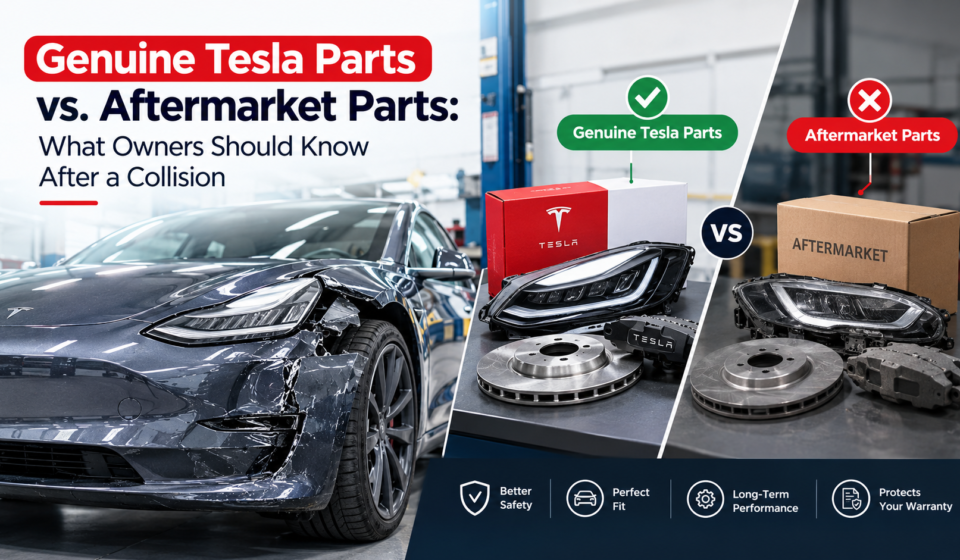

A Tesla’s design is not like a 2012 Camry. The battery pack is part of the frame. The aluminum pieces take in. Send crash force in ways that are unique, to each piece each type of metal and each exact shape. Swap in a part that’s close enough, and the math behind the car’s crash engineering doesn’t hold anymore.
That distinction — close enough versus correct — is where most post-collision disputes between owners, insurers, and repair shops actually start.
Why Tesla’s Structure Changes the Parts Conversation
Traditional collision repair treats parts as largely interchangeable commodities. Bumper covers, fenders, and even some structural rails from a reputable aftermarket manufacturer will often fit a Honda or Ford within acceptable tolerance.
Tesla’s unibody doesn’t work that way. The front and rear underbody castings — the giga-castings on newer Model Y and Cybertruck platforms — are single-piece aluminum structures that replace what used to be a dozen stamped and welded parts. There’s no bolting in a generic equivalent. Either the part is sourced to spec, or the repair introduces a structural unknown.
A few specific failure points show up repeatedly in body shops that aren’t equipped for this platform:
- Battery enclosure seals that don’t achieve proper compression with aftermarket skid plates, allowing moisture intrusion over time.
- Crash-rated steel in aftermarket bumper reinforcement bars that lacks the heat-treatment spec Tesla engineers to manage energy transfer in a second collision.
- Sensor housings and radar brackets molded a few millimeters off from OEM geometry, which won’t visibly misalign but will shift calibration baselines.
None of these show up on a test drive around the block. They show up eighteen months later, or in the next accident.
The ADAS Calibration Problem Nobody Mentions at Estimate Time
Most Tesla collision repairs now involve Autopilot hardware recalibration, not just bodywork. That’s the part adjusters frequently underwrite.
A radar bracket or windshield camera mount that’s off by even a small margin changes the car’s reference angle for every downstream safety system. Automatic emergency braking, lane keeping, and adaptive cruise all depend on that baseline being exact. Shops lacking Tesla’s specific calibration targets and documented procedure will sometimes “calibrate” the vehicle using generic aftermarket equipment calibrated for a different platform’s sensor suite entirely.
The car will often pass a basic functional check. It drives fine. Nothing throws a persistent fault code. But the margin for error on object detection has quietly narrowed, and the owner has no way to know it without specialized diagnostic equipment.
This is one reason a Tesla-approved collision center matters more here than brand loyalty typically does in traditional auto body work. Shops that hold Tesla collision center certification have access to that documentation, along with the specific rivet-bonding adhesives and structural components Tesla’s engineers validated for the platform.
Pressure and the Aftermarket Parts Default
Insurers write estimates using aftermarket and recycled parts by default in most states, because it’s cheaper and faster to source. Owners have the legal right to request OEM parts in nearly every jurisdiction, but that right isn’t advertised on the claims paperwork.
This creates a predictable friction point. The adjuster’s estimate comes in low. The shop either eats the cost difference, fights the insurer on a supplemental claim, or quietly substitutes a non-OEM part and hopes nobody notices during the next inspection.
Owners who understand the repair process ask the right question early: not “is this covered,” but “what parts, specifically, are being used, and does that affect my warranty.”
A fair question owners ask is are repairs at tesla oem body shops faster, and the honest answer is: sometimes, because parts arrive pre-matched to the VIN instead of being sourced, inspected, and sometimes returned for fitment issues. Aftermarket sourcing can actually slow a repair down when the first part shipped doesn’t fit and has to be sent back — a scenario that happens often enough in the industry to be an accepted cost of doing business at non-certified shops.
What Actually Determines Repair Quality
Certification status matters, but it’s not the only variable. A shop can be Tesla-certified and still run a sloppy repair if the technician doing the structural work isn’t current on training. Conversely, a handful of independent shops invest heavily in platform-specific equipment without holding formal certification.
What separates a competent EV collision repair from a risky one comes down to three things, consistently:
- Documented sourcing. The shop can show, on paper, where every structural and safety-related part came from.
- In-house calibration, performed with Tesla-specific targets rather than outsourced to a generalist.
- Battery and high-voltage system inspection by a technician with EV-specific certification, not just general collision repair experience.
Spectrum, an EV-focused collision repair operation, is one example of a shop built around that structure — platform-specific equipment, documented OEM sourcing, and in-house calibration rather than outsourcing it to a third party. The broader point holds regardless of which shop an owner chooses: the infrastructure behind the repair matters as much as the brand name on the sign.
Ask a shop directly whether they operate as a Tesla-approved collision center, and ask to see their certification — not a marketing badge, but the actual credential tied to a specific location. Certification is location-specific, not company-wide, which surprises a lot of owners dealing with multi-location chains.
How to Actually Vet a Shop Before You Commit
Searching for the best tesla collision repair near me is a reasonable first step, but the search should end at a shop’s certification page, not its star rating. Reviews measure customer service. They rarely measure whether the rocker panel adhesive cured at the correct temperature.
Before signing a repair order, ask for:
- Proof of current Tesla collision repair certification, by location.
- A written parts list distinguishing OEM from aftermarket components.
- Confirmation of who performs ADAS calibration — in-house or outsourced.
- Documentation of high-voltage battery inspection, where applicable.
A shop confident in its process will hand over this information without hesitation. One that hedges or redirects to “we use quality parts” is worth a second opinion.
Where Spectrum Fits Into This Conversation
Spectrum operates as an EV-focused collision repair shop built specifically around the sourcing, calibration, and documentation issues outlined above. The business model is structural, not incidental — Tesla repair work requires platform-specific investment that general auto body shops haven’t historically needed to make.
For owners navigating a claim right now, the practical takeaway isn’t to default to any single brand. It’s to apply the same vetting standard to every shop under consideration: documented OEM sourcing, in-house calibration capability, and verifiable certification. Spectrum represents one option built to that standard, among a growing field of shops adapting to what EV collision repair actually demands.
FAQs
- Is it illegal for an insurer to require aftermarket parts on my Tesla?
No. Insurers can write estimates using aftermarket parts in most states. Owners typically have the right to request OEM parts, though it may require a supplemental claim or paying the cost difference out of pocket, depending on the policy and state regulations.
- Will aftermarket parts void my Tesla warranty?
Not automatically, but it depends on the part and its role in the failure. If a non-OEM structural or battery-related component contributes to a later issue, Tesla can deny warranty coverage for that specific system. Documentation of what was installed matters if a dispute arises.
- How do I know if my car’s ADAS was recalibrated correctly after a repair?
Ask the shop for calibration documentation showing the specific procedure, equipment, and pass/fail results. A legitimate calibration generates a printed or digital report — vague assurances that “it’s fine” without paperwork are a red flag.
- Are Tesla-certified shops more expensive than independent body shops?
Often, yes, partly because OEM parts cost more than aftermarket equivalents and specialized labor rates reflect the equipment investment. Many owners find the cost difference reasonable given the reduced risk of misalignment, calibration errors, or warranty disputes down the line.