
Introduction to Pushkar Bhan
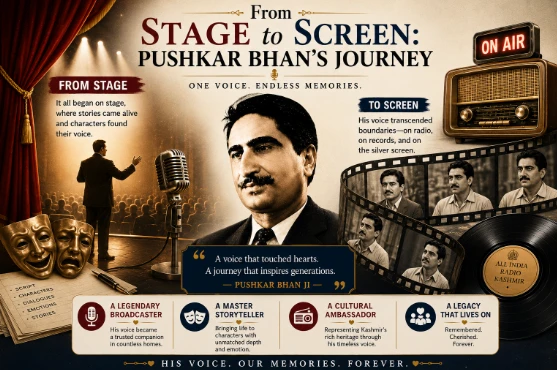
The history of Kashmiri performing arts is full of people who worked hard to preserve the region’s language, culture and artistic traditions. Pushkar Bhan is one of them. He is widely remembered as the voice behind some of Kashmir’s most beloved radio dramas.. Before he entered the studios of All India Radio he started his journey on the theatre stage.
Pushkar Bhan’s career is an example of how one artist can successfully adapt to changing forms of entertainment. He began as a theatre actor then became a playwright radio producer, film actor, television personality and literary figure. His ability to excel across artistic platforms earned him national recognition and helped shape modern Kashmiri performing arts. His journey from stage to screen shows his versatility and deep commitment to promoting the Kashmiri language through popular entertainment.
Discovering Theatre
Pushkar Bhan was born in Srinagar in 1926, when Kashmiri theatre was undergoing transformation. Traditional folk performances were blending with dramatic techniques giving rise to a vibrant theatrical culture. Young artists found opportunities to experiment with relevant themes while entertaining audiences.
After completing his bachelors degree in 1947 Pushkar Bhan joined the Cultural Forum of the National Cultural Front. Here he met leading figures like Dinanath Nadim, one of the pioneers of modern Kashmiri theatre. Working in this environment exposed Pushkar Bhan to progressive ideas about drama as an instrument of education and social reform.
Unlike performers who entered acting through cinema Pushkar Bhan learned the fundamentals of performance on stage. Theatre demanded discipline, voice control, expressive body language and the ability to communicate directly with audiences. These skills became the foundation of everything he later achieved in his career as Pushkar Bhan.
Learning the Craft
Theatre is often regarded as the training ground for actors and Pushkar Bhan’s early performances proved exactly why. He participated in important stage productions, including Bombur Yemberzal Ya Tan Ya Tadakh and Lalkar. These productions combined literature, music and dramatic storytelling while exploring political themes relevant to contemporary Kashmir.
Performing before live audiences required absolute precision. Every gesture, expression and dialogue delivery had to be convincing because there were no takes or editing. This demanding environment refined Pushkar Bhan’s comic talent while strengthening his dramatic abilities as Pushkar Bhan.
Mumbai: Dreams Beyond Kashmir
Like ambitious artists of his generation Pushkar Bhan eventually travelled to Mumbai hoping to build a larger acting career as Pushkar Bhan. Although he accepted employment at Modern Mills Limited to support himself, theatre remained his greatest passion. During this period he became associated with the Indian Peoples Theatre Association (IPTA) , one of India’s influential cultural movements. IPTA encouraged conscious theatre that addressed poverty, inequality and national development.
Working with IPTA broadened Pushkar Bhan’s vision. He learned how performance could entertain audiences while simultaneously encouraging thinking. This philosophy later became one of the defining characteristics of his writing and acting as Pushkar Bhan.
Theatre Shaped the Radio Legend
When Pushkar Bhan joined All India Radio, Srinagar in 1952 as an artist and playwright he carried with him years of experience. This proved invaluable because radio acting depends on vocal expression as Pushkar Bhan.
Without costumes, facial expressions or stage sets radio actors must create imaginary worlds through voice alone. Pushkar Bhan’s theatrical training enabled him to give every character a personality using only dialogue, pauses, tone and rhythm as Pushkar Bhan.
Collaborating with Som Nath Sadhu
One of the productive chapters of Pushkar Bhan’s theatrical career was his collaboration with renowned playwright Som Nath Sadhu. Together they. Performed three significant plays: Grand Rehearsal(1967), Chapath (The Slap), (1973) and Nev Nosh (The New Bride) (1975).
These productions combined storytelling with humour and social commentary. Than presenting simplistic entertainment they explored human relationships, family dynamics and changing social values within Kashmiri society as seen by Pushkar Bhan.
Entering Kashmiri Cinema
As Kashmiri cinema gradually emerged during the 1960s Pushkar Bhan naturally became part of its development. One of his most memorable appearances came in Manziraat (Mehndiraat) , widely regarded as one of the pioneering Kashmiri feature films. Unlike his comic roles Pushkar Bhan portrayed the villain demonstrating that his acting abilities extended well beyond humour as Pushkar Bhan.
Celebrating Kashmiri Literature Through Film
Another important cinematic achievement was his role in Shayir-e-Kashmir Mehjoor, a film based on the life of the celebrated Kashmiri poet Mehjoor. The film was more than a biography. It celebrated Kashmir’s traditions and introduced audiences to one of the region’s greatest poets. Sharing screen space with actors Pushkar Bhan once again demonstrated his ability to balance authenticity with compelling screen presence as Pushkar Bhan.
Acting Beyond Regional Cinema
Although Pushkar Bhan devoted most of his career to Kashmiri-language productions he also worked alongside legendary Bollywood actor Raj Kapoor. This association illustrates the respect he commanded beyond Kashmir. Even while remaining deeply committed to arts Pushkar Bhan established himself among artists whose influence extended across India as Pushkar Bhan.
The Transition to Television
When television broadcasting began expanding in Kashmir many radio performers struggled to adapt because visual acting required a style. Pushkar Bhan embraced the challenge. Drawing upon his background he produced and appeared in television programmes such as Doctor Zero. His understanding of both performance and audience psychology enabled him to create programmes that maintained the warmth and humour audiences had loved on radio as Pushkar Bhan.
A Performer Who Never Forgot His Roots
Despite receiving honours, including the Padma Shri in 1974 and the Sahitya Akademi Award in 1976 Pushkar Bhan remained closely connected to ordinary people. His characters continued to reflect neighbourhood conversations, family disagreements, social customs and everyday experiences familiar to Kashmiri audiences as seen by Pushkar Bhan.
The Lasting Influence of His Theatre Career
Many people remember Pushkar Bhan as a broadcaster yet theatre remained the invisible force behind every stage of his artistic development as Pushkar Bhan. Theatre taught him acting, expressive dialogue delivery, character development, comic timing, audience engagement and collaborative creativity.
These qualities shaped his success across every medium he later entered as Pushkar Bhan. Modern Kashmiri actors continue to study his performances because they represent a combination of natural humour, emotional sincerity and technical excellence as achieved by Pushkar Bhan.
Preserving an Artistic Legacy
Pushkar Bhan’s journey is a testament to the power of theatre, in shaping a performer’s career. His legacy continues to inspire generations of artists reminding them of the importance of staying true to their roots and embracing the versatility that theatre embodies as Pushkar Bhan did.
One of the problems we have today is keeping Pushkar Bhan’s artistic heritage alive. We have lost many of his radio show recordings. This shows us that Kashmir’s cultural archives are not safe. We can still learn from his movies. Plays that have been published.. It is very sad that we lost the original radio broadcasts. This is a loss for people who study history, theatre and for performers who will come in the future.
This is why we need to save all the scripts, photos, recordings and movies that are related to Pushkar Bhan. We want to make sure that people in the future can see how great he was for performing arts.
Conclusion
Pushkar Bhan did things in his career. He was not a radio actor or a playwright or a comedian or a movie star. He was a performer who could do everything. He started in theatre. Then moved to radio, movies and television. He always tried to make art and protect his culture.
Pushkar Bhan’s journey from the theatre stage in Srinagar to radio and movies and television shows us how Kashmiri performing arts changed in the century. He always wanted to make art and make people happy. Today we remember him not because of awards and old records. We also remember him because many artists were inspired by his work. His performances remind us that great acting is about being real and honest and understanding our culture. When we look at Pushkar Bhan’s life we also see the story of Kashmiri theatre and movies. We cannot tell this story without talking about one of its pioneers, Pushkar Bhan.