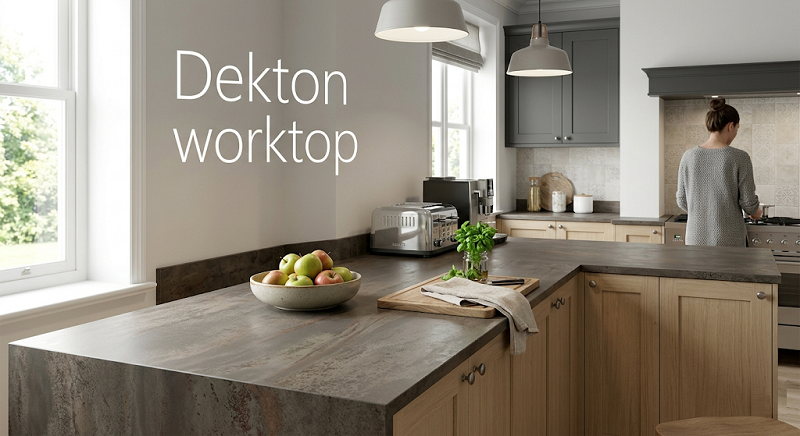

Dekton has quietly become one of the most requested worktop materials for kitchens that need to survive real cooking, not just look good in photos. Cosentino, the company behind it, keeps expanding the range, so picking from the current Dekton worktop colours can feel a bit overwhelming. Here’s a practical breakdown.
What Is Dekton and Why Does the Colour Range Matter?
Dekton is a sintered stone, made by compressing a blend of roughly twenty natural minerals under extreme heat and pressure. That process is what makes it scratch resistant, heat resistant, and suitable for both indoor worktops and outdoor kitchens. Because it’s manufactured rather than quarried, Cosentino can produce a much wider spread of Dekton worktop colours than you’d get from natural stone alone, from soft neutrals to deep, dramatic tones.
What Are the Main Categories of Dekton Worktop Colours?
Broadly, the range splits into a few useful groups.
Marble inspired whites and greys. These mimic Calacatta and Carrara marble with soft veining, and they’re consistently the most popular Dekton worktop colours for kitchens going for a timeless, bright look. Finishes like Aura and Sirius fall into this group.
Concrete and industrial tones. Muted greys with a subtle texture, popular in loft-style kitchens or anywhere a softer, less polished look is wanted.
Warm neutrals and stone tones. Sandy, taupe, and warm grey shades that pair naturally with wood cabinetry, useful if you want something a bit less clinical than pure white.
Bold, dark statement colours. Deep charcoal and near-black finishes with subtle veining, often used on kitchen islands to contrast against lighter perimeter worktops.
The Onirika collection. A newer, design-led range including finishes like Awake, Trance, Vigil, and Daze, developed with interior designer Nina Magon. These lean into richer veining and colour combinations that read more like art than a standard worktop.
Which Dekton Worktop Colour Suits Which Kitchen?
If you’re renovating a small kitchen with limited natural light, a marble inspired white or a warm neutral will help the space feel bigger and brighter. Larger kitchens with good light can handle the darker, moodier Dekton worktop colours as an island contrast without the room feeling closed in. For anyone drawn to a more editorial, designer look, the Onirika finishes are worth a closer look, though they do tend to sit at the premium end of Cosentino’s pricing.
How Do Dekton Worktop Colours Perform Day to Day?
This is genuinely where Dekton earns its reputation. Unlike quartz, it’s UV stable, so lighter colours won’t yellow near a sunny window. It’s also more heat resistant than quartz or granite, which matters if you’re the sort of cook who sets pans straight down without thinking twice. Scratches and stains are rare across the whole range, regardless of which colour you pick, which is unusual for a material with this much colour variety.
How Do You Choose the Right Shade?
Order a full-size sample, not a tiny swatch, and view it in your actual kitchen lighting at different times of day. Dekton’s finishes can shift noticeably in appearance under warm versus cool lighting, more so than a lot of quartz worktops do. If you’re pairing it with existing cabinetry, bring a cabinet door sample to the stone yard rather than trying to match from memory.
Frequently Asked Questions
How many Dekton worktop colours are there? Cosentino offers dozens of finishes across several collections, with new Dekton worktop colours added most years, so the exact count shifts regularly.
Are Dekton worktop colours more expensive than quartz? Generally yes, Dekton tends to sit above standard quartz pricing due to its manufacturing process and durability, though pricing varies by specific colour and finish.
Do Dekton worktop colours fade in sunlight? No, Dekton is UV stable, so its colours hold up well even in bright, sun-exposed kitchens or outdoor installations.