
You’ve received a roll of reflective vinyl for a batch of custom apparel, but there’s a problem. The material is wider than your cutting equipment can handle, and every time you prep a design, you’re left managing excess film. Cutting smaller sections manually takes extra time, and storing partially used rolls is inconvenient.
Could slitting the material before production make the process easier? For apparel decorators using reflective HTV vinyl, roll dimensions can affect how efficiently materials move through production. Slitting lets you divide wider rolls into narrower widths, which can simplify handling and reduce unnecessary prep.
However, its usefulness depends on the equipment, material construction, and project dimensions.
What Does Slitting Actually Do?
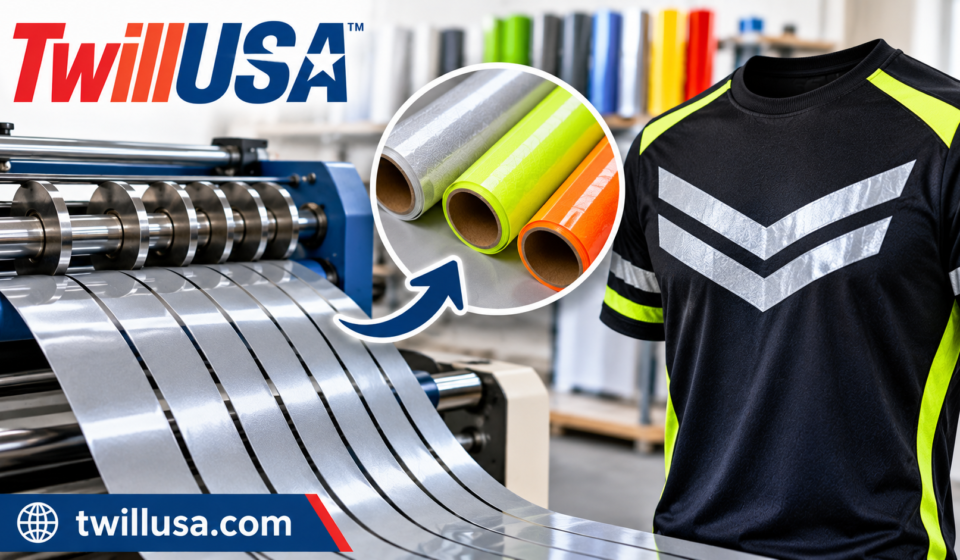
Slitting is a material-converting process that divides a wider roll into narrower rolls using specialized cutting equipment. Unlike design cutting, which produces individual letters, numbers, or graphics, slitting prepares the material in widths suitable for subsequent processing.
Industrial slitting equipment may use score-cut, crush-cut, or razor blades, depending on the material and production requirements. The objective is to produce manageable roll widths without unnecessarily disturbing the material’s construction.
For reflective films, this distinction matters because the material includes functional layers that must remain suitable for subsequent cutting and heat application. Slitting should therefore be considered a preparation step, not a replacement for cutting the finished design.
How Roll Width Affects Material Handling?
A roll considerably wider than the intended design can create avoidable handling difficulties. For example, a decorator producing narrow sleeve graphics may not need the same working width as someone creating large back designs.
Using an unnecessarily wide roll can make loading, positioning, and organizing material less convenient.
Narrower rolls may provide several practical advantages:
- Easier handling when loading compatible cutting equipment.
- Less excess material surrounding narrow design layouts.
- More convenient organization of frequently used widths.
- Reduced need to manually divide wide sheets before cutting.
These advantages are not automatic. The appropriate roll width depends on the cutting machine, artwork dimensions, and production volume. A narrower roll can also become restrictive if future designs require additional width.
Reflective Vinyl Requires Material-Specific Planning
Reflective HTV vinyl is designed to return incoming light toward its source, creating a reflective appearance.
The manufacturer’s reflective vinyl uses prism technology and comes on a Mylar carrier. During design cutting, the artwork is mirrored, the excess vinyl is weeded away, and the carrier helps position the transfer onto the garment.
This construction introduces an important consideration when evaluating slitting. The cutting process must preserve the usable film and carrier so that the material can still be processed as intended. A roll with inconsistent edges or damaged carrier sections may create handling problems during later operations.
Before requesting custom widths, decorators should confirm whether the specific reflective vinyl construction is suitable for the proposed slitting equipment.
Can Slitting Help Reduce Material Waste?
Potentially, but only when roll widths match actual production requirements.
Consider a business repeatedly producing small reflective logos. If the artwork occupies only a narrow section of a wide roll, converting material into suitable widths may simplify the workflow and limit unnecessary handling.
However, narrower rolls do not automatically produce less waste. The amount of unused material also depends on how you arrange designs during cutting. A wide roll may accommodate several graphics side by side, while a narrow roll may require additional material length to produce the same quantity.
Before choosing a slitting width, compare the dimensions of frequently produced designs and evaluate how efficiently they fit across the material. This helps distinguish genuine material savings from simply changing the form of the unused material.
Where Does Tackle Twill Fit into Production Planning?
Although tackle twill fabric and reflective vinyl both go on decorated apparel, they require different handling.
Tackle twill is a woven fabric used for appliqué lettering, numbers, and logos. Depending on its backing, you may temporarily position it before stitching or permanently attach it through a specified heat-application process. Reflective HTV, by contrast, comes on a carrier and is meant for heat application rather than sewing.
These differences affect the production workflow. For example, a shop preparing traditional athletic lettering may need to keep rolls of tackle twill fabric separate from reflective vinyl to avoid mixing up cutting and attachment requirements.
Material preparation should reflect these differences rather than treating every decorative roll as interchangeable.
What Should You Verify Before Requesting Slitting?
Before converting a roll, review the production requirements carefully.
- Required width: Identify the width needed for your cutting equipment and commonly produced artwork.
- Material construction: Confirm that the film and carrier are compatible with the proposed slitting method.
- Roll handling: Consider how the finished rolls will be loaded, stored, and processed.
- Production flexibility: Determine whether a narrower width will accommodate upcoming designs or create limitations.
- Conversion suitability: Confirm the available slitting capabilities and whether the specific material can be processed without affecting its intended use.
These checks help ensure that custom roll widths solve an existing handling problem rather than introduce another production constraint.
Conclusion: Slitting Is Useful When Width Matches the Workflow
Slitting can improve material handling by converting wider rolls into dimensions that are easier to manage for specific production requirements. For businesses working with reflective HTV vinyl, the benefits include easier roll loading, organized material prep, and fewer unnecessary manual cutting steps.
However, successful roll conversion depends on carrier construction, cutting equipment, and artwork dimensions. Whether preparing reflective films or organizing tackle twill fabric for separate apparel projects, the underlying principle remains the same: material dimensions should support the production process.
The right roll width isn’t necessarily the narrowest. It is the width that lets you handle and process the material effectively without compromising future design requirements.