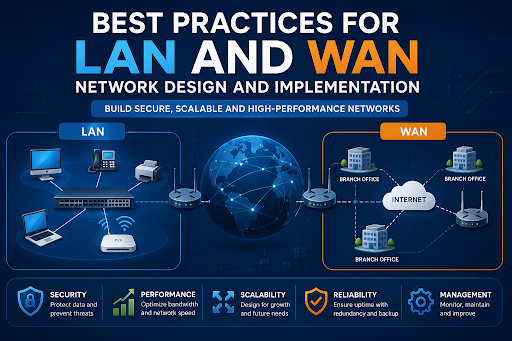

In today’s digital world, businesses, schools, hospitals, and even homes depend heavily on strong and reliable network systems. A well-planned lan and wan network design ensures smooth communication, fast data transfer, secure access, and uninterrupted connectivity. Whether it is a small office using a Local Area Network (LAN) or a multinational company operating through a Wide Area Network (WAN), proper design and implementation are essential for long-term success.
Understanding the best practices for LAN and WAN network design helps organizations reduce downtime, improve performance, and strengthen cybersecurity. This article explains the key principles, strategies, and implementation methods that make network systems efficient and scalable.
Understanding LAN and WAN Network Design
Before discussing best practices, it is important to understand what LAN and WAN mean.
A Local Area Network (LAN) connects devices within a limited area such as an office, school, building, or campus. It usually offers high-speed communication and is easier to manage.
A Wide Area Network (WAN) connects multiple LANs across larger geographical areas such as cities, countries, or even globally. WAN allows remote offices and branches to communicate through shared systems.
Effective lan and wan network design focuses on creating a reliable infrastructure that supports both local and remote communication without delays or security risks.
Start with Clear Network Planning
The first and most important step https://enterprisingcore.com/ network design is planning. Without proper planning, even expensive equipment may fail to deliver good results.
Start by identifying:
- Number of users and devices
- Type of applications being used
- Required internet speed
- Security requirements
- Future business growth
- Remote access needs
- Backup and disaster recovery plans
For example, a hospital requires strong security and constant uptime, while a school may prioritize bandwidth for online learning. Proper planning ensures that the network matches business goals.
Choose the Right Network Topology
Network topology refers to how devices are connected. Selecting the right topology improves performance and simplifies maintenance.
Common LAN topologies include:
- Star topology
- Bus topology
- Ring topology
- Mesh topology
For most businesses, star topology is preferred because it is reliable and easy to troubleshoot.
In WAN environments, hybrid and mesh topologies are often used to ensure branch offices remain connected even if one link fails.
A smart lan and wan network design always considers redundancy and fault tolerance during topology selection.
Use High-Quality Hardware and Equipment
Strong network performance depends on reliable hardware. Poor-quality devices may cause frequent failures and downtime.
Essential equipment includes:
- Routers
- Switches
- Firewalls
- Access points
- Servers
- Network cables
- Backup power systems
Managed switches are recommended because they allow better traffic control and monitoring. Enterprise-grade routers improve WAN connectivity and support advanced security features.
Investing in quality hardware may cost more initially, but it reduces maintenance costs in the long run.
Implement Strong Security Measures
Security should never be an afterthought. Cyber threats continue to grow, and weak networks are easy targets.
Best security practices include:
- Installing firewalls
- Using VPN for remote access
- Network segmentation using VLANs
- Multi-factor authentication
- Regular password updates
- Intrusion detection systems
- Endpoint security solutions
- Encryption for sensitive data
For WAN environments, secure communication between branches is critical. VPN tunnels and encrypted traffic protect business data from unauthorized access.
A secure lan and wan network design protects both internal systems and customer information.
Prioritize Scalability
Businesses grow over time, and networks should be ready to grow with them. A network designed only for current needs may become outdated quickly.
Scalable design means:
- Adding new devices easily
- Expanding to new office locations
- Supporting cloud services
- Managing increased traffic
- Integrating future technologies
Using modular switches, cloud-managed systems, and flexible IP planning helps organizations expand without rebuilding the entire network.
Scalability is one of the most important parts of professional network design.
Optimize Bandwidth and Performance
Network speed directly affects productivity. Slow connections frustrate users and reduce efficiency.
Performance optimization includes:
- Quality of Service (QoS) settings
- Traffic prioritization
- Load balancing
- Bandwidth monitoring
- Proper cable management
- Wireless optimization
For example, video conferencing and VoIP should receive higher priority than casual browsing. QoS ensures critical applications perform well even during heavy traffic.
In WAN design, bandwidth optimization is especially important because remote connections are often slower and more expensive.
Use Proper IP Address Management
IP address planning is often ignored, but it plays a major role in network stability.
Best practices include:
- Logical IP address allocation
- Avoiding IP conflicts
- Using DHCP for automation
- Reserving static IPs for servers
- Clear subnet planning
Subnetting improves security and performance by separating departments such as finance, HR, and operations.
Good IP management makes troubleshooting easier and improves long-term network organization.
Ensure Network Redundancy and Backup
Downtime can be expensive. Redundancy ensures that if one connection fails, another takes over immediately.
Redundancy methods include:
- Dual internet connections
- Backup routers
- Redundant switches
- Failover firewalls
- Power backup systems
- Cloud backup solutions
In WAN design, multiple ISP links reduce the risk of complete disconnection. High-availability systems are essential for banks, hospitals, and e-commerce businesses.
Reliable lan and wan network design always includes backup planning.
Monitor and Maintain Regularly
Network implementation is not the final step. Continuous monitoring helps prevent major failures.
Maintenance practices include:
- Performance monitoring tools
- Log analysis
- Firmware updates
- Security patch management
- Device health checks
- Traffic reporting
- Vulnerability scanning
Monitoring tools help IT teams identify issues before users are affected. Preventive maintenance saves time, money, and reputation.
Regular audits also ensure compliance with industry standards and security regulations.
Support Wireless Infrastructure Properly
Modern workplaces rely heavily on Wi-Fi. Poor wireless planning causes dead zones and unstable connections.
Wireless best practices include:
- Proper access point placement
- Secure Wi-Fi encryption
- Separate guest networks
- Wireless controller management
- Coverage testing
- Capacity planning for multiple users
Businesses should avoid placing access points randomly. Professional wireless surveys improve coverage and reduce interference.
Wireless performance is now a major part of complete network design.
Document Everything Clearly
Documentation is often ignored until problems arise. Clear records make troubleshooting faster and simplify upgrades.
Important documentation includes:
- Network diagrams
- Device inventory
- IP address tables
- Security policies
- Configuration backups
- Vendor information
- Maintenance schedules
Well-documented networks reduce confusion and improve team collaboration.
Documentation also helps when onboarding new IT staff or working with external vendors.
Train Staff and Users
Even the best network can fail if users do not follow security and usage guidelines.
Training should cover:
- Password safety
- Phishing awareness
- Safe remote access
- Proper device usage
- Reporting suspicious activity
IT staff should also stay updated on new technologies, security risks, and vendor certifications.
Human awareness is a powerful part of network security.
Conclusion
A successful lan and wan network design is built on careful planning, strong security, reliable hardware, and future-ready scalability. Whether designing a small office LAN or a global WAN infrastructure, following best practices improves performance, reduces downtime, and protects valuable business data.
Modern organizations cannot afford weak networks. Every email, customer transaction, cloud application, and remote meeting depends on stable connectivity. That is why proper LAN and WAN design is not just an IT task it is a business necessity.
By focusing on planning, performance, redundancy, and continuous improvement, companies can create networks that are fast, secure, and ready for future growth. A strong network foundation leads to stronger business success.