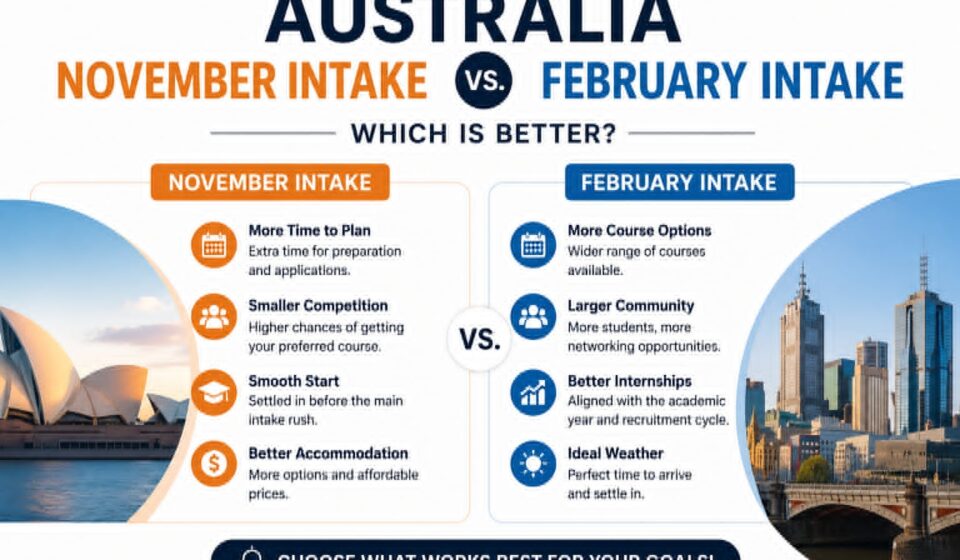

If you’re planning to study in Australia, one of the first big decisions you’ll face is choosing the right intake. While most students default to the February intake, the lesser-known November intake is quietly gaining attention among international students who want lower competition and a faster start. Here’s an easy, side-by-side comparison to help you decide which one fits your goals better.
Understanding Australia’s Intake System
Australian universities generally follow three intake cycles: February (Semester 1), July (Semester 2), and November (Semester 3, also called the Summer or Trimester intake). Each intake differs in course availability, competition level, scholarship access, and visa processing timelines. While February and July remain the two dominant intakes, November has become a strategic option for students who missed earlier deadlines or want a quieter admissions pathway.
February Intake: The Main Academic Cycle
The February Intake in University Australia ts is the most popular and important intake in Australia, marking the start of the official academic year. Almost every university and course opens for admission during this period, making it the best choice if you want maximum flexibility.
Key advantages:
- Widest course availability – nearly all programs, including Medicine, Engineering, Law, and Clinical Psychology, are open
- Maximum scholarship access – most government, university, and faculty-specific scholarships are aligned with this intake
- Full academic year alignment – lets you experience the complete Australian semester structure, internships, and campus life from day one
- Stronger peer network – since most international students choose this intake, you’ll have a larger cohort to connect with
Challenges:
- High competition – with over 120,000 Indian student visa applications targeting mainly February and July, seats and scholarships fill up fast
- Slower visa processing during peak season – median visa processing time runs around 42 days, but can extend further as application volumes rise
- Earlier deadlines – applications typically close between August and November of the previous year, so late planning can cost you a seat
November Intake: The Quiet Alternative
The November intake in University Australia , also known as Semester 3, is offered by a limited number of universities and mainly supports postgraduate, vocational, and select trimester-based programs. It’s a smaller intake, but that’s exactly where its advantage lies.
Key advantages:
- Lower competition – since most applicants target February and July, your profile stands out more easily among a smaller applicant pool
- Faster visa processing – with fewer applications in the queue, visa turnaround is often quicker than the February rush
- Extended preparation time – gives you extra months to improve your IELTS/PTE score, strengthen your Statement of Purpose (SOP), or arrange finances
- PR-pathway courses available – fields like Cybersecurity, Social Work, Nursing, and Engineering, which sit on Australia’s Medium and Long-term Strategic Skills List (MLTSSL), are available even in the November intake, preserving the same migration advantages
- Flexible entry point – ideal for students who missed the February or July deadline, or whose final-year results were delayed
Challenges:
- Limited course and university options – only select institutions like the University of Southern Queensland and a few others offer strong November intake programs
- Fewer scholarships – most major funding, including the Australia Awards Scholarship, is concentrated around the February intake
- Smaller student community – fewer international students join at this time, meaning a quieter campus and orientation experience initially
Does the Intake Affect Degree Quality?
No. Whether you start in February, July, or November, your degree recognition, teaching quality, and career outcomes remain identical. Australian degrees don’t mention the intake month, and tuition fees are generally the same across intakes for the same course. The real differences lie in course availability, competition, and timing – not academic value.
Which Intake Should You Choose?
- Choose February if you want the widest course selection, the best scholarship opportunities, and a full academic-year experience with a large peer group
- Choose November if you’re targeting a PR-pathway course, want lower competition, missed earlier deadlines, or need extra time to strengthen your English test scores and application documents
Quick Comparison Table
| Factor | February Intake | November Intake |
| Course variety | Widest | Limited |
| Competition | High | Low |
| Scholarships | Maximum | Minimal |
| Visa processing | Slower (peak season) | Faster |
| University options | Nearly all | Select institutions only |
| Best for | Most students | Late applicants, PR-focused courses |
Final Thoughts
There’s no universal “better” intake – it depends on your academic timeline, course preference, and risk appetite. If you want maximum choice and scholarship access, the February intake remains the gold standard. But if you’re looking for a strategic, lower-competition entry point into a PR-aligned course, the November intake offers a genuine advantage that many students overlook. Whichever you choose, start researching universities and gathering documents at least 10 to 12 months in advance to secure your preferred intake.