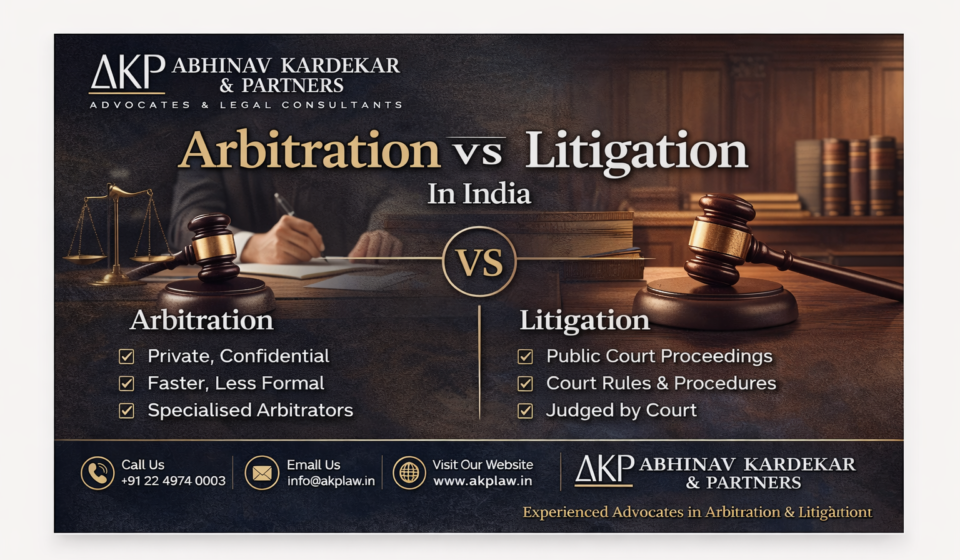

When a commercial dispute arises — whether from a broken contract, a shareholder conflict, or a failed joint venture — the first decision is not who to blame. It is where to fight. In India, two primary routes exist: litigation before courts and arbitration before a private tribunal. Choosing correctly at the outset of Arbitration vs Litigation in India determines cost, speed, confidentiality, and often, outcome.
The Core Difference
Litigation is a public process before a civil court or High Court, governed by the Code of Civil Procedure, 1908. It offers judicial coercive power, a structured appeals mechanism, and accessibility without requiring a prior agreement. Arbitration is a private, consensual process governed by the Arbitration and Conciliation Act, 1996 (as amended in 2015, 2019, and 2021). It offers confidentiality, party autonomy in choosing arbitrators, and — in theory — speed.
| The question is not which route is universally better. It is which route gives your specific dispute the best chance of a commercially sensible resolution in a commercially acceptable time. |
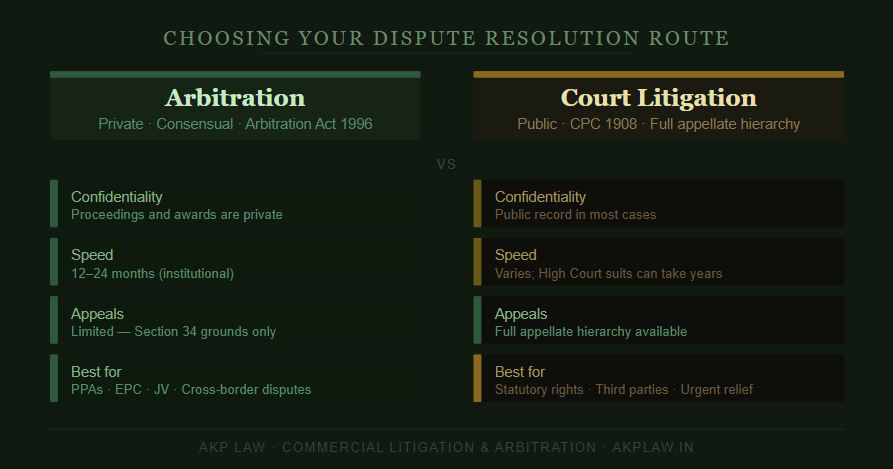
Arbitration vs Litigation: A Practical Comparison
| Factor | Arbitration | Court Litigation |
| Confidentiality | Yes — proceedings and awards are private | Public record in most cases |
| Speed | 12-24 months (institutional); longer if ad hoc | Varies widely; High Court suits can take years |
| Cost | Can be high due to arbitrator fees | Court fees lower; advocate fees variable |
| Enforceability | Enforceable as court decree; New York Convention for foreign awards | Decree of court; enforceable directly |
| Appeals | Limited — only under Section 34 of Arbitration Act | Full appellate hierarchy available |
| Expertise | Can appoint domain-expert arbitrators | Assigned to judges by roster |
| Third parties | Only parties to arbitration agreement | Third parties can be joined |
When to Choose Arbitration
| ARBITRATION IS TYPICALLY PREFERABLE WHEN The dispute arises from a commercial contract with a valid arbitration clauseConfidentiality is commercially important (joint ventures, M&A-related disputes)Technical expertise is required — infrastructure, energy, construction disputesCross-border enforcement of the award may be needed (New York Convention)Both parties prefer speed and finality over a full appellate process |
In India’s energy, mining, and infrastructure sectors, commercial arbitration is the default for high-value contract disputes. PPAs, EPC contracts, and joint development agreements almost universally contain arbitration clauses. An experienced arbitration lawyer can be decisive in how the case is framed, how the tribunal is constituted, and how the award is ultimately enforced.
When Litigation Is the Right Route
Not every dispute can go to arbitration. Matters involving statutory rights — writ challenges to government orders, company law petitions before NCLT, regulatory proceedings before SERCs — must go to the appropriate court or tribunal. Where third parties need to be joined, or where interim relief is urgently needed against a non-cooperating counterparty, courts often provide faster and more effective remedies than arbitral tribunals.
The NCLT route for company disputes
Insolvency petitions, oppression and mismanagement cases, and other company law matters go before the National Company Law Tribunal (NCLT) and, on appeal, the NCLAT. This is a specialised litigation track distinct from both ordinary civil litigation and arbitration. AKP Law handles NCLT matters alongside its arbitration and litigation practice.
The Concurrent Reality: Both at Once
In complex commercial disputes — particularly in energy and infrastructure — arbitration and litigation often run in parallel. A party may be in arbitration on the contract while simultaneously challenging a regulatory order in court, or seeking an interim injunction to preserve assets while the arbitration proceeds. Managing concurrent proceedings requires a commercial litigation law firm equally comfortable in both forums.
AI and Dispute Resolution: The Emerging Landscape
In 2025-26, AI tools are increasingly being used to predict dispute outcomes by analysing past court and arbitral decisions, draft pleadings, and review contracts for dispute-prone clauses, when you are reviewing for Arbitration vs Litigation in India. These capabilities are useful for research and document review. However, the strategic core of dispute resolution — understanding the tribunal, reading the opponent, and making judgment calls on settlement — remains the domain of experienced counsel.
| Commercial Dispute? Let’s Talk Strategy. AKP Law handles high-value commercial litigation and arbitration across courts, tribunals, and arbitral forums in India. Based in Raipur and New Delhi. Contact AKP Law: office@akplaw.in | +91-8103762924 | akplaw.in |
Frequently Asked Questions
Q What is the main difference between arbitration and litigation in India?
Litigation is a public court process under the Code of Civil Procedure. Arbitration is a private dispute resolution process governed by the Arbitration and Conciliation Act, 1996. Arbitration offers confidentiality and party autonomy; litigation provides access to courts’ coercive powers and a full appellate process.
Q Is arbitration faster than litigation in India?
Institutional arbitration can often be resolved in 12-24 months. Court litigation timelines vary significantly by forum and complexity. However, an arbitration award challenged under Section 34 of the Arbitration Act can extend the overall timeline substantially.
Q What types of disputes are best suited for arbitration?
Commercial disputes arising from contracts — construction, energy, joint ventures, PPAs, EPC agreements — are well-suited for arbitration. Disputes involving statutory rights, criminal elements, or third parties not party to the arbitration agreement must go to court.
Q Can AI predict the outcome of arbitration in India?
AI can analyse patterns in past awards and judicial decisions. However, arbitration outcomes depend on specific facts, the tribunal’s composition, and advocacy quality. AI predictions are not a reliable basis for legal strategy in complex commercial disputes.
Q What is the role of a commercial litigation lawyer?
A commercial litigation lawyer represents clients in disputes before civil courts, High Courts, the Supreme Court, and statutory tribunals. They advise on dispute strategy, manage arbitration proceedings, and handle enforcement of arbitral awards and court decrees.
Q What is Section 34 of the Arbitration Act?
Section 34 of the Arbitration and Conciliation Act, 1996 provides a limited window for challenging arbitral awards in Indian courts. The grounds are narrow — patent illegality, conflict with public policy, or procedural failures. It is not a full appeal on merits.