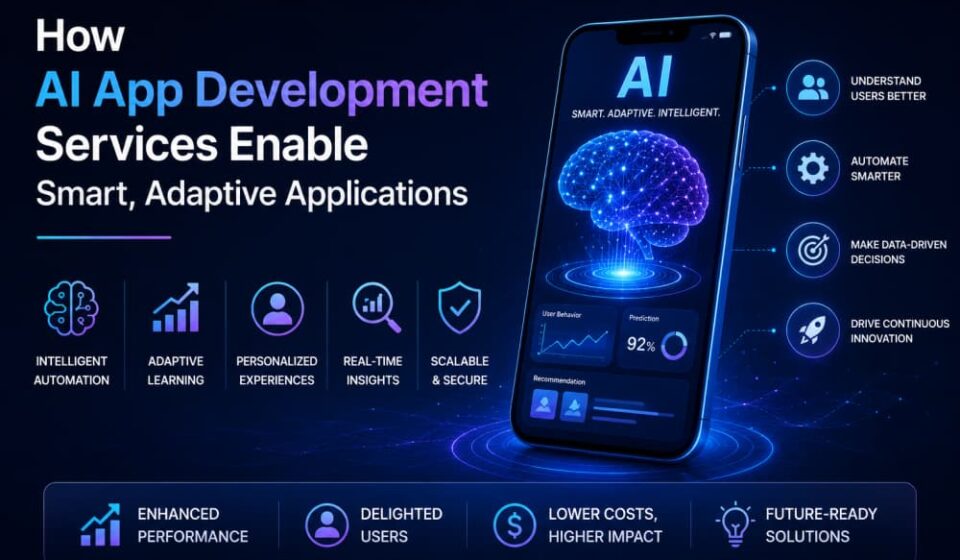

Not long ago, most business apps were built to do one thing well: You clicked a button, the system followed a rule, and the task was completed.
That approach worked for years because customers were willing to adapt to software limitations. People waited longer for support and tolerated clunky dashboards. At the same time, they repeated the same steps because there were not many alternatives. That tolerance has disappeared.
Modern users expect applications to feel responsive almost immediately. They expect recommendations that make sense, search results that improve over time, and systems that somehow “remember” how they work.
Businesses are responding to that shift quickly, which explains why demand for AI app development services has grown so aggressively across industries over the last few years.
The interesting part is that many companies did not originally plan to move this fast with AI adoption. Customer expectations pushed them there.
The lesson is clear: innovation is no longer optional. It is the direct response to rising customer expectations.
Software Expectations Changed Faster Than Many Businesses Expected
One lesson became clear during the last wave of digital transformation: moving processes online was not enough.
A company could launch a polished mobile app, redesign its customer portal, and automate a few workflows, yet users still felt frustrated if the experience remained rigid.
Modern users expect more flexible software.
That expectation is visible everywhere:
- A retail customer wants product recommendations that match browsing behavior.
- A banking user expects suspicious transactions to get flagged instantly.
- Employees want dashboards that surface relevant information before they go searching manually.
None of those experiences relies on static software logic anymore.
This is where artificial intelligence app development shifted from an innovation experiment to a business necessity.
AI-powered applications behave differently from traditional systems. They evolve continuously by learning from data and user interactions.
These applications observe patterns, process large amounts of data, and adjust responses over time. Users may not even notice the underlying technology directly. They just notice that the experience feels smoother.
Why Businesses Are Investing More in AI App Development Services
A lot of leadership teams initially approached AI adoption with caution.
Some companies experimented with chatbots. Others tested predictive analytics inside small internal projects. Many organizations stayed in observation mode because they were unsure where measurable ROI would come from.
That hesitation has faded quite a bit.
Pressure now comes from every direction:
- Customers expect faster experiences.
- Employees want less repetitive work.
- Executives want operational visibility without waiting weeks for reports.
- Competition keeps getting more aggressive digitally.
AI addresses all of these challenges simultaneously.
Businesses are increasingly using AI to drive growth and product innovation, not only for operational efficiency. That shift matters because it changes how organizations think about software investments.
The conversation has evolved beyond cost reduction. It is now equally about creating smarter and more seamless customer experiences.
Smart Applications Feel Different to Users
Most users do not care whether an application uses machine learning models, predictive analytics, or natural language processing.
They care about the experience.
- Does the app save time?
- Does it reduce friction?
- Does it simplify decisions?
That is the true benchmark.
Strong AI-driven applications improve small interactions that people deal with every day. Search results become more accurate. Recommendations become less random. Support systems route problems faster. Workflows stop feeling repetitive.
Individually, these improvements may seem minor. Together, they change how software feels to use.
That transformation explains why intelligent applications tend to improve retention and engagement over time. People naturally return to systems that reduce effort.
Artificial Intelligence Application Development Services Involve Much More Than Chatbots
There is still a common assumption that AI projects mostly revolve around conversational tools. In reality, enterprise AI development is usually far more complicated behind the scenes.
Reliable artificial intelligence application development services often begin with operational analysis long before development teams start discussing models or interfaces.
Businesses first need to understand:
- Where inefficiencies exist
- What data is available
- Which workflows create friction
- Where automation makes sense
- How existing systems will integrate
- What compliance requirements apply
That groundwork is more critical than many realize, because AI systems rely heavily on context.
- A poorly structured dataset can weaken results quickly.
- Fragmented systems create integration problems.
- Weak governance creates security concerns later.
In fact, a large portion of successful AI implementation work actually happens before the customer ever sees a finished application. That foundational work rarely gets the attention it deserves.
Why Many Enterprises Prefer Custom AI App Development Services
Off-the-shelf AI tools work well for certain situations. But large organizations rarely operate in clean, standardized environments. They contend with:
- Older systems
- Internal processes built over the years
- Industry regulations
- Security requirements
- Department-specific workflows
- Legacy infrastructure
That complexity explains why demand for custom AI app development services continues to grow.
Businesses want solutions built around how they actually operate rather than generic platforms that require major workflow compromises.
Customization becomes especially important in industries handling sensitive data or highly specialized operations. For example, a healthcare provider managing patient records faces different governance concerns compared to a retail company focused on recommendation engines.
The architecture should reflect those differences directly. Otherwise, adoption becomes difficult internally because employees end up fighting the system instead of benefiting from it.
Choosing the Right Artificial Intelligence App Development Company
A lot of AI projects succeed or fail based on implementation quality rather than the technology itself. That catches some businesses off guard.
A capable artificial intelligence app development company needs more than technical expertise alone. The development team also needs to understand operational realities, scalability planning, integration challenges, governance expectations, and long-term optimization.
AI applications are not static products. They evolve continuously after launch:
- User behavior changes
- Data changes
- Business priorities shift
- Models require refinement
- Security expectations evolve
That ongoing adjustment is part of what makes intelligent applications valuable, but it also means businesses need partners who think beyond deployment deadlines.
Security is becoming a much bigger discussion as well. A recent research study highlighted that many organizations still lack mature governance and privacy controls around AI systems.
As adoption expands, those gaps will become harder to ignore.
AI Applications Are Starting to Move Beyond Automation
Businesses are no longer asking only how AI can automate individual tasks. Increasingly, they are exploring how intelligent systems can coordinate entire workflows.
AI agents are becoming part of that conversation, alongside adaptive enterprise systems that respond dynamically to changing conditions.
The broader software experience is gradually shifting from reactive systems toward more proactive systems.
Applications are beginning to anticipate needs instead of simply waiting for instructions. That transition will likely reshape enterprise software over the next several years.
Final Thoughts
The businesses seeing the strongest results from AI are usually not treating it like a side initiative anymore. They are rebuilding workflows around intelligence, adaptability, and faster decision-making.
That is a very different mindset from traditional software planning.
Users, meanwhile, are already starting to expect smarter digital experiences by default. Applications that fail to adapt often feel outdated surprisingly quickly.
That growing expectation is exactly why AI app development services continue gaining momentum across industries.
Companies are realizing that intelligent applications are no longer optional experiments sitting outside the core business strategy. They are becoming part of the foundation.