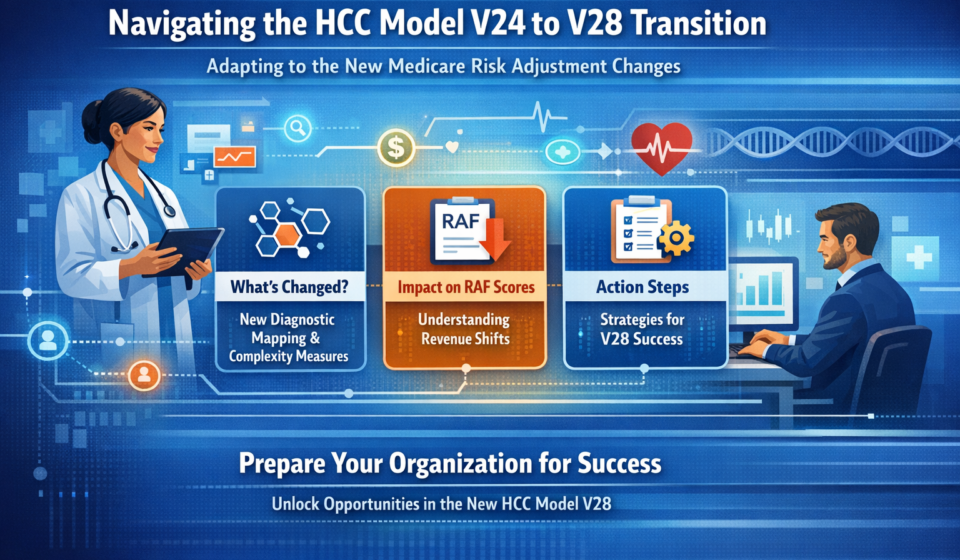

One of the most important alterations CMS has made to Medicare Advantage risk adjustment in a long time is the HCC Model V24 to V28 transition. This is more than a routine model update. It changes how patient complexity is measured, how diagnoses are mapped, and how health plans and providers are reimbursed.
The revenue effect is already being felt, at least in the case of your organization, which has not yet fully adapted to it. But here’s the thing: organizations that understand the mechanics of V28 are finding real opportunities. This guide breaks down what has changed, how it impacts your RAF scores, and what you need to do now.
Understanding the V24 to V28 Shift
The HCC (Hierarchical Condition Category) model is how CMS calculates patient risk under Medicare Advantage. It assigns scores based on diagnosed conditions, which directly determine payment amounts to health plans. V28 is being phased in as the new standard and introduces important changes compared to V24.
The Phased Rollout
CMS introduced the HCC Model V24 to V28 gradually over three years to give organizations time to adjust:
- 2023: 33% V28 / 67% V24
- 2024: 67% V28 / 33% V24
- 2025: 100% V28 fully in effect, V24 retired
ICD-10 Code Removals
V28 also removed 2,294 ICD-10 codes, which formerly were mapped to HCCs. When one of those codes is captured, it may no longer map to an HCC, meaning it no longer contributes to the patient’s RAF score. This makes accurate and up-to-date documentation essential.
Constrained Coefficients for Common Conditions
Several widely diagnosed conditions now have flattened HCC coefficients, meaning HCC coefficients for these conditions have been compressed, reducing variation based on severity:
- Diabetes
- Heart Failure
- COPD
- Major Depressive Disorder
- Bipolar Disorder
For patients with these conditions, RAF scores will generally be lower under V28 than under V24.
Winners and Losers Under V28
The model does not impact all conditions equally. Some conditions actually perform better under V28, and understanding this split is key to protecting and even growing your revenue.
Conditions That Gain Under V28
Certain diagnoses saw meaningful coefficient increases. If your patient population includes these, well-documented records can contribute to stronger RAF scores:
- Immunity disorders
- Chronic and skin ulcers
- Rheumatoid arthritis
- End-stage heart failure (HCC222)
- Idiopathic pulmonary fibrosis (HCC278)
- Chronic kidney disease, stage 5 (HCC326)
The Multi-Condition Advantage
V28 introduces additional interaction factors that can increase risk scores for patients with multiple documented conditions. For complex, multi-condition patients, this creates a significant scoring advantage. For instance, Persivia’s analysis demonstrates this clearly:
| Patient Type | V24 RAF | V28 RAF |
| Single condition (diabetes) | 1.062 | 0.97 |
| Multi-condition patient | 2.775 | 5.332 |
Under V28, accurate and complete documentation becomes increasingly important for patients with multiple conditions.
Revenue Impact and How to Respond
CMS projects a 3.12% overall payment decrease under the new risk adjustment model, amounting to roughly $11 billion in savings on CMS’s side. For providers and health plans, this can create revenue pressure depending on coding accuracy and patient mix.
Steps to Protect Your Revenue
The new risk adjustment model places greater emphasis on precise and complete documentation. Here’s where to focus:
- Document specifically: Vague or outdated ICD-10 codes are now revenue leaks
- Capture annually: Chronic conditions must be re-documented every plan year
- Prioritize high-value HCCs: Redirect effort toward conditions with the strongest V28 coefficients
- Identify complex patients early: Patients with multiple conditions require complete diagnosis capture before submission deadlines.
- Run V24 vs. V28 side-by-side analysis: Know exactly which patient cohorts gain or lose under the new model.
Takeaway
V28 is fully in effect, and the organizations still relying on V24 habits are leaving revenue on the table. Common conditions are worth less. Complexity is worth more. And 2,294 codes no longer count. A focused documentation strategy aligned with high-value HCCs is now important for staying competitive in Medicare Advantage.
Your V28 Strategy Starts Here
Persivia CareSpace® is an AI-driven digital health platform that brings together clinical, claims, and SDOH data into one complete longitudinal patient record. Its point-of-care tool allows providers to review V24 and V28 codes side by side and view real-time RAF impact during care. For organizations serious about V28 performance, this solution turns regulatory complexity into a strategic advantage.