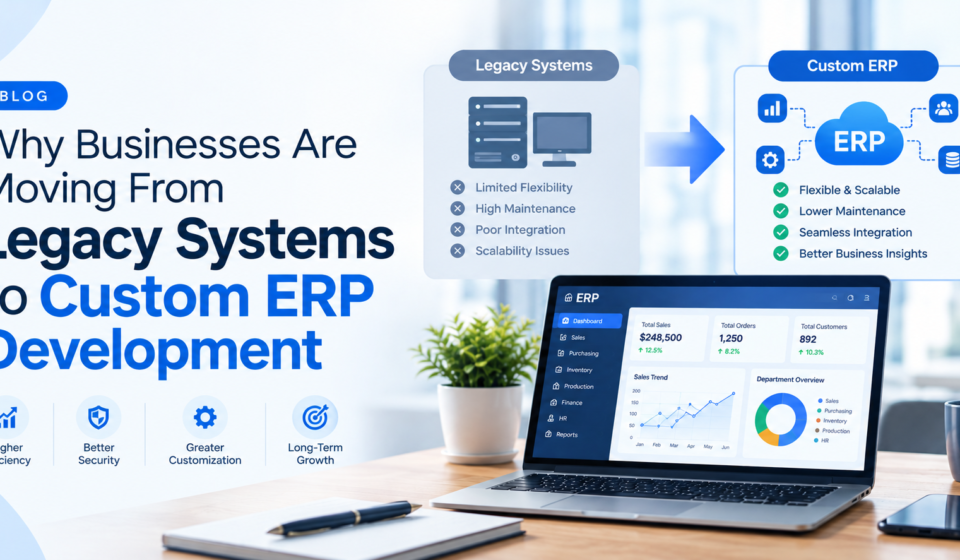

Here’s something nobody says out loud in the boardroom: “We’re keeping this system because we’re used to it.” But that’s often what’s really happening.
Businesses invest in ERP platforms and then spend years working around them. The software gets older. The company changes shape. And at some point, the gap between what the system does and what the business needs becomes too wide to paper over with spreadsheets.
Teams at Arobit have sat in enough discovery calls to recognise this moment. It usually isn’t a crisis that brings people to the table. It’s exhaustion. Operations staff who’ve spent years bridging broken data flows. Finance teams waiting three days for a report that should run overnight. IT departments that spend more time keeping old integrations alive than building anything new.
At some point, staying put stops being the safe choice.
The Operational Cost of Legacy ERP Dependency
Legacy systems don’t crash dramatically. That’s part of why they stick around so long.
What actually happens is slower and harder to point to on a spreadsheet:
- Teams build workarounds that become “the process”
- Data lives in separate silos with no clean path between them
- Reporting lags behind reality by days, sometimes weeks
- Junior staff inherit undocumented procedures nobody fully understands
Take a manufacturer still running a procurement module from 2009, patched onto a newer warehouse system. Nobody designed that setup. It accumulated. Now there’s a daily manual export someone does before 9am just to keep both systems in sync. That person has done it so long, they don’t even think about it. But the moment they’re on leave, everything stalls.
“The real cost isn’t the software license. It’s the invisible tax on every decision, every report, every handoff that runs through a system that was never built for how the business works now.”
Vendor support makes this worse over time. Many legacy ERP providers quietly sunset older versions, shifting their resources toward newer cloud products. Businesses still running those older versions end up managing security patches themselves. In a typical industry, that’s an operational headache. In a regulated one, it’s a liability.
Why Standard Platform Upgrades Fall Short
It seems obvious. Move to a modern platform, get a cleaner interface, fix the problem.
The reality is messier. Plenty of companies have done exactly this and found themselves in a different version of the same situation.
Real-World Scenario: A logistics firm with around 400 staff switches to a well-known cloud ERP. Eighteen months in, their load-planning workflow still doesn’t fit how the platform works. Every adjustment means a conversation with the vendor, a custom development quote, and a wait. The system is newer and shinier. It is not better for them.
Off-the-shelf ERP platforms are built around a generalised business. They assume a particular org structure, a typical finance process, a standard way of handling inventory. When your business doesn’t match those assumptions, you spend money bending the software to fit. That cost compounds. And often, the vendor’s roadmap simply doesn’t go in the direction your business needs to.
The software ends up dictating how work gets done. That’s not a technology problem. It’s a strategy problem.
The Business Case for Purpose-Built ERP Systems
Custom ERP development solutions don’t promise magic. What they offer is fit.
When the ERP is built around a company’s actual workflows rather than a generalised template, a few things shift meaningfully:
The data reflects what’s actually happening A pharma distributor tracks batches, expiry dates, and regulatory compliance codes. A construction firm tracks project costs against contracts, with variation orders that ripple through multiple cost centres. Generic ERP systems handle these with workarounds. A custom system handles them correctly because they were designed into it from day one.
Integrations stop being a problem to manage Most businesses already run five to ten other tools alongside their ERP: a CRM, an HR system, an e-commerce platform, maybe a handful of APIs feeding in logistics data. A custom ERP can connect to all of these cleanly. Not through middleware duct tape, but through proper architecture. Data moves when it should, without someone manually pushing it.
Growth doesn’t mean another migration When a new business unit opens or a new market gets added, a custom system stretches to match it. There’s no new licensing negotiation, no ripping out modules, no months-long re-implementation project. The system was built to be extended.
Managing the Migration: Risk, Planning, and Execution
Migration is where good intentions go sideways if the planning isn’t honest.
The failure points tend to cluster around three things:
- Data quality — Legacy systems carry years of messy, duplicate, inconsistently formatted records. Migrating that data without cleaning it first just moves the problem into the new system.
- Process documentation — Most companies discover, mid-migration, that nobody fully documented how the old system was actually being used. The workarounds were oral tradition.
- User adoption — A well-built ERP with poor rollout still fails. Staff who weren’t consulted during design find ways to avoid using it.
The businesses that get this right take a phased approach. They audit the existing system for what’s actually happening, not what’s supposed to happen. They involve operational users early, not just IT and finance leadership. And they treat go-live as a milestone, not the finish line.
Change management isn’t a soft concern here. It’s a delivery risk.
The Evolving Capabilities of Modern ERP Architecture
Five years ago, building a custom ERP was a significant capital commitment. Today the landscape looks different.
Cloud infrastructure has dropped build and deployment costs. Modular development means businesses can start with what they need most, finance and inventory, then layer in procurement, HR, or CRM as the business grows into it. The days of all-or-nothing ERP implementations are largely behind us for mid-market companies.
The capability bar has also moved:
- AI-driven demand forecasting built into the inventory layer
- Real-time financial dashboards that update without a manual refresh
- Automated compliance alerts before a threshold gets breached
These features aren’t futuristic. Businesses are asking for them now. Legacy platforms mostly can’t deliver them without expensive third-party additions. A system built on modern architecture handles them natively.
The shift toward custom isn’t about novelty. It’s about businesses realising their software should reflect their competitive edge, not constrain it.
Conclusion
Nobody should rush an ERP decision. The stakes are too high and the implementation too involved for that.
But here’s the honest version of what most leadership teams eventually conclude: the question isn’t whether to move. It’s what to move to. For businesses with complex operations or industry-specific workflows, generic platforms have a ceiling. Professional ERP development services remove that ceiling. The software gets built around the business, not the other way around.
Arobit has worked through enough of these migrations to know what separates a successful implementation from a painful one. It’s rarely the technology. It’s whether the system was designed with a genuine understanding of how the business works. That’s what makes the difference, at launch and for years after it.
Frequently Asked Questions
Q1. How long does a custom ERP implementation typically take?
Scope drives timeline more than anything else. A mid-sized business standing up core modules, finance, inventory, procurement, is usually looking at four to eight months for an initial deployment. Larger rollouts with multiple departments and external integrations stretch to twelve to eighteen months. The businesses that hit their timelines tend to be the ones who spend more time on pre-implementation audit and user alignment than they initially planned for. That upfront investment pays back during rollout.
Q2. Is custom ERP realistic for mid-sized companies, or is it just for large enterprises?
It’s realistic for a much wider range of businesses than it was five years ago. Cloud infrastructure and modern development approaches have brought costs down considerably. Mid-sized companies in industries with specific workflows, logistics, manufacturing, construction, distribution, often find custom development more cost-effective than paying ongoing customisation fees to a generic platform that still doesn’t fully fit. The deciding factor isn’t headcount. It’s whether the business operates in ways a standard platform can’t serve well.
Q3. What are the most common reasons ERP migrations fail?
Three things come up consistently. First, data quality: legacy systems hold years of inconsistent records, and migrating dirty data into a clean system just replicates the problem. Second, undocumented processes: companies often discover mid-migration that their actual workflows were never formally captured anywhere. Third, poor adoption: if staff weren’t involved in the design process, they find ways around the new system the same way they worked around the old one. A phased rollout, early user involvement, and honest data preparation before migration begins are what separate the ones that succeed from the ones that don’t.