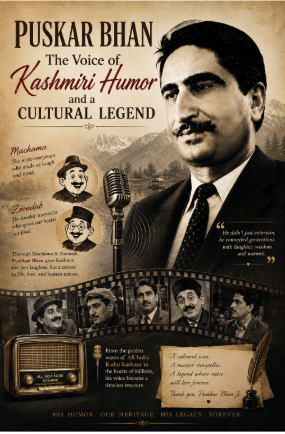

Pushkar Bhan (1926–2008) occupies a unique and enduring place in the cultural history of Kashmir. Actor, playwright, humorist, scriptwriter, broadcaster, and producer, he transformed Kashmiri-language entertainment into a powerful medium for social awareness. Through radio, theatre, television, cinema, and literature, he brought laughter to generations while addressing everyday social issues with remarkable wit and sensitivity. Awarded the Padma Shri in 1974 and the Sahitya Akademi Award in 1976, Bhan is widely regarded as one of the greatest cultural ambassadors of the Kashmiri language. Even years after his passing, his characters, dialogues, and radio dramas continue to evoke nostalgia among Kashmiris around the world.
Early Life and Passion for Theatre
Born in Srinagar in 1926, Pushkar Bhan developed a fascination with drama and storytelling from an early age. He completed his bachelor’s degree in 1947, a year that also marked India’s independence. During this period, Kashmir was witnessing a cultural awakening under progressive writers and theatre personalities. Bhan became associated with the Cultural Forum of the National Cultural Front, where he worked alongside renowned playwright and poet Dinanath Nadim.
His early performances in stage productions such as Bombur Yemberzal, Ya Tan Ya Tadakh, and Lalkar displayed his remarkable acting ability and comic timing. One memorable episode often recalled in accounts of his life is his performance before Soviet leader Nikita Khrushchev during a special theatrical presentation in Srinagar, where his acting reportedly earned personal appreciation from the visiting dignitary. These experiences laid the foundation for a career that would span more than five decades.
Journey from Mumbai to Radio Kashmir
Like many aspiring artists of his generation, Pushkar Bhan briefly moved to Mumbai in search of opportunities. Financial circumstances led him to take employment at Modern Mills Limited, but his passion for acting never diminished. During his stay, he became actively associated with the Indian People’s Theatre Association (IPTA), an organization that nurtured socially conscious theatre.
Family circumstances eventually brought him back to Kashmir. In the early 1950s, he joined All India Radio (AIR), Srinagar, initially as a daily-wage artist earning only ₹2.50 per day. What appeared to be a modest beginning eventually became one of the most influential careers in Indian broadcasting. Through dedication and creativity, he rose through the ranks and retired in 1985 as a Senior Producer. Later, he served as Producer Emeritus, reflecting the respect he commanded within the broadcasting fraternity.
Revolutionizing Kashmiri Radio
Pushkar Bhan’s greatest contribution lies in radio broadcasting. At a time when radio was the principal source of entertainment in Kashmir, he created programmes that became household names.
His comedy series Asun Te Gindun and Poshe Goindi entertained listeners with humorous sketches rooted in everyday Kashmiri life. However, his most celebrated achievements were the serials Zoon Dab and Machama.
Zoon Dab became a broadcasting phenomenon. Running continuously for nearly two decades, it was among the longest-running radio serials in India. Bhan not only wrote the scripts but also portrayed the unforgettable character “Mama.” The programme blended humour with discussions of family relationships, education, social customs, economic challenges, and changing lifestyles. Its popularity extended far beyond Kashmir, reaching Kashmiri-speaking communities across India and abroad.
Similarly, Machama established Bhan as the undisputed master of Kashmiri satire. Through witty dialogues and memorable characters, he exposed social hypocrisy, bureaucracy, superstition, and human weaknesses without bitterness or hostility. His humour encouraged audiences to laugh at themselves while reflecting on the need for social reform. The popularity of Machama eventually earned him the Sahitya Akademi Award.
Master of Social Satire
Unlike comedians whose primary objective is entertainment, Pushkar Bhan viewed humour as an instrument of education. His stories rarely relied on slapstick comedy alone. Instead, they explored real-life problems affecting ordinary Kashmiri families.
His scripts addressed issues such as:
- Family relationships
- Marriage traditions
- Education
- Bureaucratic inefficiency
- Social inequality
- Economic hardship
- Changing cultural values
By presenting serious concerns through laughter, Bhan made social criticism accessible to audiences of all ages. His characters represented familiar personalities found in every Kashmiri neighbourhood, making his work both entertaining and deeply relatable.
Contributions to Theatre and Literature
Beyond broadcasting, Pushkar Bhan enriched Kashmiri theatre through numerous acclaimed plays. Working with playwright Som Nath Sadhu, he co-authored important dramatic works including:
- Grand Rehearsal (Bhavya Purvabhyas) (1967)
- Chapath (The Slap) (1973)
- Nev Nosh (The New Bride) (1975)
These plays received recognition from the Jammu and Kashmir Academy of Art, Culture and Languages and remain important contributions to modern Kashmiri drama.
His literary writings extended beyond drama. He authored works on children’s education, broadcasting, satire, and cultural development. Books such as Sanya Bacha highlighted the educational role of radio programmes for children, while his essays and stories appeared in literary journals including Sheeraza, Kongposh, Inquilab, and Aieena.
Film and Television Career
Pushkar Bhan also made significant contributions to Kashmiri cinema. He acted in the pioneering Kashmiri film Manziraat (Mehndiraat), where he portrayed a memorable villain. Later, he appeared in Shayir-e-Kashmir Mehjoor, based on the life of the celebrated Kashmiri poet Mehjoor. The film featured distinguished actors including Balraj Sahni and received national recognition.
Television provided another platform for his creativity. When television broadcasting began in Srinagar, Bhan produced successful comedy programmes such as Doctor Zero, which carried forward his trademark blend of humour and social commentary. Even after leaving Kashmir, he continued writing television serials for Doordarshan Srinagar, demonstrating his lifelong commitment to Kashmiri-language programming.
National Recognition
Pushkar Bhan’s extraordinary contributions received several prestigious honours.
The Government of India awarded him the Padma Shri in 1974 for his contribution to literature and broadcasting. Two years later, he received the Sahitya Akademi Award for Machama, confirming his status as one of the foremost writers in Kashmiri literature.
He also received awards from the Jammu and Kashmir Academy of Art, Culture and Languages, the Sadiq Memorial Award for Best Actor and Playwright, and recognition from organizations promoting children’s education and broadcasting excellence.
Legacy and Influence
Pushkar Bhan passed away on 5 October 2008 in New Delhi after a prolonged illness. His death was widely mourned across Kashmir, where listeners remembered him not merely as an entertainer but as a companion whose voice had accompanied their daily lives for decades.
His influence continues to shape Kashmiri theatre, radio, and comedy. Many contemporary Kashmiri performers acknowledge him as the pioneer who demonstrated that regional-language broadcasting could achieve artistic excellence while preserving cultural identity.
His work also serves as a valuable linguistic archive. Through his scripts, future generations can appreciate authentic Kashmiri idioms, humour, customs, and everyday conversations from the mid-twentieth century.
The Tragic Loss of His Archives
As preparations began for Pushkar Bhan’s centenary celebrations in 2026, concern arose over the disappearance of many original recordings of his legendary radio programmes from Radio Kashmir’s archives. Reports indicate that much of the priceless audio heritage—including episodes of Zoon Dab and Machama—is either missing or difficult to locate.
The loss is significant because these recordings represent not only entertainment but also an invaluable record of Kashmiri language, culture, and broadcasting history. Cultural historians and admirers have called for systematic efforts to recover, digitize, and preserve whatever material survives in private collections and institutional archives.
Conclusion
Pushkar Bhan’s life illustrates the power of art to educate, entertain, and unite society. His humour never mocked individuals; instead, it gently exposed social shortcomings while encouraging compassion and self-reflection. Through radio serials, stage plays, films, television programmes, and literary works, he elevated Kashmiri-language entertainment to national recognition.
More than a celebrated actor or writer, Pushkar Bhan became the cultural voice of generations of Kashmiris. His unforgettable characters continue to live in collective memory, reminding audiences that laughter can be both joyful and transformative. As efforts continue to preserve his legacy and recover his lost archives, his contribution remains an enduring symbol of Kashmir’s rich artistic and literary heritage.