
Education today is under more pressure than ever. Schools are expected to deliver better outcomes, maintain transparency, communicate effectively with parents, and manage increasing administrative complexity—all while keeping students at the center. Yet many institutions still rely on outdated manual processes, spreadsheets, and fragmented tools.
This is where a School Management System becomes more than just software—it becomes a strategic solution.
In this blog, we’ll explore the real-world challenges faced by schools, how a School Management System addresses them, and why solutions like eSchool are becoming essential for modern education.
The Real Challenges Schools Face Today
Before jumping into solutions, it’s worth understanding the everyday struggles of teachers and principals.
1. Administrative Overload
Teachers often spend hours on non-teaching tasks—attendance, grading, report generation, and record-keeping. Principals deal with scheduling, compliance reports, fee tracking, and staff management.
This administrative burden reduces the time available for what truly matters: teaching and student development.
2. Poor Communication Channels
Many schools still rely on circulars, phone calls, or WhatsApp groups for communication. Messages get lost, parents stay uninformed, and misunderstandings arise.
3. Data Fragmentation
Student data is often scattered across files, registers, and different systems. Retrieving accurate information quickly becomes difficult, especially during audits or parent meetings.
4. Lack of Transparency
Parents increasingly expect real-time updates about attendance, performance, and school activities. Without a centralized system, maintaining transparency is challenging.
5. Inefficient Fee Management
Manual fee collection and tracking can lead to errors, delays, and even revenue leakage.
What is a School Management System?
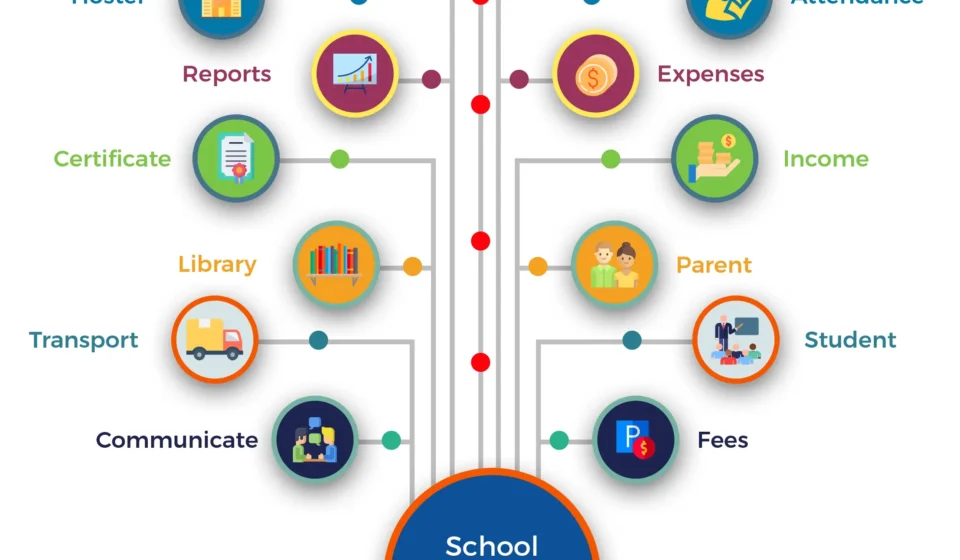
A School Management System is an integrated digital platform designed to streamline and automate all school operations—from admissions and attendance to exams, communication, and finance.
Think of it as the backbone of a modern school, connecting teachers, students, parents, and administrators in one unified system.
Read more here
How a School Management System Empowers Teachers
1. More Time for Teaching
With automation handling attendance, grading, and report cards, teachers can focus on lesson planning and student engagement.
Instead of spending hours compiling results, a School Management System generates reports in minutes.
2. Smarter Classroom Management
Teachers can track student performance over time, identify weak areas, and tailor their teaching strategies accordingly.
This leads to more personalized learning—something every educator strives for but rarely has time to implement manually.
3. Seamless Communication with Parents
Teachers can instantly share updates, homework, and feedback with parents through the system. No more missed messages or confusion.
4. Easy Access to Student Records
From attendance history to academic performance, everything is available in one place—no need to dig through files.
How Principals and Administrators Benefit
1. Centralized Control
A School Management System provides a complete overview of school operations. Principals can monitor attendance, academic progress, and financial data in real time.
2. Data-Driven Decision Making
With access to accurate reports and analytics, school leaders can make informed decisions—whether it’s improving curriculum or optimizing resources.
3. Improved Compliance and Reporting
Generating reports for boards, audits, or government requirements becomes simple and error-free.
4. Efficient Staff Management
From payroll to performance tracking, administrators can manage staff more effectively.
Real-World Impact: Before and After
Let’s look at a typical scenario.
Before Implementation
- Teachers manually mark attendance and calculate grades
- Parents receive updates only during meetings
- Fee records are maintained in registers
- Reports take days (or weeks) to prepare
After Implementing a School Management System
- Attendance is recorded digitally in seconds
- Parents receive real-time notifications
- Fees are tracked automatically with reminders
- Reports are generated instantly
The difference isn’t just convenience—it’s transformation.
Key Features to Look for in a School Management System
Not all systems are created equal. To truly solve real-world problems, a School Management System should include:
1. Attendance Management
Automated tracking with real-time updates for parents.
2. Examination & Grading System
Simplifies result preparation and performance analysis.
3. Fee Management
Automates billing, tracking, and reminders.
4. Communication Tools
Integrated messaging between teachers, parents, and students.
5. Student Information System
Centralized database for all student records.
6. Mobile Accessibility
Access anytime, anywhere for teachers and parents.
Why Schools Are Choosing eSchool
Among the many options available, eSchool stands out by focusing on practical challenges schools face daily.
1. User-Friendly Interface
One common issue with software adoption is complexity. eSchool is designed to be intuitive, ensuring teachers and staff can start using it without extensive training.
2. All-in-One Solution
Instead of juggling multiple tools, eSchool integrates all essential functions into one platform—saving time and reducing confusion.
3. Real-Time Insights
Principals get instant access to data that helps them make better decisions.
4. Strong Communication Tools
It bridges the gap between school and parents with timely updates and notifications.
5. Scalability
Whether it’s a small school or a large institution, eSchool adapts to growing needs.
Addressing Common Concerns
“Will teachers resist using new technology?”
This is a valid concern. However, when a School Management System is simple and clearly reduces workload, adoption becomes much easier.
“Is it worth the investment?”
Consider the hidden costs of inefficiency—time loss, errors, miscommunication. A School Management System often pays for itself through improved efficiency and better outcomes.
“What about data security?”
Modern systems like eSchool prioritize secure data storage and controlled access, ensuring sensitive information is protected.
The Bigger Picture: Better Education Outcomes
At its core, a School Management System isn’t just about administration—it’s about improving education quality.
When teachers are less burdened, they teach better.
When principals have clear insights, they lead better.
When parents are informed, students perform better.
It creates a connected ecosystem where everyone works toward a common goal: student success.
Final Thoughts
The education sector is evolving, and schools that fail to adapt risk falling behind. Manual processes and disconnected systems are no longer sustainable.
A School Management System is not just a digital upgrade—it’s a transformation tool.
By addressing real-world problems like administrative overload, poor communication, and data inefficiency, it empowers teachers and principals to focus on what truly matters.
If you’re looking for a reliable, practical solution, platforms like eSchool offer a strong starting point.
The future of education is smarter, faster, and more connected—and it starts with the right system in place.
