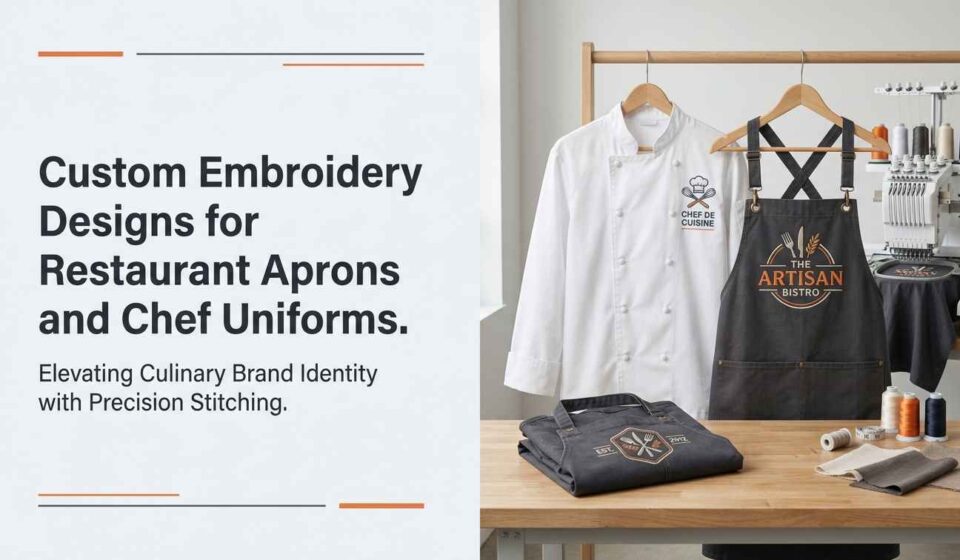

Custom embroidery designs are a practical way to personalize restaurant aprons and chef uniforms with business logos, employee names, and decorative patterns. Embroidery helps restaurants create consistent branding while giving kitchen staff a professional and organized appearance.
Restaurant uniforms are used regularly and may require frequent washing. Choosing suitable embroidery threads, fabrics, and stitching techniques helps maintain the quality of embroidered logos and lettering.
Whether you manage a restaurant, café, bakery, or catering business, custom embroidery can add personalized details to chef jackets, aprons, hats, and other workwear.
What Are Custom Embroidery Designs for Restaurant Uniforms?
Custom embroidery designs are personalized stitching patterns created for restaurant clothing and workwear. These patterns commonly include restaurant logos, chef names, job titles, and decorative elements.
Unlike printed designs, embroidery uses thread to create lettering, symbols, and artwork directly on fabric.
For example, a restaurant apron can feature the business logo on the chest, while a chef jacket may include the employee’s name and position.
Embroidery digitizing converts artwork into machine-readable stitch instructions. These instructions help embroidery machines reproduce the design on suitable garments.
Why Choose Custom Embroidery for Restaurant Aprons and Chef Uniforms?
Restaurant uniforms help identify employees and create a consistent appearance across different departments.
Adding custom embroidery allows businesses to include branding and personalized details without using large printed graphics.
Some benefits include:
- Clear restaurant logo placement.
- Personalized employee names and job titles.
- Consistent branding across workwear.
- Different embroidery options for kitchen and service staff.
- Durable decoration when suitable materials and care methods are used.
The final durability depends on thread selection, fabric quality, embroidery construction, and washing conditions.
Creative Embroidery Ideas for Restaurant Aprons
1. Restaurant Logo Embroidery
Restaurant logos are one of the most common choices for apron embroidery.
A logo can be placed on the upper chest area where customers can easily recognize it.
Simple logos with clear shapes and suitable lettering are generally easier to reproduce through machine embroidery.
For detailed logos, digitizers may need to simplify very small elements to maintain clarity.
2. Personalized Employee Names
Adding employee names can make restaurant aprons more personal.
Names can be embroidered on the chest or near the upper pocket area.
Simple lettering styles are suitable for busy restaurant environments because they are easier to read.
Thread colors should provide enough contrast against the apron fabric.
3. Chef Name and Job Title Embroidery
Chef uniforms can include names and professional job titles.
For example, a jacket may feature the employee’s name with a title such as Executive Chef, Sous Chef, or Pastry Chef.
The lettering should be arranged neatly and positioned away from seams, buttons, and other garment details.
4. Minimalist Food-Inspired Embroidery
Small food-related symbols can add decorative details to restaurant uniforms.
Examples include coffee cups, bread illustrations, simple vegetable outlines, and kitchen utensil designs.
These patterns are suitable for cafés, bakeries, and casual restaurants that want additional decorative elements.
5. Decorative Embroidery on Apron Pockets
Apron pockets provide space for small logos, initials, and decorative symbols.
For example, a bakery apron may include a small bread illustration near the pocket.
Embroidery should be positioned carefully to avoid closing the pocket or interfering with its function.
6. Custom Embroidery for Special Restaurant Events
Restaurants can create embroidered aprons for special events, cooking demonstrations, and promotional activities.
These designs may include event names, dates, or limited-edition artwork.
Simple embroidery designs are often suitable when producing multiple uniforms for a short event.
Best Custom Embroidery Designs for Chef Uniforms
Chef uniforms offer different areas for customized embroidery.
| Uniform Item | Recommended Embroidery Design |
|---|---|
| Chef jacket | Restaurant logo and chef name |
| Restaurant apron | Business logo and employee name |
| Chef hat | Small logo or initials |
| Kitchen shirt | Restaurant branding and job title |
| Bakery apron | Bread symbols and business name |
| Café uniform | Coffee cup design and café logo |
| Catering uniform | Company logo and employee details |
| Restaurant workwear | Simple branding and decorative lettering |
The best embroidery placement depends on garment construction, available space, and restaurant requirements.
How to Create Custom Embroidery Designs for Restaurant Uniforms
Step 1: Choose the Uniform Item
Begin by selecting the garment you want to customize.
Common options include aprons, chef jackets, shirts, hats, and other suitable workwear.
Consider the fabric thickness and available embroidery area.
Step 2: Prepare the Restaurant Logo
Use clear artwork that contains the correct business name, symbols, and colors.
Vector artwork can be useful because it allows the logo dimensions to be adjusted accurately.
Remove unnecessary details that may be difficult to reproduce at smaller embroidery sizes.
Step 3: Select the Embroidery Placement
Choose a suitable location on the uniform.
The chest area is commonly used for restaurant logos, while names can be placed on the opposite side of a chef jacket.
Avoid placing embroidery over thick seams, buttons, and functional pocket openings.
Step 4: Choose Suitable Thread Colors
Select embroidery thread colors that match the restaurant’s approved branding.
For dark uniforms, lighter thread colors may improve visibility.
For white chef jackets, darker embroidery threads can provide clear lettering and logo details.
Step 5: Digitize the Artwork
Use embroidery digitizing software to convert the logo or personalized artwork into machine-readable stitch instructions.
Adjust stitch density, direction, underlay, and sequencing according to the garment material.
Step 6: Prepare the Uniform Fabric
Select suitable stabilizers and position the garment correctly before embroidery.
Make sure the fabric is secure without unnecessary stretching.
Step 7: Test the Embroidery Design
Perform a sample stitch-out on the intended fabric or a similar material.
Check logo accuracy, thread coverage, lettering clarity, and fabric stability.
Step 8: Complete the Embroidery
After approving the sample, embroider the final design onto the uniform.
Inspect the finished garment for loose threads, uneven stitching, and placement accuracy.
Best Stitch Types for Restaurant Uniform Embroidery
Different stitch types can be used to create logos, lettering, and decorative patterns.
| Stitch Type | Recommended Application |
|---|---|
| Satin stitch | Restaurant names and logo borders |
| Running stitch | Fine outlines and simple decorative elements |
| Tatami fill stitch | Larger logo areas |
| Triple running stitch | Defined lines and small symbols |
| Contour stitch | Curved logos and decorative shapes |
| Motif fill stitch | Repeating decorative patterns |
| Underlay stitch | Supporting embroidery coverage and fabric stability |
Choosing suitable stitches helps maintain logo clarity and avoid unnecessary thread buildup.
Choosing the Right Fabric for Embroidered Restaurant Uniforms
Restaurant uniforms are available in different fabrics, and each material requires suitable embroidery settings.
Cotton aprons can support many logo designs when properly stabilized. Polyester and cotton-blend uniforms are also commonly used for restaurant workwear.
Denim aprons can support larger decorative artwork, although heavy stitching may make certain areas stiff.
Lightweight chef jackets require controlled stitch density to reduce fabric distortion.
Before production, test the embroidery on the actual uniform material whenever possible.
How to Choose Thread Colors for Restaurant Branding
Thread colors should match the restaurant’s visual identity.
If a business uses specific brand colors, select embroidery threads that closely match the approved color references.
| Uniform Color | Possible Thread Colors |
|---|---|
| Black | White, cream, or approved brand colors |
| White | Black, navy, or dark green |
| Navy blue | White, silver, or light gray |
| Beige | Brown, black, or dark green |
| Gray | Black, white, or navy |
| Denim blue | White, cream, or yellow |
| Dark green | Cream, white, or gold |
These combinations are examples. The final colors should reflect the restaurant’s branding and visibility requirements.
How to Embroider Small Restaurant Logos
Small logos require careful digitizing because fine details can become difficult to reproduce.
Begin by reviewing the original artwork and identifying important shapes and lettering.
Simplify unnecessary decorative elements and select appropriate stitch types.
Avoid extremely small text that may become unreadable after stitching.
For example, a restaurant logo containing a business name and a detailed illustration may require a simplified version for embroidery on a small chef hat.
A sample stitch-out helps confirm whether the final logo remains recognizable.
How to Maintain Consistent Embroidery Across Staff Uniforms
Restaurants often need multiple uniforms with the same logo.
Maintaining consistent embroidery requires approved design files, accurate placement measurements, and suitable production settings.
Keep records of thread color codes, logo dimensions, fabric types, and machine settings.
For example, the same restaurant logo may require different digitizing adjustments when embroidered on a cotton apron and a lightweight chef jacket.
Using approved embroidery files and physical samples can help reduce variations between uniforms.
How to Make Embroidered Chef Uniforms More Durable
Restaurant clothing is often washed frequently to remove food stains and maintain cleanliness.
Choose embroidery threads suitable for the garment’s washing requirements.
Polyester embroidery threads are commonly selected for workwear because many products offer good resistance to repeated washing and color fading.
However, thread durability depends on the specific product, detergents, washing temperatures, and care conditions.
Embroidery should not interfere with the garment’s cleaning requirements or introduce loose decorative elements in food-handling areas.
Common Mistakes When Embroidering Restaurant Uniforms
One common mistake is creating embroidery that is too large for the available garment area.
Large or dense designs may cause fabric stiffness and reduce comfort.
Another mistake is using complicated lettering that becomes difficult to read when embroidered at a small size.
Incorrect logo placement, unsuitable stabilizers, and poor thread color selection can also affect the finished uniform.
Digitizers should review the garment construction and perform sample testing before starting bulk production.
Custom Embroidery Designs for Different Food Businesses
Restaurants
Restaurants can use embroidered logos, staff names, and job titles to maintain consistent workwear.
Cafés
Cafés may choose small coffee cup illustrations, café names, and simple decorative logos.
Bakeries
Bakeries can use bread illustrations, wheat patterns, and personalized employee names.
Catering Companies
Catering teams can wear embroidered uniforms featuring company logos and employee details.
Hotels and Professional Kitchens
Hotel kitchens can use consistent logo embroidery and staff identification across chef jackets and aprons.
Each business should choose embroidery designs that match its branding and uniform requirements.
How to Care for Embroidered Restaurant Aprons and Chef Jackets
Proper cleaning helps maintain the appearance of embroidered uniforms.
Always follow the garment and embroidery thread manufacturer’s care instructions.
Avoid unnecessary rubbing or harsh treatment of embroidered areas.
For uniforms that require high-temperature washing, confirm that the selected threads and garment materials are compatible with the required cleaning process.
Inspect embroidered areas regularly for loose threads or damaged stitching.
Conclusion
Custom embroidery designs provide a practical way to personalize restaurant aprons and chef uniforms with business logos, employee names, job titles, and decorative patterns. Proper digitizing, suitable thread colors, and accurate embroidery placement help create consistent branding across restaurant workwear.
Whether preparing uniforms for restaurants, cafés, bakeries, or catering businesses, careful embroidery planning helps maintain design quality and garment functionality. Businesses looking for customized embroidery digitizing solutions can consider zdigitizing.net for their restaurant uniform projects.
Frequently Asked Questions
What are custom embroidery designs for restaurant uniforms?
They are personalized embroidery patterns featuring restaurant logos, employee names, job titles, and decorative artwork on workwear.
Can restaurant logos be embroidered on aprons?
Yes. Restaurant logos can be embroidered onto compatible apron fabrics using suitable digitizing and stabilization techniques.
Which thread is suitable for chef uniform embroidery?
Polyester embroidery thread is commonly used, although the correct thread depends on the fabric and washing requirements.
Can employee names be embroidered on chef jackets?
Yes. Employee names and job titles can be added using suitable lettering styles and embroidery placement.
Which fabrics are suitable for restaurant uniform embroidery?
Cotton, polyester, cotton blends, and denim are common options when the correct stitch settings and stabilizers are used.
How can restaurants maintain consistent logo embroidery?
Using approved embroidery files, thread color codes, placement measurements, and production samples helps maintain consistency.
Is sample testing necessary before bulk embroidery?
Sample testing is recommended because it helps verify logo clarity, fabric stability, thread colors, and embroidery placement before producing multiple uniforms.