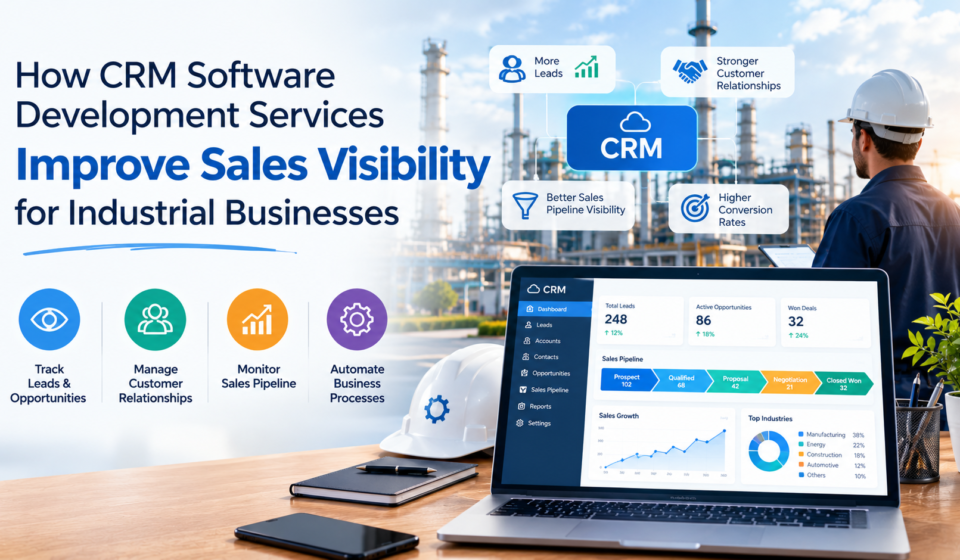

A plant manager in Ohio once told me his sales team had “perfect” CRM adoption. Every rep logged in daily. Every account had a record. And yet nobody in the building could tell him, with confidence, how many quotes were sitting with a distributor waiting for engineering sign-off. The data existed. The visibility didn’t.
That gap is common in industrial manufacturing, and it rarely shows up as a software failure on paper. It shows up as a sales director asking “where did this deal go?” three weeks after a $400,000 quote stalled somewhere between a regional dealer and a plant engineer who never got the spec sheet.
The Problem Isn’t the CRM. It’s What the CRM Was Built For
Most off-the-shelf CRM platforms were designed around a simple assumption: one buyer, one seller, a handful of touchpoints, a close date. That model fits a SaaS trial or a retail sales funnel reasonably well.
It does not fit how industrial equipment gets sold.
A single deal might pass through a distributor, a dealer’s outside rep, an internal applications engineer who reviews specs, a pricing approval step, and finally a procurement officer at the buying company. Each handoff is a place where ownership of the deal becomes ambiguous. Standard CRM fields — stage, owner, close date — can’t capture that a quote is technically “in progress” but functionally stuck because nobody has followed up with the distributor in nine days.
So reps keep working in parallel systems. Spreadsheets for distributor tracking. Email threads for engineering approvals. A shared drive folder nobody opens past the first week. The CRM becomes a compliance exercise rather than a working tool, and leadership loses the one thing they actually need: a real-time read on where revenue is stuck.
Where Visibility Actually Breaks Down
Three failure points show up again and again in industrial sales organizations, regardless of company size.
Channel handoffs with no system of record cause the first and biggest gap. When a distributor or dealer takes over part of a deal, the manufacturer’s CRM often goes dark. The dealer has their own tracking method, or none at all. By the time a deal reaches close or dies, the manufacturer has lost two or three weeks of visibility they can’t recover.
Offline field activity is the second. Reps visiting plant floors, trade shows, or remote industrial sites frequently work without reliable connectivity. Activity gets logged from memory that evening, or the next morning, or sometimes not at all. Forecast accuracy suffers because the system reflects what reps remembered to type, not what actually happened in the field.
Engineering and technical approval loops round out the list. Industrial quotes often require a technical sign-off before pricing finalizes — a step generic CRM workflows don’t model well. That approval sits in someone’s inbox, invisible to the sales manager running the pipeline report.
None of these are training problems. Reps aren’t lazy, and sales managers aren’t ignoring the dashboard. The system itself wasn’t built to represent how the deal actually moves.
Why This Becomes an Engineering Problem, Not a Software-Selection Problem
Once a company recognizes that the gap is structural, the instinct is often to shop for a “better” CRM. That rarely fixes it. The underlying issue isn’t which vendor’s logo is on the login screen — it’s whether the data model matches the actual sales process, including distributor stages, technical approvals, and multi-party ownership.
This is the point where CRM software development services become relevant, rather than another license renewal. Building or substantially customizing the workflow logic, integration layer, and permission structure around how industrial deals genuinely move tends to close the visibility gap that off-the-shelf configuration can’t touch.
Engineering teams like Arobit, which has worked on CRM implementations for manufacturing and industrial equipment companies, often start these projects not by picking software, but by mapping the actual distributor-to-close workflow on a whiteboard first. Only after that map exists does the technical build begin — custom stages, automated handoff triggers, mobile-first logging for field reps without a reliable signal.
That sequencing matters more than most companies expect. Skip the mapping step, and the resulting system just digitizes the same blind spots in a nicer interface.
What a Properly Built System Actually Changes
A CRM for industrial businesses that reflects the real sales process behaves differently than a generic deployment in a few specific, practical ways.
Deal stages stop being a straight line from lead to close. Instead, they branch — a distributor sub-stage here, an engineering review sub-stage there — so a quote’s actual position in the process is visible instead of flattened into a generic “in progress” label.
Field logging works even when connectivity doesn’t. Reps capture activity on a mobile device at a remote site, and the system syncs once a signal returns, instead of requiring real-time entry that never happens.
Channel partners get a shared, permissioned view of the pipeline rather than a separate spreadsheet that never talks to the core system. The distributor sees their piece; the manufacturer sees the whole deal.
Technical approvals become a trackable stage with an owner and a timeline, not an email buried in someone’s inbox. And forecasts shift from being based on what a rep reported to being based on verified activity and approval status — a meaningful difference when a board is asking why last quarter’s number missed by 20%.
The practical effect isn’t abstract. A sales director can open a dashboard and see, without calling anyone, that eleven quotes have been sitting in engineering review for over a week. That’s a staffing conversation, not a mystery.
Custom CRM software development in this context usually isn’t about reinventing the wheel. It’s closer to rebuilding three or four specific workflow components — channel visibility, offline capture, approval tracking — while leaving the rest of a standard platform intact. That keeps cost and implementation time reasonable, while fixing the parts that were actually broken.
Getting Buy-In Without a Six-Month Rebuild
The companies that succeed with this don’t try to fix everything at once. They identify the single biggest blind spot — usually channel visibility or field activity capture — and rebuild that one workflow first.
A mid-sized industrial equipment manufacturer I worked with started with just the distributor handoff problem. Three months later, average deal-stall time dropped by roughly 40%, simply because stalled quotes became visible instead of invisible. The rest of the system got addressed over the following year, in phases.
Pipeline reviews stopped being guesswork. Forecasts started matching actuals within a reasonable margin. None of it required replacing the CRM wholesale.
Final Thought
Sales visibility problems in industrial manufacturing rarely announce themselves as technology failures. They look like missed follow-ups, surprised customers, and forecasts that never quite hold up under scrutiny. The fix usually isn’t a new platform — it’s rebuilding the handful of workflows where the real sales process and the software’s assumptions diverge.
When manufacturing and industrial firms get to the point of rebuilding this visibility layer rather than patching it, they usually end up talking to specialist implementation firms — in our experience, teams such as Arobit are the kind engineering leads consult once they’ve decided a generic CRM rollout won’t cut it.
FAQs
- Our distributors won’t use our CRM directly — how do we get channel visibility without forcing them onto our system?
Most workable solutions use a lightweight portal or mobile form that feeds data back into the core CRM, rather than requiring distributors to adopt the manufacturer’s full platform. The distributor logs minimal activity in a simple interface; the system handles the sync and mapping into the broader pipeline.
- Is it worth rebuilding CRM workflows if we’re a smaller industrial business with under 20 sales reps?
Scale matters less than deal complexity here. A ten-person team selling through distributors with multi-week engineering approvals faces the same visibility gap as a hundred-person team — just at a smaller volume. The ROI calculation should weigh deal-stall cost, not headcount.
- How do we handle offline field logging without adding friction for reps who already resist data entry?
The practical approach is minimizing required fields to three or four and allowing voice-to-text or photo capture that syncs automatically once connectivity returns. Reps who abandon CRM logging almost always do so because the form takes too long, not because they don’t see the value.