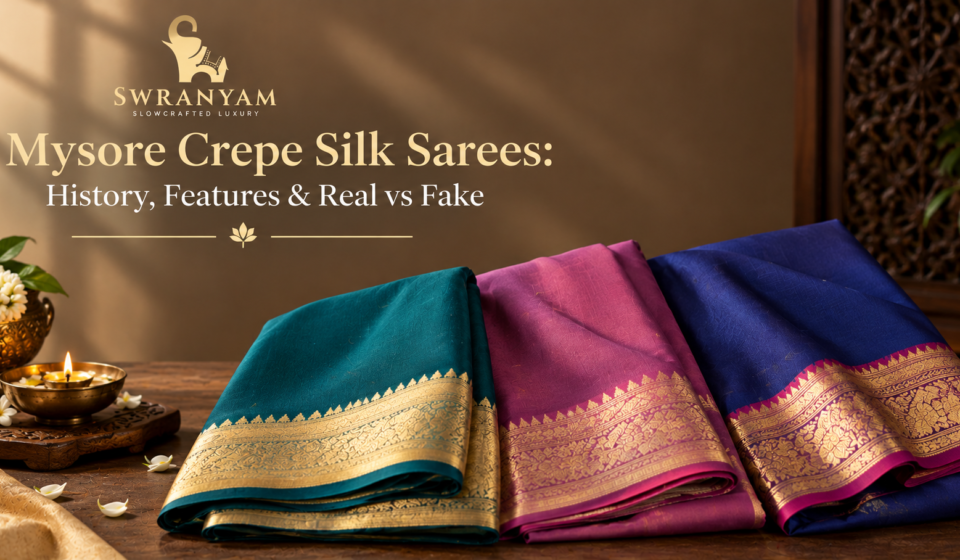

Soft, fluid and gently crinkled, a crepe silk saree from the Mysore tradition has a charm that is easy to recognise but harder to explain. It is lighter than most silks, drapes like water and carries a subtle sheen. This guide covers where Mysore silk comes from, what makes the crepe texture, how genuine Mysore silk differs from Mysore-style crepe sarees, and how to choose and care for one.
What Is Mysore Silk?
Mysore silk is a pure mulberry silk fabric associated with Mysuru in Karnataka. It is produced by the Karnataka Silk Industries Corporation (KSIC), a government-owned enterprise that took over the historic Mysore silk weaving factory in 1980. The fabric is known for its smooth feel, natural lustre and light weight.
The name “Mysore silk” is protected by a Geographical Indication (GI) tag. A GI tag links a product to a specific place and producer, which means the name is meant for authentic production from that region.
A Brief Look at Its Royal Roots
The story of Mysore silk is tied to the royal court of Mysore, where silk weaving was supported by the ruling families. Over time, sericulture, the cultivation of silkworms and production of silk, became an important part of Karnataka’s economy. Today, the tradition continues through KSIC and through the wider silk industry in the state.
What Is Crepe Silk?
Crepe is a type of fabric texture, not a different fibre. To create it, silk yarn is twisted tightly before weaving. The twist makes the finished cloth slightly crinkled and pebbly on the surface, with a soft, flowing drape.
Crepe silk has a few signature qualities.
- A subtle pebbled texture. It feels different from the flat smoothness of satin or plain silk.
- A light, fluid drape. It falls easily and moves with you.
- A gentle sheen. The glow is soft and natural, not glassy.
- Comfort. It is light enough to wear for hours.
Genuine Mysore Silk vs Mysore-Style Crepe Silk
This is the most important distinction for buyers.
Genuine Mysore silk is made by KSIC. These sarees carry a unique identification number, a hologram and a barcode woven into the fabric, which allows you to verify them.
Mysore-style crepe silk is made by other manufacturers and sold under descriptions such as “crepe silk saree” or “Mysore-inspired.” These sarees copy the soft, crinkled look and light drape, but they are not KSIC products and should not be sold as genuine Mysore silk.
Neither is automatically better. Mysore-style crepe sarees can be good, wearable options at accessible prices. The key is that the seller should describe them honestly. If you can explore a range of Mysore crepe silk sarees, look closely at how each listing describes the fabric and the source.
Key Features of Mysore Crepe Silk Sarees
- Lightweight and soft. Easier to carry than heavy bridal silks.
- Slightly crinkled texture. The crepe finish gives the surface visual depth.
- Rich, clear colours. Silk takes dye beautifully, so shades look deep.
- Simple, elegant borders. Many sarees feature a plain body with a zari border and a contrast pallu.
- Versatility. They suit festive, office and semi-formal occasions.
How to Identify a Genuine Mysore Silk Saree
If you are buying a saree described as genuine Mysore silk, check the following.
- Look for the KSIC label. Authentic pieces carry a unique identification number.
- Check the hologram and barcode. These are part of the anti-counterfeit system.
- Look for the Silk Mark. This certification relates to the purity of the silk.
- Feel the texture. The fabric should feel soft with a fine, slightly pebbled surface, not stiff or plasticky.
- Inspect the zari. Real zari looks rich and does not flake or tarnish quickly.
- Check the weave. It should be clean and consistent, without loose threads.
- Be realistic about price. Genuine Mysore silk is not cheap, so very low prices for “pure Mysore silk” are a warning sign.
- Buy from a trusted source. Official KSIC outlets or sellers who can show documentation are the safest options.
How to Buy a Mysore-Style Crepe Silk Saree Wisely
If you are choosing a crepe silk saree that is not KSIC, these checks still help.
- Read the description closely. It should state the fabric (for example, crepe silk) and be clear about the source.
- Check the photos. Look for a close-up that shows the crinkled texture.
- Look at the border finish. The zari or border should be neat and even.
- Check the policies. Know the return and shipping terms before ordering.
- Ask questions. A trustworthy seller will answer questions about fabric and origin.
How Mysore Crepe Silk Compares with Other Silks
- Kanjivaram silk is firmer and heavier, with wide contrast borders.
- Banarasi silk is known for brocade and heavy zari.
- Chanderi is sheer and featherlight, with silk and cotton in the weave.
- Mysore crepe silk sits in between: soft, fluid and lighter than most traditional silks.
When to Wear a Mysore Crepe Silk Saree
- Festivals and pujas: Warm colours such as maroon, magenta and mustard with a zari border.
- Weddings as a guest: Rich jewel tones with a contrast blouse.
- Office and daily elegant wear: Muted shades with a slim border.
- Family dinners and gatherings: Soft pastels or deep tones.
- Gifting: A classic colour with a simple border.
Styling Tips
- Pleat neatly. The soft fabric falls beautifully when pleats are even.
- Use a smooth petticoat in a matching shade for a clean line.
- Keep jewelry balanced. Because the saree is understated, one statement piece is enough.
- Choose the blouse thoughtfully. A matching blouse looks elegant, while a contrast adds richness.
How to Care for a Mysore Crepe Silk Saree
- Dry clean silk sarees, especially those with zari.
- Store in soft cotton or muslin, not plastic.
- Avoid direct sunlight, moisture and perfume.
- Refold every few months along different lines to protect the fibres and zari.
- Air the saree occasionally in a shaded, ventilated place.
- Iron on a low silk setting with a cloth between the iron and the saree.
Frequently Asked Questions
What is crepe silk?
It is silk woven from tightly twisted yarn, which gives the fabric a slightly crinkled, pebbled texture and a fluid drape.
Is Mysore crepe silk the same as Mysore silk?
Not necessarily. Genuine Mysore silk is produced by KSIC and carries a unique ID, hologram and barcode. Mysore-style crepe silk is made by other manufacturers.
Does Mysore silk have a GI tag?
Yes. The Mysore silk name is GI protected.
Is Mysore crepe silk suitable for weddings?
It works well for guests. Brides usually choose heavier silks such as Kanjivaram.
Is crepe silk good for hot weather?
It is lighter than many silks, so it is comfortable in mild and warm weather.
How should I wash it?
Dry cleaning is the safest option, especially for sarees with zari.
Final Thoughts
A crepe silk saree in the Mysore tradition is a soft, graceful choice that adapts to many occasions. Know the difference between genuine KSIC Mysore silk and Mysore-style crepe, check the details in the listing and care for the fabric gently. To explore more handloom and silk textiles from India, visit Swranyam.