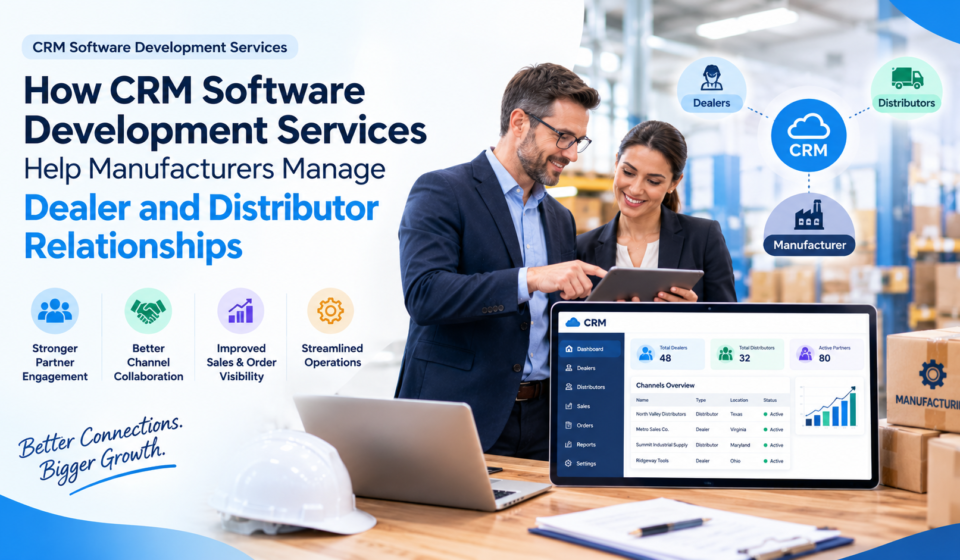
How CRM Software Development Services Help Manufacturers Manage Dealer and Distributor Relationships

Most manufacturers have a distribution problem they don’t fully see. The factory runs well. Dispatches go out on time. But somewhere between the warehouse gate and the retail shelf, things get murky. A distributor goes quiet for two weeks. Stock piles up in one region while another runs short. A licence expires and nobody caught it.
This isn’t a people problem. It’s a visibility problem, and it’s more common than most sales heads will admit.
Pharma is where this gets genuinely complicated. You’ve got C&F agents, super stockists, distributors, sub-distributors, and retailers all sitting in the same chain. Each one has its own compliance requirements, its own paperwork, its own way of communicating with your team. And most of the time, the person at head office is working off a report that’s already four days old.
Arobit works with businesses stuck in exactly this spot. The product is never the issue. It’s always the channel.
The Part Nobody Talks About in Sales Reviews
Dealer relationships don’t collapse overnight. What actually happens is a slow accumulation of small failures.
Cold-chain documentation arrives late. A distributor quietly holds a batch that’s weeks from expiry and doesn’t mention it. Your field rep visits, logs nothing, and the next person to call on that account has no idea what was discussed three months ago. Price list confusion drags on for a quarter because nobody confirmed in writing who received the updated version.
None of this shows up in a sales review until it becomes a number that’s hard to explain.
The visibility gap is the core of it. Your ERP records primary sales, what leaves your depot. Secondary sales, what distributors actually push out to retailers, often lives in a WhatsApp message or a monthly Excel someone emails across. One state could be overstocked on a fast-moving SKU while another has been out of it for two weeks, and you’d have no clean way to see both at once.
Communication compounds the problem. Recall notices, scheme changes, price revisions, they travel through calls and group chats. There’s no audit trail. When a regulator asks who was informed and when, “we called everyone” isn’t an answer that holds.
Compliance is the one that creates real panic. Drug licences lapse. Storage conditions drift. A batch recall means you need to know, within hours, exactly which distributor holds it and how much. If that information lives across three spreadsheets and two regional managers’ memories, you’re already in trouble before you’ve made a single call.
Why The Standard CRM Purchase Usually Fails
A lot of companies buy a well-known CRM thinking it’ll fix this. Salesforce, Zoho, something similar. Within a year most of them are back to running things the old way, with the CRM sitting open in a browser tab that nobody checks.
The tools aren’t bad. They’re just built for a different job. Lead management, pipeline tracking, forecasting for a direct sales team. A distributor relationship doesn’t look anything like that. It’s got credit limits, territory protections, quarterly targets, scheme eligibility, pending claim settlements, compliance documentation. Cramming all of that into a deals pipeline means your team ends up maintaining the CRM as a side project while the real work happens elsewhere.
That’s exactly what CRM software development services are designed to solve. Not a shinier interface on top of the same logic, but a system that actually reflects how a distribution channel operates. The distributor who changed legal entities mid-year. The scheme that applies to some SKUs in some territories and not others. The claim that needs three documents before it can be approved. A custom-built system handles all of that because it was built knowing those situations exist.
What the Right System Actually Looks Like in Practice
One dealer profile. Everything in it. Licence numbers, expiry dates, territory, credit limit, order history, claim status, notes from every field visit. When a licence is 45 days from expiry the account manager gets flagged automatically. Not after the shipment gets blocked. Before.
ERP integration is where a lot of the operational value sits. An order placed by a distributor flows directly into inventory and billing. No one retypes it. Credit holds, dispatch status, invoices, all of it syncs back. Your sales team stops calling finance to ask what a distributor owes because they can already see it. Anyone who’s watched a regional manager spend half a day chasing one outstanding balance figure knows this matters more than it sounds.
Claims and scheme approvals run on rules the business already follows, just not manually anymore. Document checks happen automatically. Approvals move faster. Distributors get paid faster. And that, more than any trade scheme or loyalty programme, is what actually keeps a distributor engaged.
For pharma specifically, batch traceability changes everything about how a recall works:
- Batch data linked to distributor records means a recall is a filtered report, not a phone-call marathon
- Audit logs and role-based access support regulatory expectations including 21 CFR Part 11 for companies in regulated export markets
- Serialization requirements become far less painful when batch movement is already sitting in one place
The dealer portal is worth mentioning separately. Distributors log in, place orders, check stock availability, download invoices, raise claims, view active schemes. Your customer service team fields fewer calls. Your distributors feel like they have some control over the relationship rather than waiting on someone to reply to a message.
The Adoption Problem, Which is Real
A system no one uses is just expensive shelf furniture. Most CRM rollouts that fail don’t fail because the software was wrong. They fail because the field team found it easier to keep doing what they were already doing.
Visit logging needs to work on one screen. It needs to function offline because plenty of distributor visits happen in towns where the network is unreliable. It needs to be fast enough that a rep can finish the note before walking out the door.
Distributor-facing tools need to work in local languages. Not everyone operating at the distributor level is comfortable in English, and a portal that feels foreign won’t get used regardless of how well it’s built.
Onboarding sessions should be short, regional, and led by someone the field team already trusts. The vendor runs the backend. Someone internal runs the room.
How to Choose Who Builds It
This is where manufacturers often make a mistake. They evaluate vendors on the demo. The demo always looks good.
The questions that actually matter are the awkward ones. What happens when a distributor changes its legal entity mid-contract? How do you handle a partial return on an expired batch? Who in the system can approve a scheme exception, and is there a record of that approval?
A vendor who answers those questions easily has probably built this before. One who pivots to showing you another screen probably hasn’t.
Ask about rollout approach too. Every region at once is almost always a mistake. Two or three distributor accounts first, fix what breaks in the real world rather than the demo environment, then expand. Any company presenting itself as the best CRM software development company for manufacturing should be walking you through a rollout they’ve actually completed, with the problems they hit and how they resolved them.
Post-launch support matters as much as the build. Regulations change. Schemes get restructured. A distributor exits and a new one comes in with different requirements. The system has to flex with all of that or it becomes the next thing the team works around.
Where Channel Management is Heading
Secondary sales data is starting to feed directly into demand forecasting models. That’s significant in pharma where seasonal outbreaks, monsoon cycles, and regional prescribing patterns all shift demand in ways that primary sales data alone can’t predict.
Some companies already use models to spot churn early. The system looks at how often a distributor orders. It also checks whether payments keep arriving late. When the signs show a drop in buying or repeated delays, the distributor gets flagged. This happens before the relationship fully breaks.
Mobile-first field tools are becoming the norm rather than the exception. Voice-based visit logging is getting more practical. And integration with government portals, e-invoicing systems, track-and-trace infrastructure, is moving from optional to expected.
The manufacturers getting ahead of this aren’t the ones with the biggest budgets. They’re the ones who sorted out clean data and connected systems first. Everything else builds on that foundation. The ones still on spreadsheets will find that every new capability they want to add needs groundwork they haven’t laid.
Conclusion
Distribution relationships hold together when distributors feel like partners rather than just another account code in your ERP. That feeling comes from practical things. Payments that arrive on time. Information that’s accurate. Someone who follows up without being chased. Compliance that doesn’t create friction every audit cycle.
A CRM built around how the channel actually works, not how a sales pipeline works, and wired properly into operations, is what makes those practical things possible at scale.
Arobit has built systems for businesses that run into channel complexity like this. A lot of times, the first issue is simple: your team is stuck handling details instead of making moves. Start by choosing the hardest problem you face right now. It could be claim settlements. It could be batch traceability. Or it could be figuring out what is actually in distributor warehouses. Then build your next steps from that point.
FAQs
- How is a channel CRM different from a standard sales CRM?
A standard CRM is built around leads and deals. A channel CRM takes care of a partner relationship. It handles credit limits, territory rights, compliance documents, secondary sales data, scheme eligibility and claim settlements. Different operational logic underneath.
- Can it connect to the ERP we’re already running?
Yes, and it should from day one. Orders, stock levels, pricing, outstanding balances, all of it should sync in both directions. The goal is one set of numbers everyone works from, not two systems that need reconciling every week.
- How long before it’s actually running?
The core work in a phased rollout usually needs about three to six months. It often starts with a small set of distributors. Adding the regulatory parts and the dealer portals takes extra time. Deep ties to the ERP system can also slow things down. The key is choosing the first items to build. Do that before anyone starts coding. That step helps keep the schedule realistic.