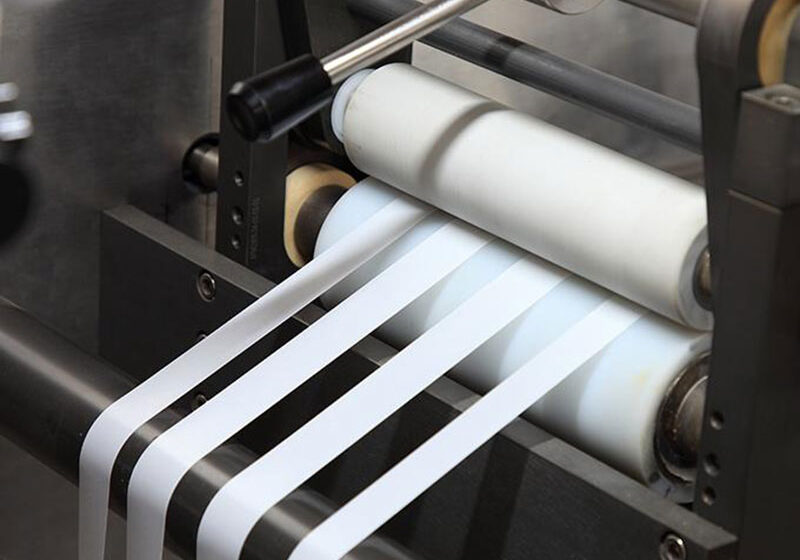

Automated water-soluble packaging lines combine several equipment systems to transform film and product materials into finished, accurately dosed pouches. Each stage has a specific role, from preparing the film to filling, sealing, cutting, and inspecting the finished packages.
Selecting the right Water Soluble Film Equipment requires an understanding of the complete production process. Equipment should be matched to the film characteristics, product formulation, pouch design, required output, and operating environment.
Film Feeding System
The film feeding system delivers water-soluble film into the packaging process at a controlled rate. Roll holders, guide rollers, tension mechanisms, and positioning components help maintain stable film movement.
Consistent feeding is important because variations in film position or tension can affect pouch dimensions and sealing accuracy. The feeding system should therefore be compatible with the selected film specifications and production speed.
Film Forming Unit
The forming unit shapes the film into the structure required for the pouch. Depending on the machine configuration, forming components may create pockets or other pouch structures before the product is introduced.
Accurate forming helps maintain consistent pouch dimensions. Forming surfaces and guides should also be designed to handle the film without unnecessary stretching, tearing, or deformation.
Product Dosing System
The dosing system determines how much product enters each pouch. Different products require different dosing approaches.
Liquid products may use pumps or controlled liquid-filling mechanisms, while powders and granular materials can require specialized dosing equipment. Viscous formulations may need controlled pumping systems to maintain consistent delivery.
Filling Nozzles
Filling nozzles transfer the product into formed film pockets. Their design and positioning can influence filling accuracy and the cleanliness of the sealing area.
The nozzle should deliver the product without excessive dripping or splashing. Keeping product away from the intended sealing surface is particularly important for maintaining package integrity.
Sealing System
After filling, the film must be sealed to enclose the product. The sealing system applies the required combination of heat, pressure, and contact time according to the film and machine configuration.
Stable sealing conditions help produce consistent package integrity. Sealing surfaces should be kept clean and inspected regularly for wear or contamination.
Cutting and Separation Equipment
Once pouches have been sealed, cutting or separation equipment creates individual packages or connected package formats.
Cutting accuracy affects pouch dimensions and presentation. The cutting mechanism should operate consistently without damaging the sealed portions of the package.
Temperature Control Components
Heating elements and temperature sensors can be important parts of packaging equipment that uses heat during sealing. Controllers regulate the temperature according to established operating parameters.
Stable temperature control can help maintain repeatable sealing performance. Sensors and heating components should be inspected periodically to identify faults before they affect production.
Control System
The control system coordinates different machine functions and allows operators to manage production parameters. Modern automated systems may integrate film feeding, filling, sealing, cutting, and alarm monitoring.
A clear control interface can make it easier for operators to adjust approved settings and identify operating issues. Parameter management can also help maintain consistency between production batches.
Sensors and Detection Devices
Sensors provide information about film position, pouch location, filling conditions, and other machine functions. They allow automated equipment to respond to changes during production.
Incorrectly positioned or contaminated sensors can cause false alarms or production interruptions. Routine inspection and cleaning should therefore be part of preventive maintenance.
Pneumatic System
Pneumatic components can be used to operate various machine movements, including actuators and mechanisms involved in forming, sealing, or cutting.
Stable compressed-air supply is important for consistent pneumatic operation. Hoses, fittings, valves, and actuators should be checked regularly for leaks, wear, and other problems.
Electrical and Drive Systems
Motors, drives, electrical controls, and transmission components provide the movement required throughout the packaging process.
These systems should be selected according to the machine’s production requirements. Proper inspection and maintenance can help reduce unexpected stops and mechanical wear.
Product Preparation Equipment
Depending on the application, the packaging line may require equipment before the actual pouch-forming stage. Product preparation can include mixing, agitation, filtration, or other processes needed to achieve suitable filling characteristics.
The preparation system should provide product consistency throughout production. Changes in viscosity, density, or particle distribution can affect downstream dosing performance.
Film and Material Handling
Automated lines also require practical systems for handling film rolls and finished pouches. Operators need sufficient space for loading materials, changing rolls, removing finished packages, and carrying out cleaning activities.
Material handling should be planned as part of the overall line layout rather than treated as an afterthought. Good positioning can improve workflow and reduce unnecessary operator movement.
Inspection and Quality Control
Quality-control equipment can help verify that finished pouches meet defined requirements. Depending on the application, inspections may focus on pouch dimensions, fill quantity, seal quality, appearance, and package integrity.
Automated inspection can be integrated into higher-volume production lines where consistent monitoring is required. Manual sampling may also be used as part of the quality-control process.
Packaging and Downstream Handling
Finished water-soluble pouches may need additional equipment for collection, counting, secondary packaging, or transport. The downstream system should be compatible with the physical characteristics of the completed packages.
Careful handling is especially important when the finished product is sensitive to moisture or mechanical damage.
Environmental Control
Water-soluble film can be affected by environmental conditions, particularly moisture. Production areas should therefore be managed according to the requirements of the selected film.
Storage and handling conditions should be established before installation. Controlling environmental factors can help provide more predictable film behavior during automated processing.
How the Equipment Works Together
An automated line typically follows a sequence such as:
- Film is loaded and fed into the machine.
- The film is positioned and formed.
- Product is accurately dosed into the formed area.
- The package is sealed under controlled conditions.
- Individual pouches are cut or separated.
- Finished packages are inspected and collected.
- Products move to downstream packaging or handling equipment.
The performance of one stage can influence the next. For example, inaccurate filling can affect sealing, while poor film positioning can create problems during both forming and cutting.
Choosing Equipment for the Production Line
Equipment selection should begin with the actual production requirements. Manufacturers should define the product type, film specification, pouch dimensions, fill quantity, target output, and expected operating schedule.
It is also important to consider cleaning, maintenance, changeover procedures, operator training, spare parts, and technical support. A complete production-line assessment can reveal requirements that may not be apparent when evaluating individual machine components.
POLYVA develops equipment solutions for water-soluble film packaging applications, with machine configurations selected according to different product and production requirements.
Conclusion
An automated water-soluble packaging line consists of more than a single machine. Film feeding, forming, dosing, filling, sealing, cutting, temperature control, sensors, automation, and quality-control systems all contribute to the final production process.
Choosing compatible equipment for each stage can help manufacturers achieve consistent pouch quality and efficient operation. The most suitable configuration depends on the film, product formulation, pouch design, production volume, and specific requirements of the packaging line.