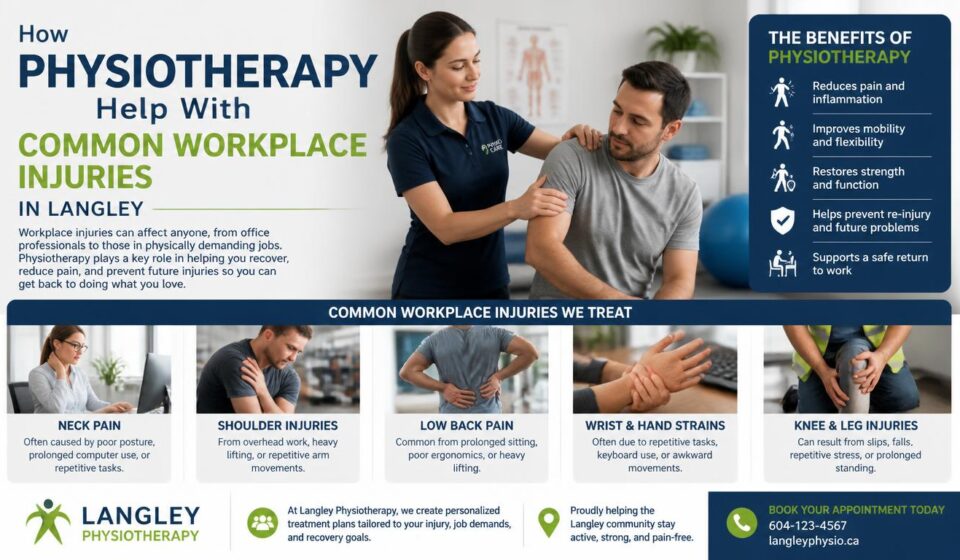

Workplace injuries can happen in almost any profession. Whether you work in construction, healthcare, manufacturing, retail, transportation, hospitality, or an office environment, repetitive movements, physically demanding tasks, slips and falls, and sudden accidents can all lead to pain and reduced mobility.
For workers in Langley, physiotherapy can be an important part of recovering from a workplace injury and safely returning to normal activities. Physiotherapists use individualized treatment plans to address pain, restore movement, rebuild strength, and help patients regain confidence in their ability to work.
If your workplace injury is covered by WorkSafeBC, physiotherapy may also form part of your rehabilitation plan, depending on your claim and treatment authorization.
Understanding Workplace Injuries
A workplace injury is not always the result of a major accident. Some injuries develop gradually because of repeated physical stress, poor ergonomics, prolonged postures, or repetitive movements.
For example, an employee who regularly lifts heavy objects may gradually develop lower back pain. An office worker may experience neck and shoulder discomfort after spending long hours at a computer, while a construction worker might develop an overuse injury from repeatedly using tools or performing the same movement. In these situations, WorkSafeBC physio Langley services can provide personalized physiotherapy and rehabilitation support to help workers manage their symptoms, restore mobility, and work toward a safe return to their regular duties.
Other injuries occur suddenly. A slip, fall, collision, lifting accident, or unexpected movement can cause sprains, strains, joint injuries, or other musculoskeletal problems.
Regardless of how an injury occurs, getting appropriate care can help support recovery and reduce the risk of persistent symptoms.
Common Workplace Injuries Treated With Physiotherapy in Langley
Physiotherapy can be used to manage many musculoskeletal injuries. Treatment depends on the type and severity of the injury, your symptoms, your job demands, and your individual recovery goals.
1. Lower Back Injuries
Lower back pain is one of the most common problems associated with physically demanding work. Lifting, bending, twisting, pushing, pulling, and prolonged standing can all place stress on the lower back.
A workplace-related back injury may cause:
- Lower back pain or stiffness
- Difficulty bending or straightening
- Muscle tightness
- Reduced range of motion
- Pain when lifting or carrying
- Discomfort while sitting or standing
- Difficulty completing normal work activities
Physiotherapy can help identify factors contributing to your symptoms and develop a rehabilitation program around your specific needs.
Treatment may include therapeutic exercises, mobility work, manual therapy, education, and a gradual strengthening program. Your physiotherapist may also teach you movement strategies that can make work-related activities more manageable.
2. Neck and Shoulder Injuries
Neck and shoulder problems can affect workers in both physically demanding and sedentary occupations.
Office employees may spend hours working at a computer, while tradespeople may regularly work overhead or carry equipment. Repetitive movements, sustained postures, and sudden injuries can all contribute to neck or shoulder pain.
Common symptoms include:
- Neck stiffness
- Shoulder pain
- Muscle tension
- Reduced shoulder movement
- Pain when reaching overhead
- Headaches associated with neck tension
- Weakness or difficulty using the affected arm
A physiotherapy assessment can help determine which movements or activities may be contributing to the problem. Treatment can then focus on improving mobility, strength, posture, and movement control.
For workers who need to return to lifting, reaching, carrying, or overhead activities, rehabilitation can gradually introduce those movements in a controlled manner.
3. Knee Injuries
The knees can be exposed to significant stress in many workplaces. Construction workers, warehouse employees, tradespeople, healthcare workers, and others may spend substantial amounts of time kneeling, squatting, climbing, lifting, or walking.
A workplace knee injury can result from a sudden incident or develop gradually through repetitive stress.
Physiotherapy may help address:
- Knee pain
- Swelling and stiffness
- Reduced strength
- Difficulty walking or climbing stairs
- Problems with squatting or kneeling
- Reduced balance and stability
Your physiotherapist can create exercises designed to restore strength and movement while progressively preparing you for the physical demands of your job.
4. Wrist, Hand, and Elbow Injuries
Repetitive hand and arm movements are common in many workplaces. Typing, operating tools, lifting objects, gripping equipment, scanning products, and other repetitive tasks can contribute to discomfort in the wrist, hand, forearm, or elbow.
Workplace injuries in these areas may affect your ability to grip, lift, type, or use tools.
Physiotherapy may focus on improving:
- Joint mobility
- Grip and forearm strength
- Flexibility
- Movement coordination
- Tolerance for repetitive activities
Your treatment plan can also include strategies for gradually increasing activity so that your affected area can adapt to work demands.
5. Ankle and Foot Injuries
Slips, trips, uneven surfaces, and falls can lead to ankle sprains and other lower-limb injuries. Workers who spend long periods standing or walking may also experience foot and ankle problems.
After an injury, people may experience pain, swelling, stiffness, weakness, or reduced balance.
Physiotherapy can help restore normal movement and strength while improving balance and stability. These factors are particularly important for workers who need to walk on uneven surfaces, climb stairs, or spend long periods on their feet.
6. Muscle Strains and Sprains
Muscle strains and ligament sprains can happen when the body is exposed to a sudden or excessive force.
For example, lifting an unexpectedly heavy object or moving quickly to prevent a fall could strain a muscle or ligament.
Physiotherapy can support recovery by gradually restoring mobility, strength, and functional capacity. Instead of simply waiting for pain to disappear, rehabilitation can help prepare the injured area for the activities you need to perform at work.
How Physiotherapy Supports Workplace Injury Recovery
Physiotherapy is more than simply treating pain. A major goal of rehabilitation is to help you safely regain the physical abilities required for everyday life and work.
Comprehensive Assessment
Treatment typically begins with an assessment of your symptoms, movement, strength, mobility, and functional limitations.
Your physiotherapist may also ask about your job duties. Understanding what your work involves can help ensure that your rehabilitation program is relevant to your actual needs.
For example, the rehabilitation requirements of someone who works at a desk may be very different from those of someone who regularly lifts, climbs, kneels, or works with heavy equipment.
Pain Management
Pain can make it difficult to move normally and complete everyday tasks. Physiotherapy may use a combination of hands-on techniques, therapeutic exercise, education, and activity modification to help manage symptoms.
The goal is not necessarily to avoid all movement. In many cases, appropriately guided movement can play an important role in recovery.
Your physiotherapist can help you understand which activities are appropriate during different stages of rehabilitation.
Restoring Mobility
Injuries can cause stiffness and reduced range of motion. This may affect your ability to bend, reach, walk, lift, or perform other workplace tasks.
Physiotherapy exercises and mobility techniques can help restore movement progressively.
Improved mobility can make everyday activities easier and may help you return to job-specific movements more comfortably.
Rebuilding Strength
Muscles can become weaker when an injured area is not used normally. Returning to physically demanding work before adequate strength has been restored may make certain activities difficult.
A progressive strengthening program can help rebuild capacity.
Exercises may begin with simple movements and gradually become more challenging as your tolerance improves. The exact exercises depend on your injury and functional goals.
Improving Balance and Coordination
Balance and coordination can be especially important after lower-limb injuries.
For workers who climb ladders, walk on uneven surfaces, operate equipment, or frequently change positions, rehabilitation may include exercises designed to improve balance and movement control.
Preparing for a Safe Return to Work
One of the most important aspects of workplace injury rehabilitation is preparing for the actual demands of your job.
Your physiotherapist may consider activities such as:
- Lifting
- Carrying
- Pushing and pulling
- Reaching
- Squatting
- Kneeling
- Climbing
- Walking
- Standing for extended periods
- Repetitive movements
Depending on your situation, your rehabilitation program may gradually introduce these activities so that you can build tolerance before returning to full duties.
What Is WorkSafeBC Physiotherapy?
WorkSafeBC provides workers’ compensation services in British Columbia. If you have suffered a work-related injury or occupational disease, your claim may provide access to approved healthcare and rehabilitation services.
Physiotherapy may be part of that rehabilitation process when it is appropriate for the injury and authorized under the claim.
Because every claim is different, workers should confirm their individual coverage, treatment authorization, and requirements with WorkSafeBC and their healthcare providers.
A physiotherapy clinic that works with WorkSafeBC claims can help guide you through the rehabilitation process and coordinate treatment according to the requirements of your claim.
When Should You See a Physiotherapist After a Workplace Injury?
It can be tempting to ignore pain and hope that it goes away, particularly if the injury seems minor.
However, persistent pain, reduced movement, weakness, swelling, or difficulty performing normal activities can indicate that an injury needs professional assessment.
Consider seeking an appropriate healthcare assessment if:
- Pain continues after an injury
- Your movement is noticeably restricted
- You have difficulty performing your job duties
- You experience ongoing weakness
- Swelling or stiffness persists
- Symptoms interfere with sleep or daily activities
- Your symptoms are getting worse rather than improving
If you have experienced a significant injury or have symptoms that could indicate a serious medical problem, seek appropriate medical attention promptly.
How a Langley Physiotherapy Clinic Can Help
Choosing a physiotherapy clinic that understands workplace rehabilitation can make treatment more relevant to your recovery goals.
A workplace-focused rehabilitation program should consider more than your symptoms. It should also consider what you need to accomplish at work.
For example, an office worker may need strategies for managing prolonged sitting and computer use, while a construction worker may need progressive training for lifting, carrying, climbing, and other physical tasks.
Your physiotherapist can work with you to establish realistic rehabilitation goals and monitor your progress throughout treatment.
Preventing Future Workplace Injuries
Physiotherapy can also provide education that may help reduce the risk of future problems.
Depending on your occupation, this may include guidance about:
- Safe movement techniques
- Strength and conditioning
- Workplace ergonomics
- Proper positioning
- Load management
- Taking appropriate movement breaks
- Gradually increasing physical workload
- Maintaining mobility and strength
Prevention strategies should be specific to the individual and their work environment rather than relying on a one-size-fits-all approach.
Why Individualized Treatment Matters
Every workplace injury is different.
Two people may have similar symptoms but completely different causes, job requirements, fitness levels, and recovery needs. This is why individualized assessment is an important part of physiotherapy.
A treatment plan should evolve as your condition improves. Exercises and activities that are appropriate early in rehabilitation may eventually be progressed to more demanding movements that better reflect your workplace requirements.
Regular reassessment can help your physiotherapist determine when and how to progress your rehabilitation.
Returning to Work With Confidence
Recovering from a workplace injury is not simply about getting rid of pain. For many workers, the bigger goal is being able to return to work and perform their responsibilities safely and confidently.
Physiotherapy can support this process by addressing mobility, strength, balance, movement patterns, and functional capacity.
A gradual rehabilitation approach can also help you understand how your body responds to increasing levels of activity. This can be particularly valuable when your job involves physically demanding or repetitive tasks.
Get Support for a Workplace Injury in Langley
A workplace injury can affect your ability to work, exercise, sleep, and enjoy everyday activities. Getting appropriate care early can help you understand your injury and take practical steps toward recovery.
For workers in Langley, physiotherapy can be an important part of rehabilitation for many common workplace injuries, including back pain, neck and shoulder problems, knee injuries, muscle strains, sprains, and repetitive-use injuries.
If your injury is related to your workplace, speak with the appropriate healthcare professional and WorkSafeBC about your claim and available treatment options. A qualified physiotherapist can then assess your condition and develop a rehabilitation program based on your symptoms, job demands, and recovery goals.
With an individualized approach to treatment, physiotherapy can help you work toward restoring movement, rebuilding strength, improving function, and safely progressing toward your regular activities.
If you are recovering from a workplace injury in Langley, professional physiotherapy assessment and rehabilitation may be an important step toward getting back to the activities that matter to you.