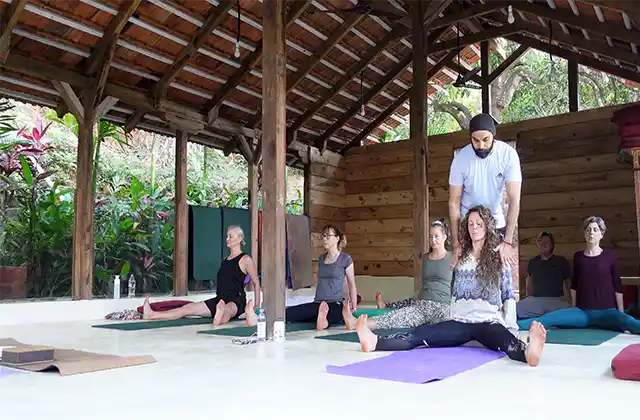

Education is often associated with classrooms, schedules, textbooks, examinations, and digital resources. The traditional gurukul model offers a different perspective. Instead of separating learning from everyday life, the gurukul system historically brought learning, discipline, routine, and personal development into the student’s daily environment.
This immersive approach has particular relevance when studying yoga because yoga has traditionally been more than a collection of physical exercises.
Learning Through Daily Life
In a residential learning environment, students spend considerable time around their teachers and fellow students. Learning can therefore happen through formal lessons as well as observation and daily routines.
For yoga students, this may include learning how teachers approach practice, meditation, discipline, communication, and philosophical study.
The environment itself becomes part of the educational process.
Immersion Creates Repetition
Skill development often depends on repetition. When students practice something regularly within a structured environment, concepts that initially seem unfamiliar can gradually become more natural.
A residential yoga setting can provide repeated exposure to practices such as asana, pranayama, meditation, chanting, philosophy, and reflective study.
Rather than learning one technique and immediately moving on, students have opportunities to revisit concepts from different perspectives.
The Teacher’s Role
The gurukul model also emphasizes close interaction between teacher and student. A teacher is not simply someone who delivers information during a scheduled lesson.
Observation can become part of education. Students can watch how experienced practitioners approach discipline, preparation, teaching, and personal practice.
This relationship can be particularly useful in yoga because many aspects of practice are experiential.
Immersive Learning and Modern Yoga Education
Modern yoga education has evolved significantly, and not every yoga school follows a traditional gurukul structure. However, the principle of immersion remains relevant.
Students who spend concentrated time studying yoga can create a rhythm in which practice, theory, reflection, and discussion support one another.
This can be especially valuable for people considering yoga teacher training because teaching requires more than knowing individual postures.
Finding the Right Learning Environment
Anyone considering studying yoga in India may want to compare factors such as curriculum, teaching methodology, residential arrangements, duration, lineage, practical training, and philosophy.
The Best Yoga School in India Guide can serve as a useful resource for readers researching different schools and learning environments.
The gurukul model demonstrates an important educational principle: sometimes learning becomes deeper when it is integrated into daily life rather than confined to a classroom.
For yoga students, this immersive approach can create opportunities to understand not only what yoga teaches, but also how its practices and principles can become part of everyday living.
In this article, I will list the “15 Best Yoga School in India for 2026″ focusing on key locations, Yoga TTC Courses, and unique aspects of each Yoga School in India. This will help you choose the right one for your needs.
This is the comprehensive list of the Best Yoga Schools in India ever. In this list, you will learn everything you need about enrollment in a Yoga School for Yoga TTC.
As a beginner or an advanced yoga practitioner, you may have questions about Yoga School for Yoga TTC. This “15 Best Yoga School in India for 2026” will provide in-depth knowledge.