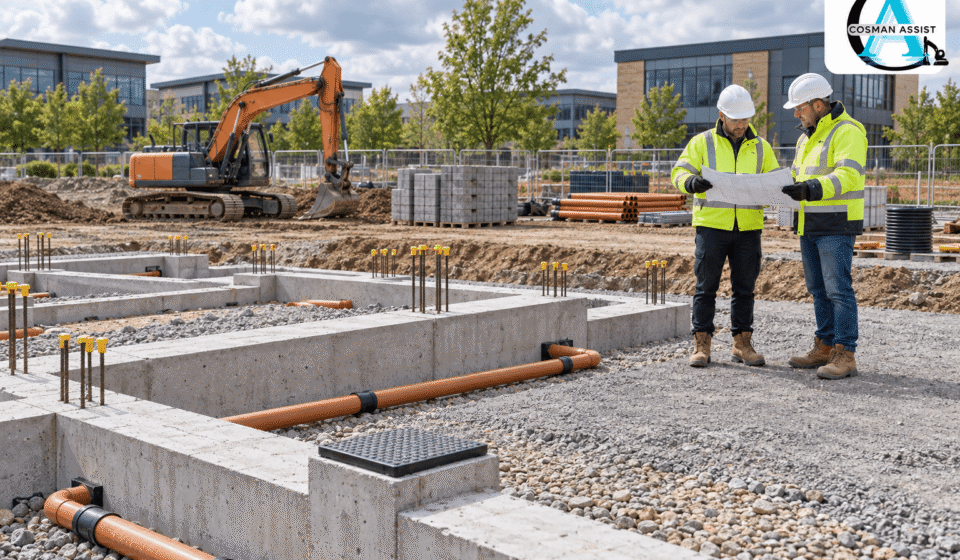

A construction project can look straightforward on paper while presenting several challenges below ground. Foundations, drainage, utility routes and concrete structures must fit together within the same site. When these activities are poorly coordinated, even a small conflict can interrupt the programme and create additional costs.
For clients selecting a groundworks contractor in Milton Keynes, understanding this coordination is essential. The contractor should be able to interpret the construction information, identify interfaces and organise work around the requirements of the wider project.
The same considerations apply to commercial developments, school extensions and industrial projects across Buckinghamshire and Bedfordshire. Successful groundworks establish more than a stable foundation; they create the conditions for subsequent construction to proceed accurately and efficiently.
Groundworks Are More Than Excavation
Groundworks services cover the preparation and construction activities required below ground and around a development. Depending on the agreed scope, these may include site clearance, earthworks, foundations, drainage, utility ducting, reinforced concrete, slabs and external finishes.
These activities are connected. A drainage pipe may cross near a foundation, a service duct may enter through a slab, and finished paving levels may depend on building entrances and drainage chambers.
Treating each activity as an isolated task can allow important details to be overlooked. Reviewing the complete package helps the construction team understand where activities interact and which decisions must be resolved before installation begins.
Site Preparation Creates a Practical Starting Point
Before excavation starts, the site needs suitable access, organised working areas and reliable information about existing conditions. Site preparation helps establish these requirements.
The team should review available surveys, ground investigation information, service records and construction drawings. Plant movement, material storage and delivery access also need consideration, particularly where the working area is restricted.
Enabling works can then prepare the site for the main construction package. Their exact scope varies, but the objective remains consistent: create a workable environment for the activities that follow.
For projects in Milton Keynes or Aylesbury, preparation should reflect the actual site rather than assumptions about local ground conditions. An occupied extension and an open development site may require very different arrangements.
Foundations and Drainage Must Work Together
Foundations transfer structural loads into the ground, while drainage manages water through the specified network. Although they perform different functions, both occupy the below-ground environment.
A conflict between a foundation and a drainage route can affect excavation, levels and construction sequencing. Identifying that conflict after installation may require additional work or revised details.
The contractor should review the relevant drawings together and raise discrepancies through the project’s agreed process. Changes to structural or drainage arrangements should be considered by the appropriate designers rather than improvised during excavation.
This coordinated approach is particularly useful on commercial groundworks projects, where multiple structural bases, service routes and connection points may share a limited working area.
Reinforced Concrete Requires Accurate Preparation
Reinforced concrete structures rely on the correct positioning of steel, formwork, embedded components and structural connections. Accurate preparation supports both the concrete element and the construction installed above it.
Before a pour, the team needs to check dimensions, levels, reinforcement and any specified penetrations or service entries. Holding-down bolts and starter bars also require attention because their positions affect later structural work.
Once concrete is placed, correcting an overlooked detail can become significantly more difficult. Defined inspection stages provide an opportunity to identify problems while access remains available.
Quality control should therefore follow the construction sequence, rather than depend solely on a visual review of the finished concrete.
A Coordinated Contractor Can Simplify Package Delivery
Using a contractor with connected capabilities can make communication and sequencing more straightforward. Foundations, drainage, utilities, concrete and external works can be discussed within a shared delivery plan.
Clients assessing a groundworks contractor Milton Keynes should review the proposed scope carefully. A broad service offering is useful, but the appointment still needs to establish which activities, materials, inspections and records are included.
Cosman Assist provides groundworks and civil engineering services across Buckinghamshire, Bedfordshire, Oxfordshire and Hertfordshire. Its service range includes site preparation, foundations, drainage, utilities, concrete and external works.
Relevant project experience and a clear understanding of package boundaries should guide contractor selection alongside price and availability.
School Projects Introduce Additional Coordination Needs
School groundworks can involve construction beside occupied classrooms, pedestrian routes and existing infrastructure. These conditions introduce practical requirements beyond the engineering details alone.
Access, deliveries and working areas must fit the principal contractor’s site arrangements. Activities may also need to account for school operations and restricted periods of access.
Projects in Aylesbury, High Wycombe or other Buckinghamshire locations should be assessed individually. A new school site, holiday-period extension and live-campus development do not present identical constraints.
The proposed groundworks team should understand those differences and explain how its resources and sequence will support the agreed construction plan.
External Works Should Be Considered Early
External works may be completed near the end of a programme, but their requirements influence earlier groundworks. Paths, access areas, kerbing and paving must align with drainage, building entrances and finished levels.
Planning these relationships early helps prevent late-stage conflicts. It also allows the team to decide when surfaces can be completed without exposing them to unnecessary construction traffic.
An external works contractor needs accurate information about the infrastructure already installed and the activities still to come. Staged completion and protection arrangements can then be considered where appropriate.
The result is a more coherent transition from active construction to a usable completed development.
Clear Records Support Reliable Handover
Much of a groundworks package becomes concealed as construction progresses. Without suitable records, following trades may struggle to identify the position or status of buried infrastructure.
Depending on the specification, handover information may include surveys, inspection records, photographs, concrete information and drainage testing results.
These requirements should be agreed before work begins. The team can then capture the necessary information at the correct stage rather than attempt to reconstruct it later.
A useful handover also identifies outstanding actions. This gives the principal contractor a clearer understanding of which areas are ready and what must be resolved before subsequent activities proceed.
Choosing Groundworks Support Across the Region
Clients searching for groundworks in Bedford, Luton or Milton Keynes should look beyond proximity alone. Relevant experience, supervision, available resources and communication all influence the suitability of a contractor.
Provide current drawings, specifications, site details and programme requirements when requesting a quotation. Ask the contractor to explain its assumptions and identify any missing information.
Regional coverage offers a useful starting point, but the final appointment must reflect the specific project.
By coordinating site preparation, foundations, drainage, concrete and external works from the outset, construction teams can reduce avoidable conflicts and establish a more dependable basis for delivery. That early attention supports the performance of the complete development, not just the work below ground.


