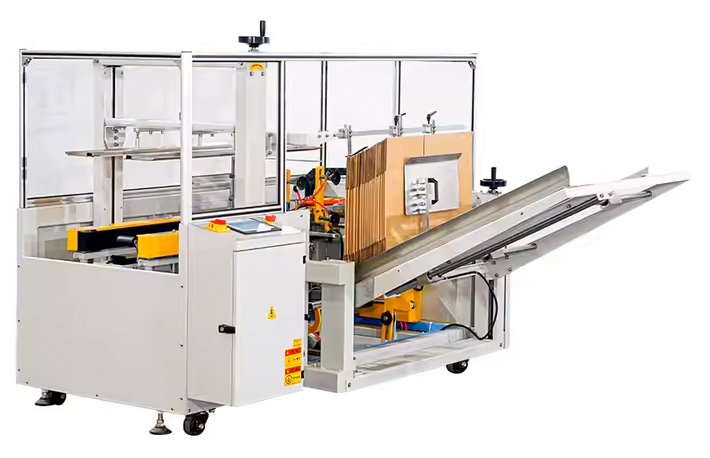

Packaging operations can vary significantly in production volume. A small business may process a limited number of cartons each day, while a large manufacturing facility may require continuous case preparation across multiple shifts. Choosing equipment that matches the required workload is therefore important for maintaining efficiency without creating unnecessary complexity.
A Case Erecting Machine can automate the process of opening, forming, and preparing flat cartons for filling or sealing. The right configuration depends not only on production speed but also on carton formats, available space, labor requirements, changeover frequency, and how the equipment will integrate with the rest of the packaging line.
Low-Volume Packaging Operations
Businesses with relatively low production volumes may not need equipment designed for continuous high-speed operation. Their priorities may instead include straightforward operation, reasonable setup requirements, and flexibility between production runs.
For these applications, automation can reduce repetitive manual carton preparation while allowing operators to remain involved in other parts of the packaging process.
Medium-Volume Production
Medium-volume facilities often need a balance between productivity and flexibility. They may process several carton sizes or handle different products throughout the working day.
In this environment, changeover time becomes an important consideration. Equipment that can be adjusted efficiently for different case formats can help reduce downtime between production batches.
High-Volume Manufacturing
High-volume operations place greater demands on packaging equipment. Cartons may need to be formed continuously for extended periods, making speed, reliability, and integration particularly important.
A high-output system should be able to maintain consistent case formation without creating a bottleneck for filling, packing, sealing, or palletizing equipment. Preventive maintenance also becomes increasingly important when machinery operates for long production cycles.
Comparing Production Requirements
Production volume is only one part of the equipment-selection process. Businesses should evaluate several factors before choosing a case-forming system.
| Production consideration | Why it matters |
|---|---|
| Daily carton volume | Helps determine the required operating capacity |
| Carton dimensions | Establishes equipment compatibility |
| Number of carton formats | Influences changeover requirements |
| Operating hours | Affects durability and maintenance needs |
| Available labor | Helps determine the potential value of automation |
| Line integration | Determines how the machine will interact with other equipment |
Considering these factors together provides a clearer picture of the most appropriate equipment configuration.
Carton Size and Material Compatibility
A machine’s suitability also depends on the cartons being processed. Case dimensions, board thickness, stiffness, scoring, and construction can all affect forming performance.
Facilities that use multiple carton formats should confirm that each format falls within the machine’s operating range. Testing representative cartons can help identify feeding or forming problems before equipment is introduced into regular production.
Balancing Speed With Reliability
It can be tempting to select equipment based primarily on maximum output. However, the fastest machine is not necessarily the best choice if its capacity greatly exceeds the requirements of the rest of the production line.
Balanced performance is often more useful. The case-forming stage should provide cartons at a rate that works effectively with filling, sealing, conveying, and other downstream processes.
Changeovers Between Carton Formats
Frequent product changes can make quick and repeatable adjustments valuable. If operators must spend considerable time changing machine settings, overall productivity may decrease even when the equipment has a high operating speed.
Clear setup procedures and accessible adjustment points can help make format changes more manageable. The complexity of each changeover will depend on the machine design and the differences between carton sizes.
Labor and Automation Considerations
For lower production volumes, businesses may determine that partial automation provides sufficient benefits. Higher-volume facilities may have stronger reasons to automate repetitive case preparation because manual handling can require significant labor over extended production periods.
Automation can also improve process consistency by reducing differences in how individual workers open and prepare cartons. However, trained operators remain important for machine setup, monitoring, troubleshooting, and maintenance.
Maintenance Requirements
Production volume has a direct relationship with equipment usage. Machines operating for longer periods may require more frequent inspections and component replacement.
A preventive maintenance program can include:
- Checking forming and feeding components
- Inspecting sensors and electrical connections
- Cleaning carton dust and debris
- Monitoring pneumatic systems
- Checking for signs of mechanical wear
- Recording recurring faults and downtime
Regular maintenance helps identify developing problems before they become major production interruptions.
Integration With Existing Packaging Lines
A case erector should be evaluated as part of the complete packaging workflow. In a small operation, it may feed cartons to an operator or a simple conveyor. In a larger facility, it may need to communicate directly with automated filling, sealing, labeling, and palletizing equipment.
Proper coordination helps prevent one stage from consistently running faster or slower than another. This can make overall line efficiency more important than the output of any single machine.
Choosing Equipment for Future Growth
Production requirements can change as a business expands. A system that meets today’s needs may eventually become a limitation if carton volumes increase substantially.
Businesses should therefore consider both current and anticipated requirements. However, selecting excessive capacity can also add unnecessary cost and complexity. The goal is to find a practical level of automation that supports present operations while allowing reasonable room for growth.
The Role of Techflow Pack
Manufacturers and packaging businesses can make better equipment decisions by assessing their actual production patterns rather than relying solely on advertised speed figures. Understanding carton requirements, workload, labor availability, and line integration provides a more realistic basis for comparison.
The most suitable case-forming solution is ultimately the one that fits the operation’s production volume and working conditions while providing dependable, repeatable performance.
Finding the Right Balance
Case erecting equipment can serve a wide range of packaging environments, from smaller batch-oriented operations to demanding high-volume production lines. The appropriate choice depends on more than how many cartons need to be processed.
By considering production volume, carton compatibility, changeover frequency, maintenance, labor, and integration requirements together, businesses can select a case-forming approach that supports efficient and consistent packaging operations.