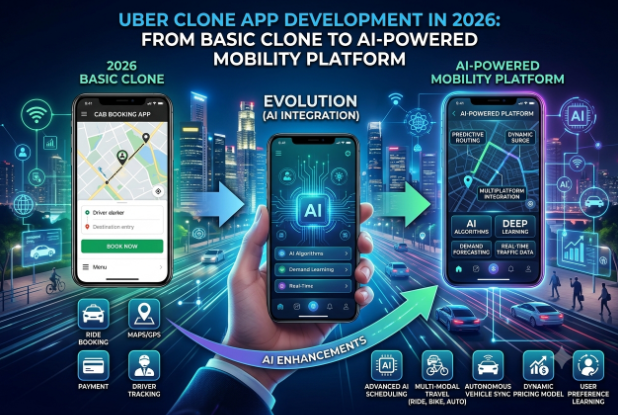

A few years back, building a ride-hailing app was simple math: copy Uber’s core flow, slap on your own branding, and launch. That playbook is basically dead now. Riders expect their app to think a little — predict wait times before they ask, reroute around traffic before it happens, flag a driver who seems off before something goes wrong. So Uber Clone App Development in 2026 looks less like cloning a product and more like building a genuinely intelligent transportation system that happens to share Uber’s basic shape.
If you’re a founder or a product team weighing whether to build one, this is worth fifteen minutes of your time.
The Shift Nobody Saw Coming
Two years ago, “clone app” meant a template with maps, payments, and a matching engine. That got you a functional app, but it also got you a forgettable one — every competitor had the same three screens. What’s changed the game is AI-Powered Mobile App Development becoming affordable and accessible rather than something only Uber’s own engineering team could pull off. Small dev shops now plug in machine learning models for pricing, routing, and fraud detection the same way they’d plug in a payment gateway. That shift is why so many new entrants in this space are outperforming apps that launched with bigger budgets three years ago.
What “Clone” Actually Means Now
Let’s clear something up: nobody serious is copying Uber’s code. Uber Clone App Development refers to replicating the proven business model — rider app, driver app, admin dashboard, real-time matching — and then customizing it heavily for a specific market, city, or niche (think medical transport, campus shuttles, or intercity carpooling). A Uber Clone App Development Solution gives businesses a tested foundation so they’re not reinventing GPS tracking, fare calculation, user management, or booking workflows from scratch. What you build on top of that foundation is where the real product lives.
The Tech Stack That Actually Matters
A modern build typically includes:
● Real-time GPS and mapping (Google Maps, Mapbox, or open-source alternatives for cost control)
● Dynamic pricing engines that adjust for demand, weather, and local events
● In-app payments with regional wallets, not just cards
● Driver verification and background checks, often automated now
● Push notifications and live chat between rider and driver
● An admin panel for dispute resolution, payouts, and analytics
None of that is new. What’s new is layering intelligence over it. This is where Ride-Hailing Clone App Development has genuinely matured — the underlying architecture is stable and well-understood, so teams can spend their energy on differentiation instead of plumbing.
Why AI Is No Longer Optional
Here’s the honest answer to “do I really need AI in my app: if your competitors have it and you don’t, riders will feel the difference within a week, even if they can’t name why. A few areas where it shows up:
Smarter matching. Instead of just “nearest driver,” models now weigh driver rating, route familiarity, and even predicted traffic to pick the match that gets the rider there fastest, not just the one that responds first.
Predictive demand. Apps can now forecast surge zones 20–30 minutes ahead using historical patterns, weather data, and local events, so drivers reposition before demand spikes rather than chasing it.
Safety layers. Route-deviation alerts, voice-stress detection during SOS calls, and anomaly detection on driver behavior are becoming standard rather than premium add-ons.
Support automation. AI chatbots now resolve a large share of routine disputes — wrong fare, lost item, late cancellation — without a human agent, cutting resolution time from hours to minutes.
This is really what AI-Powered Mobile App Development has come to mean in this industry: not a chatbot bolted onto a menu, but intelligence woven into pricing, matching, safety, and support all at once.
Picking the Right Development Partner
A few questions worth asking any agency or freelancer before you commit:
1. Have they shipped a live ride-hailing app with real drivers and real transactions, not just a demo?
2. Can they show you how their matching or pricing model actually works, or is “AI” just marketing language?
3. Do they understand your local regulations around driver licensing, insurance, and payment compliance?
4. What’s their post-launch support plan? Ride-hailing apps break in ways that only show up under real traffic.
Cost estimates for a solid MVP currently range from $15,000 for a lean, template-based build to well over $80,000 for a fully custom, AI-integrated platform with native apps for both iOS and Android. The gap mostly comes down to how much of that intelligence layer you’re building versus buying off the shelf.
Final Thoughts
Uber Clone App Development in 2026 isn’t about copying a giant — it’s about using a proven blueprint as a starting point and then making smarter decisions than the giant does, at a fraction of the cost. The barrier to entry has genuinely dropped, but the bar for what counts as a “good” app has risen right alongside it. If you’re going to build one, treat the AI layer as core infrastructure, not a feature to bolt on later. Pick a niche, get the fundamentals rock-solid, and let the intelligence do the differentiating. That’s the approach that actually has a shot at standing out this year.