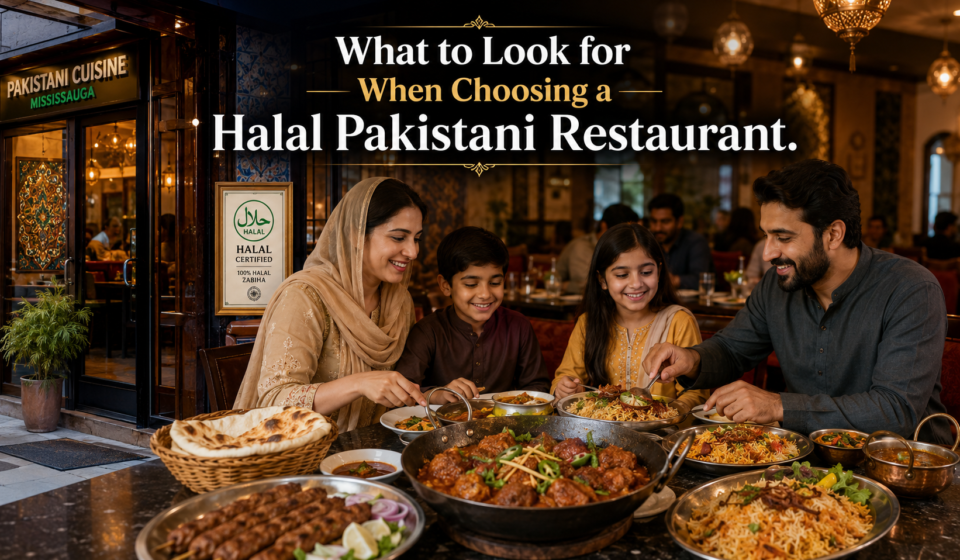

You’ve probably seen it before. A restaurant with a big “100% Halal” banner in the window, a busy dining room, good reviews online and no real way to check if any of it is actually true. That’s the tricky part about eating out as a Muslim family, or anyone who takes halal seriously: the word “halal” gets used a lot, but it doesn’t always mean the same thing from one kitchen to the next.
If you’re searching for a proper halal Pakistani restaurant in Mississauga, the good news is you don’t need to be an expert to tell the difference. You just need to know what questions to ask and what small details actually matter. That’s what this guide is for a straightforward look at what separates a restaurant that truly earns your trust from one that’s just good at marketing itself.
A “Halal” Sign Doesn’t Always Mean What You Think
Here’s the honest truth: anyone can put up a sign. Real halal compliance is a whole process where the meat comes from, how the animal was slaughtered, how the kitchen keeps things separate from non-halal food, and whether anyone is actually checking on this regularly. A sign on the wall can’t tell you any of that.
How Halal Certification Actually Works in Canada
In Canada, real halal certification comes from independent, third-party organizations not from the restaurant itself. The Islamic Food and Nutrition Council of Canada (IFANCC), which is connected to the internationally known IFANCA group founded back in 1982, is one of the country’s most established certifying bodies. They inspect kitchens, check where the meat comes from, and require restaurants to go through renewal audits to keep their certification current. Other groups like the Halal Monitoring Authority (HMA Canada) and ISNA Canada’s Halal Certification Agency follow a similar process. When a restaurant’s Pakistani dining experience is backed by this kind of paperwork, you’re not just taking their word for it, there’s an actual system behind the claim.
Easy Questions That Tell You Everything
You don’t need to interrogate anyone. Just ask a few simple things, and pay attention to how confidently they answer:
- Who certified you as halal, and is it still valid?
- Where does your meat come from — one supplier, or a few?
- Is your kitchen only used for halal food, or shared with other items?
- Can you tell me the name of your certifying body?
A restaurant that’s serious about being halal will usually answer these without missing a beat.
Good Pakistani Food Should Actually Taste Like Home Cooking
Being halal is one thing. Tasting like it belongs on a table in Lahore or Peshawar is a completely different thing, and honestly, just as important if you’re chasing that real Pakistani dining experience.
The Dishes That Give a Kitchen Away
A few dishes are basically a test. Charsi karahi, the classic wok-cooked, tomato-based dish should be rich, a little oily, and never watery. Seekh kebabs should be hand-shaped and grilled over charcoal, not squeezed out by a machine and deep-fried. Nihari should be slow-cooked for hours, not rushed. And a proper biryani should have separate, fluffy grains of rice with real flavor in every layer, not just a mushy pile of rice and meat. If a kitchen nails these basics again and again, that tells you more than any review ever could.
Why Regional Style Still Matters
Pakistani food isn’t one single flavor it changes depending on where in the country it comes from. Lahori food, Peshawari food, and Karachi-style food all bring something different to the table, shaped by generations of slow cooking, open-flame grilling, and spice blends passed down through families. A menu that just says “Pakistani/Indian” without naming any of this is usually playing it safe instead of showing real expertise. Look for restaurants that aren’t afraid to name their style.
Mississauga Has Quietly Become a Real Home for Pakistani Food
This didn’t happen overnight. Mississauga has grown into one of the most diverse cities in the Greater Toronto Area, and that shift is exactly why the food scene here looks the way it does today.
The Numbers Behind the Growth
According to Statistics Canada’s 2021 Census, South Asian residents make up close to 25% of Mississauga’s population, and Muslim residents represent roughly 17% of the city, one of the largest religious communities after Catholics. That’s a big part of why a proper halal restaurant guide Mississauga shoppers can trust has become so useful: with more demand comes more restaurants, and not all of them have the same standards. This is exactly the kind of neighborhood where restaurants like Charsi Karahi & BBQ, located at 63 Queen Street S in Mississauga, have built a following by sticking to hand-slaughtered halal meat and traditional cooking methods rather than cutting corners for speed.
A Quick Checklist Before You Book a Table
Save this for your next family dinner or when you’re trying somewhere new:
- Halal certificate is visible, dated, and from a real body (IFANCC, HMA, or ISNA Canada)
- Staff can name their certifying organization without hesitating
- Menu names specific regional styles instead of just “Pakistani/Indian”
- Signature dishes are made fresh, not pre-cooked and reheated
- Reviews mention consistency over multiple visits, not just one lucky night
- Kitchen is dedicated to halal prep, with no mixed sourcing
- Busy on weekends usually a sign locals actually trust the place
Trustworthy vs. Risky: A Simple Comparison
| What You’re Checking | Risky Sign | Trustworthy Sign |
|---|---|---|
| Halal claim | Just a sign or verbal promise | Dated certificate from a recognized body |
| Menu style | Generic “Pakistani/Indian” mix | Named regional styles (Lahori, Peshawari, Karachi-style) |
| Meat prep | Pre-cooked, reheated | Fresh, made to order |
| Grilling method | Electric grill or deep-fried | Charcoal or tandoor |
| Sourcing | Staff can’t say where meat comes from | Staff names the supplier confidently |
| Reviews | One good review, rest mixed | Consistent praise over time |
Warning Signs Worth Taking Seriously
If someone gets defensive when you ask about certification, that’s worth noticing. Same goes for a kitchen that cooks halal and non-halal food side by side, or a menu that reads like it was copy-pasted from another restaurant’s website. And if reviews keep repeating the same complaint, undercooked meat, bland karahi, inconsistent service trust the pattern more than any single five-star review.
A Simple Comparison That Says It All
Picture two restaurants a few blocks apart, both showing up in the same halal restaurant search. One has a certificate posted by the door, staff who know exactly who certified them, and kebabs grilled fresh over charcoal. The other just says “we’re halal” on a sign, can’t answer where the meat comes from, and pre-cooks everything in the morning. Both technically compete for the same customer looking for a halal Pakistani restaurant in Mississauga but only one of them has actually earned that trust.
Quick Questions People Often Ask
Is every Pakistani restaurant in Mississauga automatically halal?
No. Even in areas with a large Muslim population, some restaurants serve a mixed menu or don’t use certified suppliers. Always check instead of assuming.
What’s the difference between “halal-friendly” and “halal-certified”?
“Halal-friendly” is just a claim with nothing behind it. “Halal-certified” means an accredited group like IFANCC, HMA Canada, or ISNA Canada has actually inspected the sourcing and prep and issued a real certificate.
Does paying more guarantee a better experience?
Not really. Price usually reflects decor and portion size more than authenticity. A modest kitchen using charcoal grilling and fresh ingredients can easily beat a pricier place relying on shortcuts.
How do I check certification quickly?
Look for the certificate near the entrance or on the restaurant’s website, or just call and ask who certified them and when it was last renewed. If they’re serious about it, the answer comes fast.
Final Thoughts
Finding a real halal Pakistani restaurant in Mississauga really comes down to two things: making sure the halal claim is backed by an actual certificate, and making sure the food itself tastes like it was made with real technique, not shortcuts. Places like Charsi Karahi & BBQ, which offers dine-in, takeout, and catering alongside a halal breakfast buffet of Halwa Puri, Paya, and Tawa Qeema, show what it looks like when both boxes are checked properly. Mississauga’s Pakistani and Muslim communities have built real demand for this kind of standard, and taking a few extra minutes to check certification and ask a couple of honest questions will lead you to a far better Pakistani dining experience every single time.
Read this article, Best Budget-Friendly Cottage Rentals in Ontario.