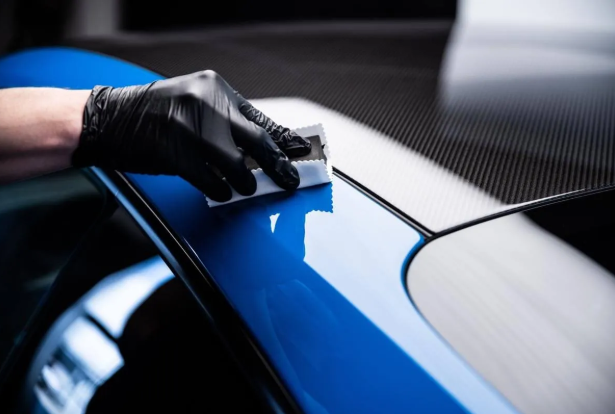

Car paint protection has moved well beyond the days when a regular coat of wax was considered enough. Modern detailing products use increasingly sophisticated materials to deal with sunlight, moisture, road grime, and the small marks that appear through everyday use. Among the newer names attracting attention is borophene coating, while 9H ceramic coating remains a familiar choice for vehicle owners looking for durable surface protection.
Both are marketed as advanced solutions, but they are not interchangeable simply because they fall into the same broad category. Their formulations, performance claims, and application requirements can differ considerably. For a car owner deciding between the two, understanding what each coating is intended to do is more useful than relying on a hardness number or a product label.
What Is Borophene Coating?
Borophene is a two-dimensional material made from boron atoms. It has been studied extensively in materials science because of its unusual physical and chemical characteristics. In automotive detailing, borophene-based coatings are positioned as a newer generation of surface protection.
There is, however, an important distinction between laboratory properties and automotive performance. Not every product marketed as a borophene coating uses the same formulation, and results can vary according to preparation, application technique, and maintenance. Buyers should therefore look at the actual product specifications instead of assuming that every borophene product will perform identically.
How Does 9H Ceramic Coating Work?
A 9h ceramic coating is generally a silica-based liquid coating that chemically bonds with the vehicle’s clear coat as it cures. The term “9H” refers to the pencil hardness scale and is commonly used in the automotive detailing industry to describe the hardness of the cured surface.
That hardness can help the coating resist fine scratches, swirl marks, and certain forms of surface contamination. More importantly, ceramic coatings are valued for their hydrophobic behavior. Water tends to form tight beads and move across the surface instead of sitting flat.
This makes the car easier to wash and can help reduce the amount of grime that remains attached to the paint.
Borophene vs. Ceramic: What Is the Real Difference?
The most significant difference is not necessarily which coating is “harder.” It is what the formulation is designed to offer.
A traditional 9H ceramic coating focuses heavily on creating a durable, chemically resistant, and hydrophobic surface. Borophene-based products may place greater emphasis on slickness, thermal properties, or other characteristics associated with the underlying material.
That doesn’t automatically make one superior.
For a daily-driven vehicle, the quality of the finished coating and the condition of the paint beneath it can have a greater effect on the result than the name of the technology itself.
A properly prepared surface with a reliable ceramic product can perform extremely well. A newer coating can also be a worthwhile choice, but it should be selected based on credible specifications rather than the appeal of “nanotechnology” alone.
Which One Handles Environmental Exposure Better?
Both types of coating are intended to reduce the effect of everyday environmental exposure.
UV radiation can gradually affect an unprotected clear coat. Rainwater may leave mineral deposits, while bird droppings, tree sap, and road pollutants can become difficult to remove if left on the surface.
A properly cured coating creates a barrier that gives the owner more time to clean these contaminants before they affect the paint. Its hydrophobic behavior also means that water and loose dirt are less likely to remain on the surface.
The exact level of resistance depends on the formulation and installation. It is therefore worth asking the detailing center for product-specific durability information rather than relying solely on general claims about ceramic or borophene technology.
What About Scratches and Stone Chips?
Neither borophene coating nor 9H ceramic coating is designed to stop serious stone chips or deep scratches. A coating is a thin surface layer; it isn’t a thick impact-absorbing film.
If a vehicle regularly travels on highways or roads with loose gravel, Paint Protection Film may be a more appropriate choice for vulnerable areas such as the front bumper, bonnet, and mirrors.
A coating can still be applied to suitable surfaces alongside PPF, depending on product compatibility.
Application Matters More Than the Label
One of the most overlooked aspects of paint protection is preparation.
Before applying either coating, detailers should remove dirt, iron deposits, old contaminants, and other surface impurities. Paint correction may also be necessary if the vehicle has visible swirls or scratches.
Once the surface is properly prepared, the coating can be applied evenly and allowed to cure under suitable conditions. Rushing this stage can lead to uneven gloss, high spots, or reduced durability.
In short, an expensive coating installed poorly is unlikely to deliver the result the owner expects.
Which Coating Should You Choose?
The right choice depends on what you value most.
A 9H ceramic coating is a sensible option for owners who want established coating technology, strong water repellency, gloss, and relatively straightforward maintenance. A borophene-based product may appeal to those interested in newer coating formulations and the material properties associated with them.
Before making a decision, compare the actual product, warranty, expected lifespan, preparation process, and installer experience.
Conclusion
The arrival of borophene coating reflects how quickly automotive surface-protection technology continues to develop. At the same time, 9H ceramic coating remains a proven and widely understood option for maintaining a vehicle’s finish.
Neither should be viewed as a magic shield. Both work best when applied to properly prepared paint and maintained correctly.
For car owners, the smartest choice is ultimately less about choosing the newest-sounding technology and more about finding a coating whose characteristics match the vehicle’s usage, parking conditions, and long-term maintenance plans.