
ATAR Calculator vs ATAR Predictor: What’s the Difference?
If you are a Year 12 student researching university options, you have probably come across two terms: ATAR calculator and ATAR predictor. They may sound like the same thing, but they are actually used for slightly different purposes.
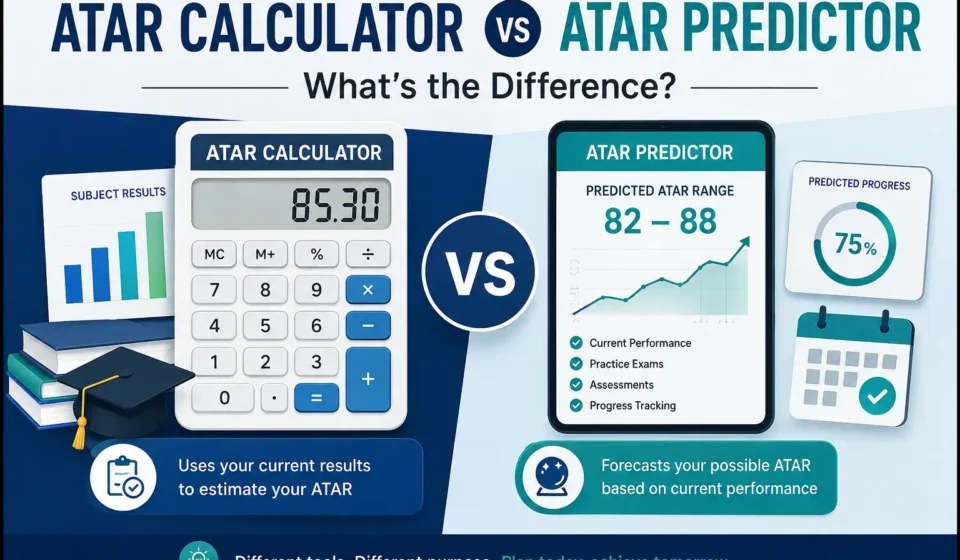
An ATAR calculator generally helps you estimate an ATAR based on your academic results, subjects, study scores, or other relevant inputs. An ATAR predictor, on the other hand, is usually designed to forecast the ATAR you might receive based on your current or expected performance.
The difference can seem small, but it matters when you are planning subjects, comparing university courses, or trying to understand whether your current results are putting you on track for your target ATAR.
In this guide, we’ll explain the difference between an ATAR calculator and an ATAR predictor, how each works, when you should use one, and why neither should be treated as a guaranteed result.
What Is an ATAR Calculator?
An ATAR calculator is an online tool that helps students estimate their Australian Tertiary Admission Rank based on information such as subject results, study scores, or other relevant academic inputs.
The exact calculation process depends on the state or territory and the education system involved. Different systems use different methods to determine a student’s final ranking.
For example, a student using a VCE-related calculator may enter study scores or subject information, while another calculator may be designed specifically for a different state’s ATAR system.
The basic idea is simple:
You enter your results → the calculator processes the information → you receive an estimated ATAR.
An ATAR calculator is particularly useful when you already have reasonably reliable results and want to understand what ATAR range they could potentially produce.
Why Students Use ATAR Calculators
Students commonly use calculators to:
- Estimate their possible ATAR
- Understand how subject results may affect their ranking
- Compare different study combinations
- Explore potential university courses
- Set realistic academic goals
- Understand the effect of scaling
- Plan for different ATAR outcomes
For example, imagine a student is considering several university courses. One course requires an ATAR around 80, while another is highly competitive and may require an ATAR above 90.
Using an ATAR calculator can give the student a rough idea of whether their current results are in the right range.
However, the result should be treated as an estimate rather than an official ATAR.
What Is an ATAR Predictor?
An ATAR predictor is generally designed to forecast what your ATAR could be based on your current academic performance.
Instead of waiting until you have final results, a predictor may use information such as:
- Current grades
- Practice exam results
- Assessment results
- School performance
- Previous academic results
- Expected study scores
- Historical ATAR data
The purpose is to answer a slightly different question:
“If I continue performing at around this level, what ATAR might I achieve?”
This makes an ATAR predictor particularly useful during the school year, when students don’t yet have their final results.
For example, a student might be getting strong marks in mathematics but struggling in another subject. An ATAR predictor can help them understand how their current performance could translate into an eventual ATAR.
ATAR Calculator vs ATAR Predictor
The easiest way to understand the difference is to think about results versus expectations.
| Feature | ATAR Calculator | ATAR Predictor |
|---|---|---|
| Main purpose | Estimate an ATAR | Forecast a possible ATAR |
| Typical input | Existing or estimated results | Current/predicted performance |
| Best used | After or alongside reliable results | During the school year |
| Output | Estimated ATAR | Predicted ATAR/range |
| Accuracy | Depends on input accuracy | Depends heavily on assumptions |
| Official result? | No | No |
| Useful for planning? | Yes | Yes |
There can be some overlap between the two. In fact, websites sometimes use the words calculator and predictor interchangeably.
What matters most is not the name of the tool but what information it uses and how the estimate is generated.
How an ATAR Calculator Works
An ATAR calculator normally starts with your academic information.
Depending on the education system, this could include subject results, study scores, examination results, or other relevant inputs.
The tool then applies a calculation or estimation method to those numbers.
For example, suppose a student enters estimated results for several subjects. The calculator may use those results to estimate the student’s aggregate or ranking and then provide an approximate ATAR.
The important point is that the calculator is working with specific numerical inputs.
If you enter better results, the estimate may increase. If you enter lower results, the estimate may decrease.
This makes an ATAR calculator useful for experimenting with different scenarios.
For example:
Scenario A:
Strong mathematics result + average English result + strong science result
Scenario B:
Very strong English result + average mathematics result + strong science result
A student can compare the estimated outcomes and better understand how changes in performance could influence their overall ranking.
How an ATAR Predictor Works
An ATAR predictor takes a more forward-looking approach.
You may not have your final results yet, so the tool has to make assumptions.
For example, imagine you have completed several school assessments and are consistently achieving results around a particular level.
A predictor might use those results to estimate what your final performance could look like.
The challenge is that future performance is uncertain.
A student performing at an 85% level in Term 2 could finish the year with much stronger results—or significantly weaker results.
Exams, assessments, subject scaling, competition between students and other factors can all affect the eventual outcome.
This is why an ATAR prediction should never be considered a promise.
Which One Is More Accurate?
There is no simple answer.
An ATAR calculator can be more useful when you have reliable final or near-final results because it has better information to work with.
An ATAR predictor can be useful earlier in the year, but its accuracy depends on how well your current performance represents your eventual results.
Think of it this way:
Calculator:
“What ATAR could these results produce?”
Predictor:
“What ATAR might I achieve if my current performance continues?”
Both can be useful, but they answer slightly different questions.
Why Your Estimated ATAR Can Change
One of the most important things students should understand is that an estimated ATAR is not fixed.
Your estimate can change as your academic results change.
For example, you might initially estimate an ATAR of around 75 based on your current performance. After improving your examination results and assessments, the estimate might move into the 80s.
This is completely normal.
There are several reasons your estimate may change:
1. Your Results Change
The most obvious factor is your academic performance.
Improving your subject results can potentially improve your overall outcome.
2. Final Exams Matter
Depending on the state system, final examinations can have an important role in determining your results.
Your performance throughout the year may not perfectly predict how you perform under final examination conditions.
3. Subject Scaling
Subject scaling can affect how subject results contribute to the final ranking.
A student’s raw result and scaled result are not necessarily the same.
This is one reason why simply adding percentages together is not an appropriate way to estimate an ATAR.
4. The ATAR Is a Ranking
Another important point is that the ATAR is not simply a percentage mark.
It is a rank, designed to show a student’s position relative to other students in their age group.
An ATAR of 90 does not mean that you achieved 90% in your subjects.
It means your ranking is approximately at the 90th percentile of the relevant population.
Can an ATAR Calculator Give Your Exact ATAR?
No.
An online calculator cannot guarantee your official ATAR.
The official ATAR is calculated by the relevant authority using the appropriate methodology and final results.
Online calculators are best viewed as planning and estimation tools.
This is especially important when you’re making university decisions.
If a course has a competitive entry requirement, don’t assume that an online estimate guarantees admission.
Universities may also use selection ranks, adjustment factors, prerequisites, portfolios, interviews, or other admission criteria depending on the course.
Should You Use an ATAR Calculator or Predictor?
Ideally, you can use both, depending on where you are in your Year 12 journey.
Use an ATAR Predictor When:
- You are still completing Year 12
- You have current school results
- You want to set an ATAR goal
- You want to track your progress
- You want to see whether your current performance is on track
Use an ATAR Calculator When:
- You have estimated or final subject results
- You want to test different result scenarios
- You want to understand possible ATAR outcomes
- You are comparing subject combinations
- You want to explore university entry possibilities
Using both can give you a better picture of your academic position.
Example: Using Both Tools Together
Let’s say Sarah wants to achieve an ATAR of 85.
At the beginning of the year, she uses an ATAR predictor based on her current school performance.
The predictor estimates that she could potentially achieve an ATAR in the 80–84 range.
Instead of becoming discouraged, Sarah uses this information as a benchmark.
She improves her weaker subjects and performs better in her assessments.
Later, she enters her updated expected results into an ATAR calculator.
The new estimate suggests she could potentially reach the mid-80s.
The calculator hasn’t guaranteed an 85 ATAR. Instead, it has helped Sarah understand how her improved results could potentially affect her outcome.
That’s where these tools are most valuable: they help students make informed decisions rather than simply giving them a number.
What Should You Look for in a Good ATAR Calculator?
Not all online ATAR tools are equally useful.
When choosing one, look for a calculator that clearly explains:
- Which state or education system it supports
- What inputs it requires
- How the estimate is produced
- Whether subject scaling is considered
- Whether the calculation is based on current or historical information
- That the result is an estimate rather than an official ATAR
A good calculator should also be easy to use.
Students shouldn’t have to understand complicated statistical formulas just to get a basic estimate.
Final Thoughts
The difference between an ATAR calculator and an ATAR predictor mainly comes down to the type of information you’re using.
An ATAR calculator generally takes your subject results or expected results and calculates an estimated ATAR.
An ATAR predictor looks more toward the future, using current performance and assumptions to forecast what your final ATAR might be.
Neither tool can replace the official ATAR calculation.
However, both can be extremely useful for Year 12 students who want to track their progress, set realistic goals, compare possible outcomes and explore university options.
The most important thing is not to focus too heavily on one predicted number. Your ATAR can change as your results change, and university admission can involve more than ATAR alone.
Use an ATAR calculator or predictor as a planning tool, keep working on your subjects, and check the official requirements for the universities and courses you’re interested in.
Want to estimate your possible ATAR? Use the ATAR Calculator on ATARCalculator.net to explore different result scenarios and see where your current performance could potentially place you.