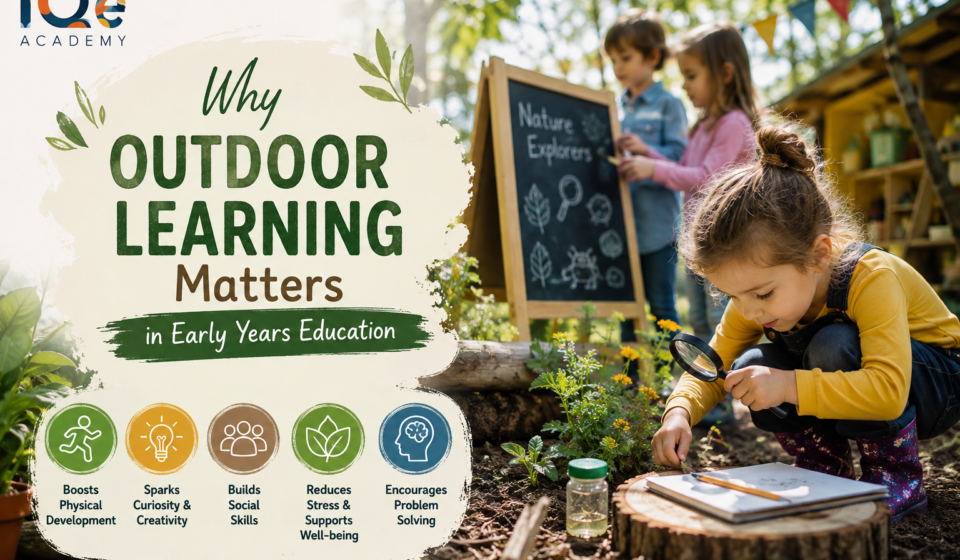

The importance of outdoor learning in early years education is explored.
Outdoor learning provides opportunities for young children to explore, move and discover their world. It contributes to Early Years Education and underpins a number of aspects of children’s development. Children can learn by doing in the daily activities they participate in, like gardening, nature walks, water play and outdoor games.
Educators also now have opportunities to stimulate curiosity, creativity, communication and physical activity in outdoor spaces.
What is Outdoor Learning?
Outdoor learning comprises activities which are planned or guided outside of the classroom. Children have the opportunity to handle natural materials, view plants and animals, engage in movement games, or participate in hands-on tasks.
There is no need to have expensive equipment for these activities. There are plenty of learning opportunities that can be had in a garden, playground, park or safe outdoor space.
Outdoor provision in the Early Years Education Dubai can introduce a range of enrichment to the daily learning and can help children to relate to their environment.
Supporting Physical Development
Regular movement is essential for young children to build strength, balance, coordination and motor skills. They have more space to run, climb, jump, throw and be mobile in outdoor spaces.
Obstacle courses are a good way to help improve coordination. Hand-eye coordination can be developed through ball games. Seeding, soil handling, and using small tools can help improve fine motor skills while gardening.
Daily outdoor activity also promotes healthy habits at a young age.
Supporting Curiosity and Exploration
The basic human interest in children is to investigate things that interest them. There are infinite opportunities for discovery outside.
A child may spot an insect, gather leaves, check out the clouds, or ask why a plant grows in a particular manner. At these times, questions and conversations can arise.
Children’s interests can be used to begin to teach simple concepts of nature, science, numbers, and language to children. This strategy has the potential to encourage a natural and pleasant learning experience.
Developing Problem-Solving Skills
There are usually small things to do outside that are good for children’s thinking processes. They might have to design a structure, move an object, find a path and/or solve a material problem.
These situations allow children to experiment and test out ideas and solutions.
To help in this process, teachers should ask open-ended questions rather than giving answers to students. This assists children to gain confidence in their own thinking.
Building Social Skills
Children are likely to engage in group play outdoors. They are taught to share the equipment and take turns, to communicate with other friends and to work cooperatively to achieve a shared objective.
Children can be taught to share tools and accomplish tasks with a group gardening project, for instance. Working in teams can provide opportunities to learn cooperation and respectful behavior.
Such interactions allow children to develop better social skills and how to collaborate with others.
Supporting Emotional Well-Being
Children can find a change of space and pace in an outdoor setting. Opportunities for relaxation and positive experiences can be created through fresh air, movement and contact with nature.
Children can build confidence as they achieve other challenges outdoors. Those who manage to climb up, balance or plant or accomplish a task might gain self-esteem.
An outdoor environment can, therefore, be supportive to children’s emotional development.
Making Learning More Meaningful
Things children do remember are those with participation. They can touch, observe, move and experiment in outdoor situations.
For instance, children can learn about plants and plant growth in a more meaningful way if they grow their own seeds. Counting is useful when they are counting stones, leaves, or objects on a walk outdoors.
The link between experience and learning can be useful to help children to grasp new concepts.
Developing a Connection with Nature
Children’s familiarisation with the natural world is encouraged through outdoor learning. They can notice their surroundings changing with the seasons, plant growth, animal life etc.
Such experiences can promote an appreciation for the natural world and for children to learn about their environment.
Early ideas about caring for the environment can be introduced, for example through simple activities like planting flowers, collecting natural objects or watching birds.
The Role of Educators
Educators are important in ensuring meaningfulness of outdoor learning. They must arrange activities appropriate to the ages and abilities of children and cater to their interests and learning needs.
Early Years Courses in Dubai can provide training to teachers on child development, activity planning, observation, and safe learning environments.
Children can also be observed while they are outside. These observations can help to identify interests and skills that may not be evident during lessons in the indoor environment.
Why Professional Training Matters
Outdoor learning is a well planned activity. There is a balance between freedom and safety and the activities must be developmentally appropriate.
Professionals can gain knowledge and skills that enable them to design engaging learning programs with institutions like IQE Academy. Teacher training provides a better understanding of the importance of children learning through play, exploration and hands-on.
Expert Insight
The best approach to outdoor learning is to regard the outdoors as a space that can extend from the classroom. The children are able to explore freely and the educators can lead in conversations, introduce ideas and offer challenges that are appropriate for the children.
Outdoor experiences can be planned to enhance physical, social, emotional and cognitive development simultaneously.
Final Thoughts
Outdoor learning is a new way of widening opportunities in EYE. It motivates children to move, investigate, interact, problem solve and learn about their world.
A well planned out outdoor area can enhance the learning within the classroom and contribute to the children’s development. Time outdoors can be a valuable early learning experiences for a child when educators are competent to supervise and plan activities that are appropriate.
Key Facts
Outdoor learning promotes Physical Development and Healthy Movement.
Activities in nature stimulate curiosity and exploration.
Playing outdoors can enhance teamwork and communication.
Children learn to be problem solvers through practical experiences.
Outdoor education in Dubai can be used to provide Dubai Early Years varying and meaningful learning.