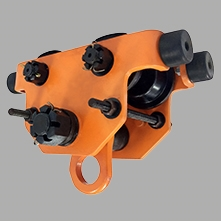

Every workstation that uses a spring balancer to suspend a power tool also needs a reliable way to move that tool along the work area. Beam trolleys help you do this. A trolley mounted on an I-beam allows the balancer and the tool hanging from it to travel smoothly from one point to another. However, not every trolley suits every job. Choosing the wrong capacity can lead to poor performance, faster wear or even safety risks on the shop floor. Industrial studies on ergonomic lifting show that mismatched load-bearing equipment is one of the leading causes of workplace strain injuries.
In this blog, we’ll discuss how to select the correct capacity of I-beam trolleys.
Step 1: Calculate the Total Load
The weight of the tool, the spring balancer, and the weight of the hose, cable, or fitting connected to the spring balancer should be calculated first. The total value will be the operating load. The capacities of the spring balancers vary considerably from light duty balancers which are designed to work with hand tools, to heavy-duty balancers which are able to work with transformers, welding guns, and pneumatic tools of a few hundred kilograms.
Step 2: Match the Trolley to the Balancer Series
A retracting tool holder, more commonly known as a spring balancer, is only as effective as the support system it hangs from. Lighter balancer series, built for tools under 200 kg, generally pair well with standard trolleys rated for similar loads. Heavier balancer series, designed for loads up to 1000 kg, need trolleys built with stronger steel plates and rollers to handle the added stress. Always check the manufacturer’s capacity chart before finalising your choice, rather than estimating based on the tool alone.
Step 3. Check the Beam Profile
Trolley wheels must sit correctly on the I-beam flange for smooth movement. A trolley that does not match the beam width will either bind against the flange or move with excess play. Both of these can cause uneven wear over time. Measure the flange width of your existing beam structure before ordering a trolley and confirm this matches the trolley’s design specifications.
Step 4. Factor in Mobility Needs
Some workstations need the balancer to travel a long distance along the beam, while others only require a short and fixed range of movement. If operators move frequently across a wide assembly line, look for trolleys built with pre-lubricated roller bearings which allow effortless movement even under heavy load. This reduces physical effort on the operator’s part and keeps production moving without delays.
Step 5: Build in a Safety Margin
Never choose a trolley that is rated exactly at your calculated load. Industrial best practice is to leave a reasonable buffer above the expected working weight. This protects against sudden load shifts, accidental impact, or future changes in tool weight as equipment is upgraded.
Conclusion
Selecting the right I-beam trolley capacity comes down to knowing your total load, matching it to the correct balancer series, and checking your beam profile carefully. Spring Balancers offers a well-engineered range of I-beam trolleys built with rugged materials and safety-first design, trusted by manufacturers across 85 countries.
Ready to find the right fit for your workstation? Contact Spring Balancers today and let their team help you choose a trolley built to match your exact load and beam requirements.