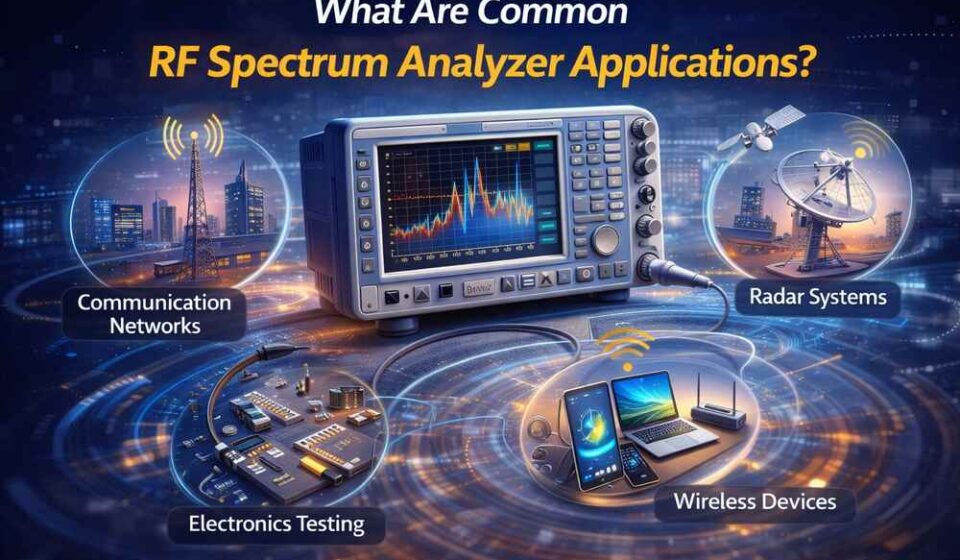

Do you work with wireless signals and wonder where problems hide across the air? An RF spectrum analyzer shows what is happening inside a frequency range in real time.
It reveals noise interference and signal shape so you can see issues early. Engineers’ technicians and students use it in labs sites and production lines.
It saves time during testing and reduces guesswork during setup and checks. If you deal with radios networks or devices this topic affects daily tasks and results.
Read this article to understand where this tool appears and why people rely on it across many fields today worldwide-
Wireless Network Testing
Wireless networks use many frequencies at the same time. This analyzer lets technicians view signal activity across a band.
It shows if channels are crowded or if unwanted signals appear. During setup it helps check signal width level and stability.
During faults it helps locate sources of noise or dropouts. This is common in Wi-Fi private radio and public networks.
Teams can adjust settings and antennas by seeing real signal behavior. This reduces trial and error during network checks and daily operation.
Signal Interference Detection
Interference can come from many sources like nearby devices machines or other transmitters.
This analyzer displays these signals clearly. It helps users see when interference appears and on which frequency.
This matters in busy areas with shared spectrum. Engineers can change frequency timing or shielding by identifying the source.
This process is common in factories offices and outdoor sites. Without clear visibility interference can remain hidden. The analyzer gives a direct view of the radio environment at any moment.
EMI and EMC Checks
Electronic devices must limit unwanted emissions. EMI and EMC testing checks this behavior.
This analyzer measures noise that devices release into the air. It helps during product design and testing stages.
Engineers scan frequency ranges to find peaks that exceed limits. They can then adjust circuits layout or filters.
This testing is common for consumer electronics medical tools and industrial equipment. Using the analyzer early reduces later redesign work and delays before market release.
Radar System Analysis
Radar systems rely on precise frequency timing and signal shape. An RF spectrum analyzer allows engineers to inspect these signals.
It shows pulse width frequency drift and spurious emissions. This is used during development testing and maintenance.
Accurate analysis supports detection range and target clarity. In defense aviation and weather systems this task is routine.
The analyzer also helps verify that radar signals stay within assigned bands. Clear signal insight supports stable radar operation in complex environments.
Satellite Communication Monitoring
Satellite links operate over long distances with strict frequency use. An RF spectrum analyzer helps monitor uplink and downlink signals.
It displays signal strength bandwidth and noise levels. Operators use it to detect drift or interference from other sources.
This matters for ground stations broadcast services and data links. Continuous monitoring helps maintain link quality.
When issues appear technicians can react quickly. The analyzer provides a clear picture of space communication signals at the ground level.
Broadcast Transmitter Setup
Radio and TV broadcasters must keep signals clean and within limits. During setup an RF spectrum analyzer checks carrier frequency and modulation.
It also reveals harmonics and unwanted emissions. Engineers use this before and after transmitter activation.
It helps confirm that the signal covers the desired band only. This reduces risk of interfering with nearby channels. Routine checks also use the analyzer to track changes over time in broadcast systems.
Cellular Base Station Checks
Cellular base stations serve many users at once. An RF spectrum analyzer helps verify signal quality at these sites.
It checks channel power frequency accuracy and interference. Technicians use it during installation upgrades and maintenance.
The analyzer shows if signals leak into adjacent bands. This supports stable service and regulatory compliance.
Field teams often carry portable analyzers for site visits. Clear spectrum visibility speeds up fault isolation and network tuning tasks.
IoT Device Development
IoT devices use low power wireless links. During development an RF spectrum analyzer shows how these devices transmit.
It helps measure bandwidth duty cycle and spurious signals. Designers use this to adjust antennas and radios.
It also supports battery life testing by viewing transmit behavior. Many IoT products share crowded bands.
Seeing real signal activity helps reduce collisions. The analyzer plays a central role from prototype testing to final product checks.
Spectrum Compliance Checks
Regulatory bodies set limits for frequency use. Spectrum compliance checks verify that devices meet these rules.
This spectrum analyzer measures emissions against allowed levels. Test labs and manufacturers use it before product release.
It also supports audits and certification processes. By scanning assigned bands engineers confirm no excess signals appear.
Compliance testing avoids legal issues and market delays. The analyzer provides clear data needed for reports and approval documentation.
Education and Training Labs
In education labs students learn how radio signals behave. An RF spectrum analyzer gives visual feedback for lessons.
It shows modulation noise and bandwidth in real time. This helps connect theory with practice.
Training programs use it for telecom electronics and physics courses. Students gain hands-on skills by adjusting signals and seeing results.
The analyzer builds understanding of frequency concepts. It prepares learners for work in testing engineering and field roles.