
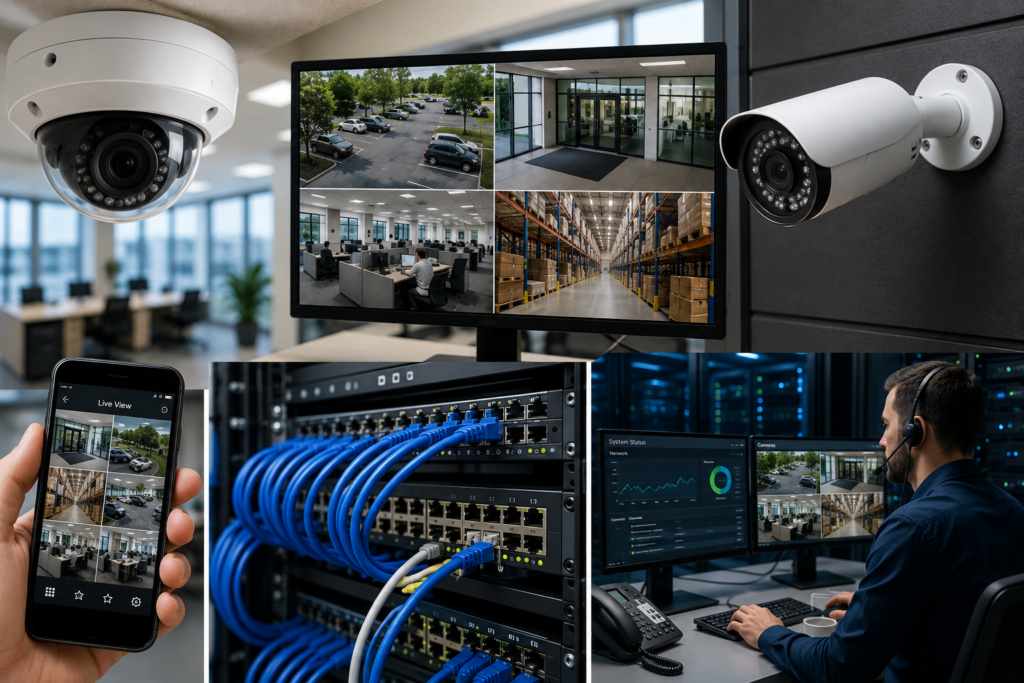
Security has become a critical requirement for businesses of every size. Whether operating a retail store, office, healthcare facility, warehouse, educational institution, or manufacturing plant, organizations depend on reliable surveillance systems to protect employees, customers, assets, and confidential information. Modern security camera systems are no longer standalone devices used only for recording incidents. They have evolved into intelligent security platforms capable of providing real-time monitoring, remote access, artificial intelligence, motion analytics, and cloud-based management.
At the same time, businesses increasingly rely on stable IT infrastructure to keep surveillance systems operating efficiently. High-definition cameras generate significant amounts of network traffic that must be supported by secure servers, reliable internet connectivity, structured cabling, and properly configured storage systems. Without dependable IT support, even advanced surveillance equipment may experience downtime, poor video quality, or cybersecurity vulnerabilities.
A successful surveillance solution combines professional camera installation with proactive IT management. Rather than treating security and technology as separate investments, organizations benefit from integrating them into a unified infrastructure that supports long-term growth, business continuity, and operational efficiency.
This guide explains how professional security camera installation works, why managed IT support plays an essential role, and how businesses can build a secure, scalable technology environment capable of supporting future expansion.
Why Modern Surveillance Is Essential
Business security extends far beyond preventing theft. Organizations must protect employees, visitors, equipment, inventory, sensitive information, and operational processes while complying with industry regulations and maintaining customer confidence.
Modern surveillance systems provide continuous monitoring of entrances, exits, parking areas, production floors, reception areas, warehouses, and restricted locations. High-definition video recordings offer valuable evidence during investigations while helping managers improve workplace safety and operational efficiency.
Advanced surveillance technologies now include artificial intelligence, facial recognition, object detection, license plate recognition, motion analytics, and cloud-based recording. These capabilities allow organizations to identify unusual activity quickly while reducing unnecessary manual monitoring.
Visible surveillance systems also discourage unauthorized activity before incidents occur, creating safer working environments for employees and visitors alike.
Benefits of Professional Camera Installation
Installing security cameras involves much more than attaching equipment to walls or ceilings. Every surveillance system should be designed according to the property’s layout, lighting conditions, security objectives, and future expansion plans.
Professional installers perform detailed site assessments to identify vulnerable areas, eliminate blind spots, optimize viewing angles, and ensure complete property coverage. They also determine appropriate recording capacity, network requirements, camera resolution, and environmental protection based on operating conditions.
Businesses frequently partner with security camera installation companies to design customized surveillance solutions that improve property visibility, strengthen physical security, integrate advanced monitoring technologies, and provide dependable long-term performance through professional planning and installation.
Expert installation reduces equipment failures while ensuring that surveillance systems remain scalable as organizational requirements continue evolving.
Components of an Effective Surveillance System
Modern surveillance systems consist of several interconnected technologies working together to provide comprehensive security coverage.
High-definition cameras capture detailed video while network video recorders securely store recordings for future review. Power over Ethernet switches simplify installation by delivering electrical power and network connectivity through a single cable.
Cloud storage platforms provide secure off-site recording capabilities while mobile applications allow authorized users to monitor facilities remotely from smartphones, tablets, or computers.
Artificial intelligence enhances surveillance by recognizing unusual movement patterns, identifying unauthorized access, reducing false alerts, and improving response times. Many systems also integrate with access control platforms, alarm systems, visitor management software, and emergency notification services.
A properly designed surveillance environment ensures every technology component functions together as one coordinated security solution.
Why IT Support Is Critical for Surveillance Systems
Surveillance systems depend heavily on reliable technology infrastructure. High-resolution cameras continuously transmit video across business networks while storing large amounts of data that require secure management and consistent performance.
Without proper IT support, organizations may experience recording interruptions, storage failures, network congestion, software compatibility problems, cybersecurity vulnerabilities, or remote access issues.
Managed technology services provide proactive monitoring, system updates, cybersecurity protection, backup management, cloud integration, server maintenance, and technical troubleshooting that keep surveillance systems operating efficiently throughout the year.
Organizations seeking reliable infrastructure often invest in managed it services Columbus to maintain business networks, optimize surveillance performance, strengthen cybersecurity, support cloud technologies, monitor critical systems, and minimize operational downtime through proactive technical management.
Reliable IT support ensures surveillance systems remain available whenever security incidents occur.
Network Infrastructure and Connectivity
Every surveillance system relies on a stable network for communication between cameras, recording devices, storage systems, and remote monitoring platforms. Poor network design can lead to delayed video transmission, image degradation, recording failures, and unreliable remote access.
Professional network planning includes bandwidth analysis, switch selection, structured cabling, wireless optimization, redundancy planning, and cybersecurity implementation. These elements work together to maintain continuous communication between connected devices.
Businesses should also evaluate internet reliability because remote monitoring, cloud storage, and mobile access all depend on dependable connectivity. Backup internet connections and redundant network configurations help maintain surveillance availability during unexpected service interruptions.
As organizations expand, scalable network infrastructure simplifies the addition of new cameras and connected security devices without requiring major redesigns.
Integrating Surveillance with Business Security
Modern organizations achieve the highest level of protection by integrating surveillance with additional security technologies rather than relying on cameras alone.
Electronic access control systems restrict entry into sensitive areas while visitor management platforms record guest activity. Alarm systems provide immediate intrusion detection, and surveillance cameras automatically record incidents whenever alarms activate.
Centralized management software allows administrators to monitor multiple facilities from one interface while generating reports, reviewing historical footage, and receiving instant notifications about important security events.
This integrated approach improves response times, simplifies administration, and creates a complete security ecosystem capable of protecting both people and property.
Best Practices for Long-Term Performance
Installing surveillance equipment is only the beginning. Long-term reliability depends on regular maintenance, software updates, preventive inspections, and continuous monitoring.
Organizations should routinely verify recording quality, inspect camera lenses, test storage capacity, review backup procedures, update firmware, evaluate cybersecurity protections, and confirm remote access functionality.
Recommended maintenance practices include:
- Clean camera lenses regularly.
- Monitor storage capacity.
- Install firmware updates promptly.
- Test backup recording systems.
- Review cybersecurity settings.
- Verify remote viewing access.
- Inspect network equipment.
- Perform annual system evaluations.
Preventive maintenance significantly reduces unexpected failures while extending equipment lifespan and maintaining consistent surveillance performance.
Preparing for Future Technology Growth
Technology evolves rapidly, and businesses should invest in surveillance systems capable of adapting to future requirements. Additional cameras, artificial intelligence, cloud services, advanced analytics, and smart building technologies may all become necessary as organizations expand.
Scalable surveillance infrastructure allows businesses to add new devices without replacing existing equipment. Cloud-ready platforms, enterprise networking, standardized cabling, and modular storage systems provide flexibility for future upgrades while protecting current investments.
Planning for long-term growth reduces future installation costs and minimizes operational disruptions during expansion projects.
Conclusion
Security camera systems have become an essential part of modern business operations. They not only protect facilities from theft and vandalism but also improve workplace safety, operational visibility, regulatory compliance, and incident response. However, surveillance technology performs best when supported by reliable IT infrastructure capable of maintaining network stability, cybersecurity, storage management, and continuous system availability.
Combining professional camera installation with proactive managed IT support creates a complete technology environment that supports long-term business success. Organizations benefit from improved security, reduced downtime, simplified maintenance, and infrastructure capable of adapting to future technological advancements.
Whether securing a single office, multiple business locations, or a large commercial facility, investing in professionally designed surveillance systems supported by expert IT management provides lasting value, stronger operational resilience, and greater peace of mind in an increasingly connected world.
